

Four Articles about Big Data.
PART I — Cloud Computing, Hardware and Software
PART II — Hadoop System Technology
PART IV — Digital Transformation
PART III — Big Data Technologies — Edge Computing
Edge Computing (Edge Computing) is another tendency in Big Data. A recent paradigm, revealing that the data will be processed near or where it is captured.
Edge refers to the computing infrastructure close to the data source, managing distributed computing, as with peer-to-peer www (World Wide Web) and blockhead and beckon.
Edge is a distributed computing work, improving the cloud processing operation, leveraging resources next to the data.
Edge is where the connected edge devices are located, processing information and producing synthetic data to large cloud systems.
Examples of Edge are dealing with local devices (cell phones, smartphones, wearables, drones), sensors in cars and turbine engines (IoT), intelligent street lighting, sensors in appliances, wind turbines, thermostats, home lighting, among others.
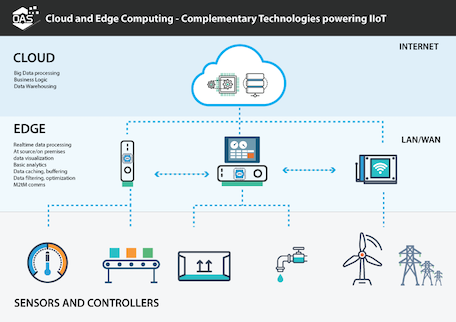
Reasons to use Edge
- Distributing computer workload closer to devices decreases data center bandwidth, latency, and overhead.
- Drop the data transmission costs, not overloading network resources, processing data close to the origin, moving only appropriate information to the cloud.
- Rise securities, believing that much of the data of IoT devices does not travel over the network, with processing near the site of generation.
- Reduce server uptime, downtime, and intermittent connectivity.
In some cases, use Virtual Private Networking (VPN) in Edge applications with insecurity of some IoT devices, causing concerns regarding privacy.
Networks CDN (Content Delivery Network) are Edge network content distributed, improving performance and security of business sites. Akamai and Cloudfare are the most famous CDNs, offering services distributed worldwide as the DNS name resolution.
Edge Computing proliferation occurred from the applications of IoT (Internet of Things), such as use of thermostats that allow preset the bath temperature when you tire of the work, or the voice assistants (Google Home, Alexa, Siri, Cortana), they learn about and reacting with human responses.
In the figure, final Big Data processing is held in the cloud, aided by lower-layer Edge Servers, collecting data from sensors and controllers, lightening cloud services and producing more responsive answers.
CURIOSITIES
- The final processing of Big Data in the cloud is being aided by Edge Computing in lower layers.
- Between Edge and Cloud Computing, there is a layer called "fog," which serves to unite the connection between devices and the cloud. We sometimes use the term Fog and Edge as synonyms.
- The sign on an iPhone using face recognition is an example of Edge Computing.
- Another example is autonomous vehicles that have hundreds of sensors collecting data, processing and decide in real time and don't wait for cloud processing.
- Data center over time may become insignificant, considering that the data is processed on Edge, which is more relevant structures with lower costs.
Support the Author's work and Subscribe to email.
More information about this article
This article has been selected from the book "Big Data for Executives and Market Professionals — Second Edition".

Read the other Articles
PART I — Cloud Computing, Hardware and Software