

In the rapidly evolving landscape of software development, enterprises are constantly striving to build robust, scalable, and efficient systems. With the advent of microservices architecture, coupled with cloud-native technologies, the possibilities for creating agile and resilient platforms are endless. In this guide, we will delve into the intricacies of architecting a comprehensive software development platform at the enterprise level using a powerful combination of tools and technologies.
Technology Stack
Before we dive into the architectural details, let's familiarize ourselves with the key components of our technology stack:
1. Spring Cloud: A set of tools provided by the Spring Framework for building robust and scalable microservices architectures.
2. Keycloak Authorization Server: An open-source Identity and Access Management solution that provides authentication and authorization services.
3. Prometheus: A monitoring and alerting toolkit designed for reliability and scalability, it is capable of collecting metrics from various systems.
4. Grafana: A multi-platform open-source analytics and monitoring solution used to visualize metrics collected by Prometheus.
5. ELK Stack (Elasticsearch, Logstash, Kibana): Elasticsearch is a distributed search and analytics engine, Logstash is a server-side data processing pipeline, and Kibana is a data visualization dashboard for Elasticsearch.
6. Kafka: A distributed streaming platform used for building real-time data pipelines and streaming applications.
7. PostgreSQL: A powerful, open-source relational database management system.
Architectural Overview
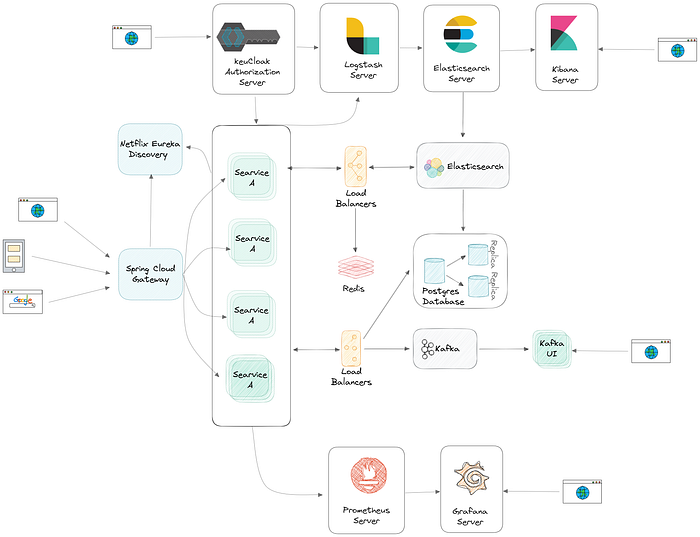
Our software development platform will be built on the principles of microservices architecture, enabling us to develop, deploy, and scale individual services independently. Here's an overview of the key architectural components:
1. Spring Cloud Microservices Pattern: Our platform will consist of multiple microservices, each serving a specific business function. These microservices will be built using the Spring Boot framework and will communicate with each other via HTTP/REST APIs.
2. Spring Cloud API Gateway: To provide a unified entry point for client applications, we will utilize the Spring Cloud API Gateway. This gateway will handle routing, filtering, and load balancing of incoming requests to the appropriate microservices.
3. Keycloak Authorization Server: To secure our microservices and manage identity and access control, we will integrate Keycloak as our centralized authorization server. Keycloak will handle user authentication, authorization, and token management. In addition, Keycloak will use Postgres for Data Storage and ELK for log aggregation.
4. Prometheus for Application Metrics: We will instrument our microservices to publish metrics to Prometheus using the appropriate client libraries. Prometheus will scrape these metrics, providing valuable insights into the performance and health of our services.
5. Grafana for Visualization: Grafana will be used to visualize the metrics collected by Prometheus. With Grafana's rich set of visualization options and dashboards, we can gain deep insights into the behavior of our system in real time. For authentication, we can configure the Keycloak Authorization Server and authorize requests for viewer, editor, and admin roles.
6. ELK Stack for Logs Aggregation and Visualization: We will aggregate logs generated by our microservices using Logstash, store them in Elasticsearch, and visualize them using Kibana. This centralized logging solution will enable us to troubleshoot issues, monitor system behavior, and analyze trends.
7. Kafka for Microservice Communication: For asynchronous communication between microservices, we will leverage Kafka as a distributed messaging system. Kafka's fault-tolerant and scalable architecture makes it ideal for handling large volumes of data and ensuring reliable message delivery.
8. PostgreSQL for Data Storage: We will use PostgreSQL as our relational database management system for storing application data, as well as metadata for Keycloak and Grafana.
Implementation Steps
Now that we have outlined the architectural design of our software development platform, let's proceed with the implementation steps:
Step 1: Setting Up Spring Cloud Microservices — Start by creating individual Spring Boot projects for each microservice. Define the business logic, API endpoints, and data models for each service. Use Spring Cloud libraries such as Eureka for service discovery and Ribbon for client-side load balancing.
Step 2: Configuring Spring Cloud API Gateway — Create a separate Spring Boot project for the API Gateway. Configure routing rules and filters to route incoming requests to the appropriate microservices. Utilize Spring Cloud Netflix Zuul for implementing the gateway.
Step 3: Integrating Keycloak Authorization Server — Set up a Keycloak server instance and configure realms, clients, and roles for your microservices. Integrate Keycloak with your Spring Boot applications using the appropriate Spring Security adapters to enforce authentication and authorization.
Step 4: Instrumenting Microservices for Prometheus Metrics — Add Prometheus client libraries to your microservices and instrument them to expose custom metrics. Configure Prometheus to scrape metrics from your services and store them for visualization.
Step 5: Visualizing Metrics with Grafana — Install and configure Grafana, and create dashboards to visualize the metrics collected by Prometheus. Use Grafana's querying and visualization capabilities to monitor the performance and health of your microservices.
Step 6: Setting Up ELK Stack for Logging — Deploy Elasticsearch, Logstash, and Kibana instances for logging aggregation and visualization. Configure Logstash to ingest logs from your microservices, enrich them, and index them in Elasticsearch. Create visualizations and dashboards in Kibana to monitor and analyze log data.
Step 7: Implementing Kafka for Microservice Communication — Set up Kafka clusters and create topics for communication between microservices. Use Kafka producer and consumer APIs to send and receive messages asynchronously. Implement event-driven architecture patterns such as publish-subscribe and message queuing.
Step 8: Utilizing PostgreSQL for Data Storage — Deploy PostgreSQL instances and create databases for storing application data, as well as metadata for Keycloak and Grafana. Configure data access layers in your microservices to interact with PostgreSQL using Spring Data JPA or JDBC templates.
By following the implementation steps outlined in this guide, teams can create a robust foundation for building and deploying microservices-based applications, enabling rapid iteration, seamless integration, and enhanced developer productivity. Embracing these best practices and technologies will position organizations for success in today's dynamic and competitive digital landscape.
Now, it's time to embark on your journey to architecting the next generation of enterprise software development platforms.
Happy coding!