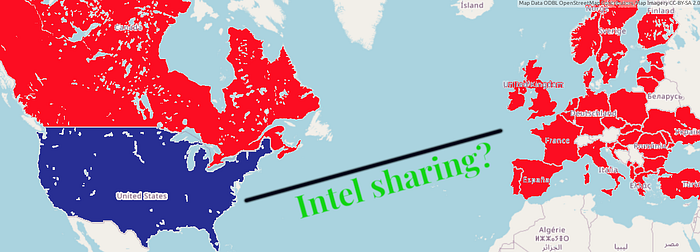


Only two weeks into the year and the geopolitical landscape of 2026 has been marked by a significant realignment of intelligence sharing protocols between Ukraine and its traditional western partners.
Ukrainian intelligence services deliberately fed false strategic information to their American counterparts to test whether it would leak to Russian forces, according to former French DGSE operative Vincent Crouzet, in a claim aired on France's LCI television network om 15 January that highlights deepening distrust between Kyiv and Washington under the current U.S. administration.
Vincent Crouzet, a former operative of the French Direction Générale de la Sécurité Extérieure (DGSE) and a noted commentator on security matters, alleged during the པh Pujadas' programme that Ukrainian intelligence services have engaged in a deliberate campaign of disinformation directed at the United States.
According to Crouzet, the Main Intelligence Directorate of Ukraine, known as the GUR, intentionally provided false strategic data to American agencies.
This operation was reportedly designed as a 'sting' to identify the source of sensitive information leaks to Russian forces.
The implications of such an action are considerable, as they point toward a belief within the Ukrainian leadership that high-level officials in Trump's administration may be compromising strategic secrets.
The shift toward European intelligence autonomy
This development occurs against a backdrop of increasing friction between the White House and the administration of President Zelenskyy in Ukraine.
Since his return to office in 2025, President Trump has frequently criticised the scale of American assistance to Ukraine and has advocated for a swift resolution to the conflict, which many observers interpret as favouring Russian territorial interests using scripts which appear to follow almost word for word those emanating from the Kremlin.
In March 2025, the United States briefly suspended intelligence sharing to pressure Kyiv into peace negotiations, a move that appears to have permanently altered the bilateral security relationship.
French positioning
French President Emmanuel Macron has positioned France as the primary alternative to American intelligence dominance.
In his January 2026 address to the French military, Macron asserted that France now provides two-thirds of the strategic intelligence required by Ukraine.
This claim suggests that European agencies, specifically the DGSE and the military intelligence agency DRM, have successfully filled the vacuum left by the withdrawal or unreliability of American support.
While some Ukrainian officials, including Kyrylo Budanov, continue to emphasise a dependence on technical American assets such as satellite imagery, the broader trend indicates a pivot toward European 'sovereign' intelligence.
Historical precedents
The suspicions voiced by Crouzet and echoed in French media are not without historical context.
Critics of the current American administration often cite past incidents to justify their wariness. These include the 2017 disclosure of classified Israeli intelligence to Russian diplomats in the Oval Office and the 2023 Pentagon leaks, which exposed critical vulnerabilities in the way the United States handles sensitive data related to the Ukrainian war effort.
The alleged Ukrainian sting operation represents a sophisticated evolution in this relationship. If the GUR did indeed feed disinformation to the U.S. only to see that information influence Russian military movements, it would provide empirical evidence of a direct pipeline between Washington and Moscow.
Such a revelation would necessitate a total replacement of American intelligence channels with those of France, the United Kingdom, and Germany to ensure the survival of the Ukrainian state.
Trump is casual with intel
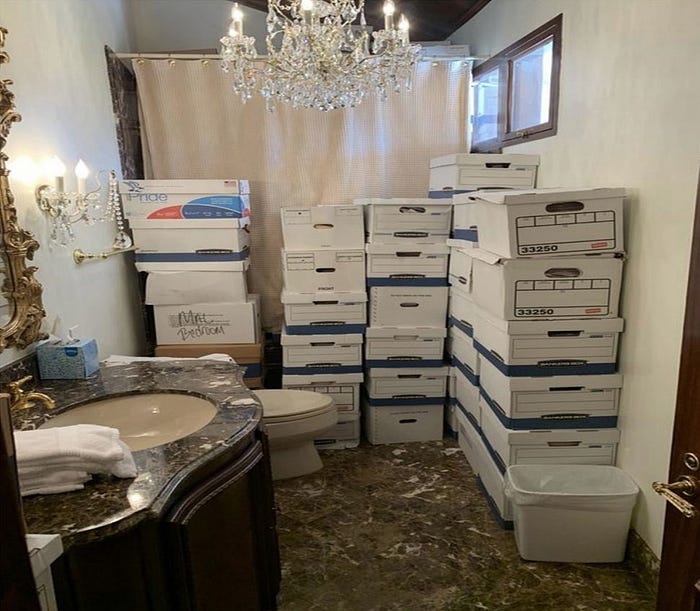
Besides the fact that Trump stored classified files in his bathroom at Mar-a-Lago and refused to return them, there are several known instances of his laxity over US secrets.
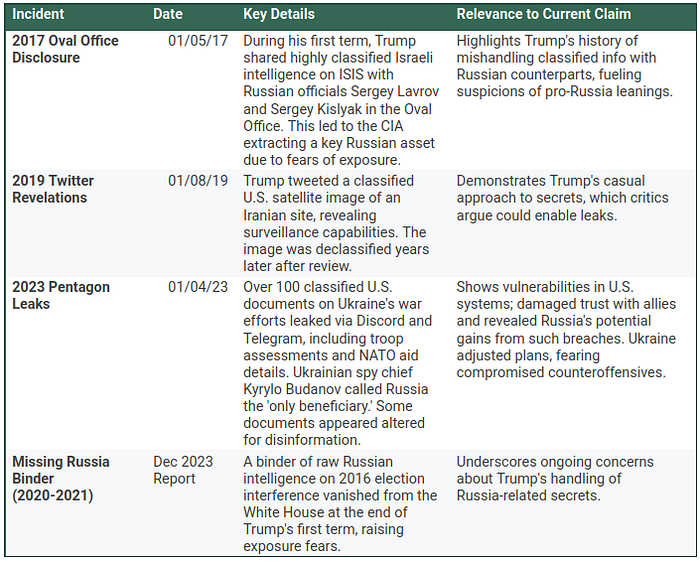
Trump was indicted over this issue but the matter was discontinued when he was elected.
Geopolitical consequences of the 'divorce'
The 'divorce' between Ukrainian and American spy agencies, as described by Crouzet, has wider implications for the North Atlantic Treaty Organisation (NATO) and European security, which is already struggling to manage Trump's ranting about taking over Greenland.
The lack of independent verification (as of time of writing) for these specific intel claims does not diminish their impact on the public and political discussion in Europe. If European leaders conclude that American intelligence is no longer a secure partner, the drive for strategic autonomy will probably accelerate.
France and other European nations have already begun to increase their commitments, with discussions involving the deployment of multinational forces to monitor borders and provide security guarantees.
As of January 18, 2026, the situation remains fluid, with official denials from Washington and silence from Kyiv.
However, the narrative of a Franco-Ukrainian intelligence axis is becoming a central pillar of the European response to the ongoing Russian genocide in Ukraine.
Realignment of the NATO intelligence architecture
The reported Ukrainian 'sting' operation and the subsequent pivot toward European intelligence providers signal a fundamental — and worrying — shift in NATO's internal security dynamics.
This transition from a U.S.-centric model to a more fragmented, polycentric architecture is sad but necessary and carries significant implications for the Alliance.
- Erosion of the single point of truth: The provision of disinformation to U.S. agencies by a partner state creates a 'trust deficit' that undermines collective decision-making. If intelligence is used as a tool for internal vetting rather than external defence, the coherence of NATO's strategic assessments is compromised.
- Rise of European strategic autonomy: France's emergence as a primary intelligence provider accelerates the 'Europeanisation' of security. This reduces the risk of single-country policy shifts but creates potential interoperability challenges between European 'Sovereign' systems and U.S. technical assets (TERCOM data used by Storm Shadow, for example).
- Splitting of data flows: We are witnessing a transition toward 'coalitions of the willing'. Intelligence is increasingly shared in smaller, high-trust clusters (e.g., France, UK, Germany, and Ukraine) rather than through broader NATO channels, potentially leaving some eastern flank members vulnerable.
These shifts require a formal reassessment of NATO's 'need-to-know' protocols to ensure that political volatility in one member state does not jeopardise the operational security of the entire Alliance, whether that includes the US or not.
Other destabilising news
In case you missed it, there are also stories circulating that the US delayed delivery of air defence missiles to Ukraine in December which gave Russia an opportunity to launch major attacks on Ukraine's energy infrastructure, reducing grid power by 40%.
President Zelensky has called Ukraine's air defence supplies "insufficient", having revealed several systems were "without missiles" until Friday morning. [16 January 2026]
"I can say this openly because today I have those missiles," the president said, adding that Ukraine had received a "substantial package" earlier in the day.
His comments follow days of intense Russian bombardment of Ukraine's energy infrastructure, leaving thousands of people without heating and electricity during a bitterly cold winter. — BBC
Was this pause in US missile supplies deliberate, requested by Moscow? Whatever the reason, this further erodes trans-Atlantic trust.
Conclusions
There is clearly distrust in NATO countries about the US's intentions and trustworthiness as an ally.
If the main story is verified then this is a major issue as many NATO systems depend on intel data provided by the US. So was there a Ukrainian intel sting on the US?
I'm inclined to believe the story and have serious doubts about Trump's motivation.
There are serious fears in NATO over Trump's trustworthiness and there is clear concern that this extends downwards into his administration, particularly intelligence.
And it's getting worse as the mad megalomaniac goes on a geopolitical rampage.
NATO is going through a very rocky patch as Trump threatens Canada, Greenland and Denmark and says he will impose tariffs on any country that does not support his desire to gain control of Greenland.
US President Donald Trump says he will charge a 10 per cent import tax starting in February on goods from eight European nations because of their opposition to American control of Greenland.
Mr Trump says Denmark, Norway, Sweden, France, Germany, the United Kingdom, the Netherlands and Finland would face the tariff. — ABC.net.au
Isn't it strange that Trump is putting tariffs on so many countries, yet none on Russia? Trade is ~$3–4 billion annually, mostly in select goods like fertilizers, nuclear fuel, and platinum.
It does make you wonder.
https://kyivindependent.com/france-replaces-us-as-macron-says/