

Before I even get started on an introduction, let me provide you some proof that I actually did what I claimed:
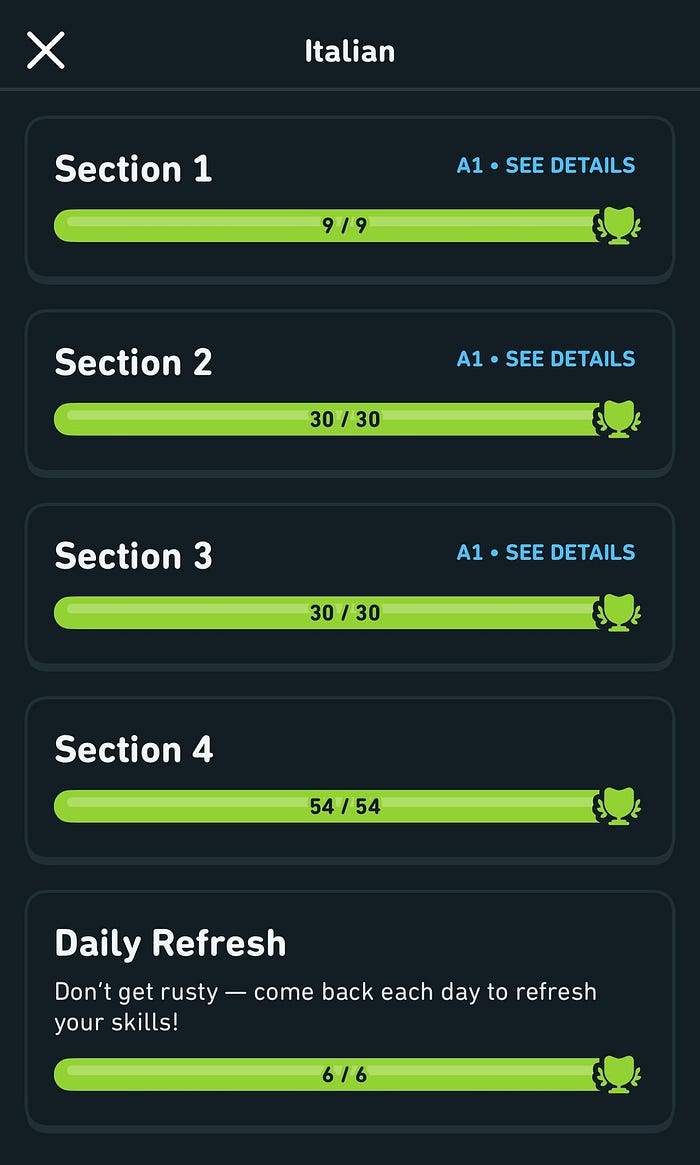
So, now for some context
I'm 24 years old and, so far, I have studied the following:
- French for 7 years at high school, then for 4 more years at university
- Portuguese for 4 years at university
- Spanish for 3 years at high school
- German for 3 years at high school
Therefore, to say I have no prior language learning knowledge would be a complete lie.
That being said, I'm certainly not some language god. I was born and raised in the United Kingdom, speaking English (and only English) up until I was thirteen years old. I therefore was not raised speaking more than one language natively and only started learning basic French during my first year of high school at age 13.
Why am I telling you this?
Well, when it comes to learning a language, it's not just about saying 'Right, today I start Italian: Ciao = Hello, Grazie = Thank you, Cane = Dog'.
No, no, no.
Actually knowing how to learn a language is arguably just as important as nailing the vocabulary. Let me give you an example. For me, I started with some basic vocabulary. Once I had that down, I learned verb forms and how to conjugate them. Then, I formed sentences in the past, present, future, and whatever other tenses existed in the chosen language.
As I got deeper and deeper into the language, I noticed patterns, similarities, which made it easier to 'get a feel' for the language; what I mean is, if I didn't know something, I was better able to make educated guesses based on patterns I had already seen.
Thanks to this, when I began learning my second foreign language at school (Spanish), I was able to immediately spot similarities, both in terms of sentence structure and vocabulary. For example,
English: "She wears a red dress" French: "Elle porte une robe rouge" Spanish: "Ella lleva un vestido rojo"
Taking these an an example, we can see that French and Spanish follow the same structure of putting the adjective after the noun, whereas in English it is before ('a red dress' in English, 'a dress red' in French and Spanish). Also, in terms of vocab, there is an evident similarity between French 'Elle' and Spanish 'Ella'.
Having this prior knowledge of how languages work is, I believe, invaluable when it comes to learning a new one. It makes it so much easier.
In summary, the point I'm trying to make is, had I not learned other languages at school, my Duolingo experience would've been very different and, in my opinion, a lot more challenging.
My starting point
In January 2025, I set myself a New-Year's-resolution-style challenge to complete a full, one-year streak on Duolingo. I already learned French, Portuguese, Spanish, and a little German, so I decided to go for Italian this time round.
I began the way I intended to continue, with full commitment. Knowing how much I detested the ads after every single lesson, I took advantage of the New Year's deal and purchased a one-year subscription to Super Duolingo. It cost me £47.99 (approximately $63.99/€54.99) and, although you definitely do not need it to successfully make the most of the app, it was more than worth the money for me to avoid the tedious ads.
In the beginning, I was extremely motivated and even more competitive.
One feature I absolutely loved were the leaderboards — 10 'cups' in which you get to compete with other users, the top 10 from each week progressing to the higher cup and the bottom 10 falling back down to the lower.
I would see the 'X took your number 1 spot!!' notifications and drop everything to go and fight for my rightful place at the top, it was a lot of fun (and also extremely stressful at times!)
As I progressed, I managed to make it to the final cup. When I finished top of the leaderboard, I expected some sort of acknowledgement or reward, but instead the leaderboard just refreshed and I had to do the same thing all over again to retain my spot. It felt kind of demotivating.
In the end, I just gave up with the leaderboards. I was simply completing the bare minimum number of lessons to keep my streak alive and not caring how many XP points I was gaining each day. As a result, I dropped down leagues and I currently sit in cup number 4. It's not worth the effort to improve anymore; been there done that — I got tired of it.
Was I actually learning useful Italian phrases?
We've all seen the memes and we all know that Duolingo can surprise us with the strangest phrases (I'm looking at you "the spiders are in the sugar"…)
In reality, it can be like this.
Sometimes you find yourself typing a translation and you just think what the hell is going on and why exactly do I need to know this? But, for the most part, the sentences were quite useful and definitely helped to teach things like gender agreements, plurals, and pronouns.
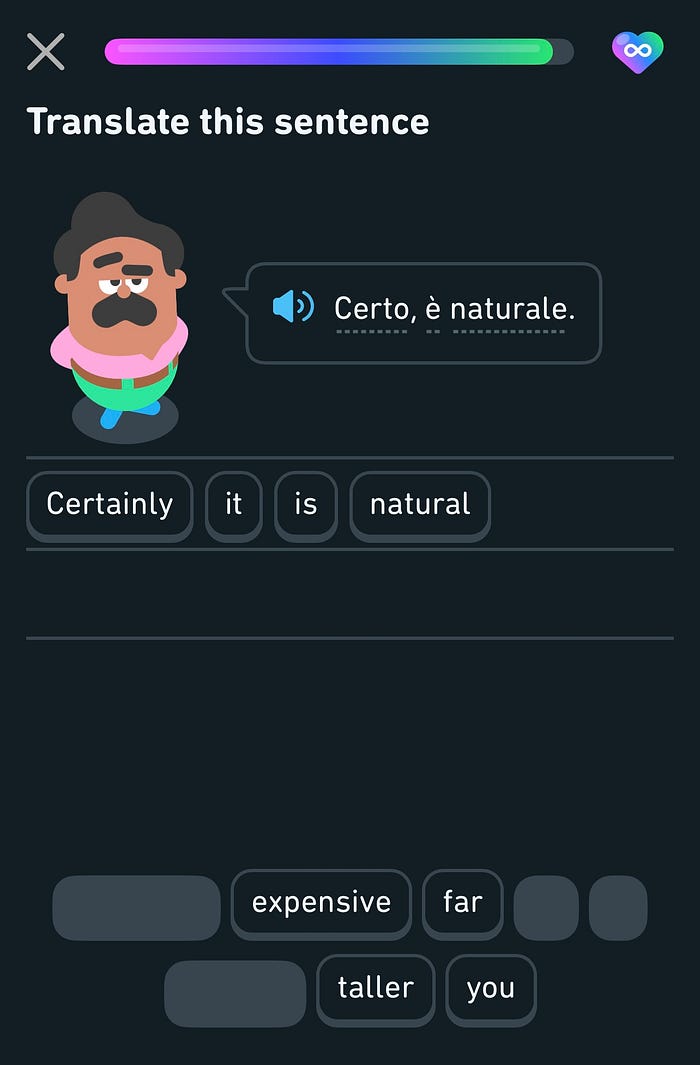
In my opinion, I found the order to be quite strange from time to time. I'd spend a lot of time learning the same kind of things then all of a sudden the lessons would jump to something way more complicated. This happened in reverse too; when I reached one of my very final lessons of the whole course, as you can see in the picture above, it decided to teach me "Certainly, it is natural" — quite an easy sentence when you compare it to others in previous lessons such as "The main problem is the crisis and its consequences" It didn't really make sense to me why it jumped back and forth so much.
How long did it take me to finish?
As I write this article, it's currently the 26th July 2025. As I started around the 1st January 2025, my current streak is 207 days.
At the beginning, I Duo'ed at an alarming rate (trying to beat all my fellow linguists in a race up the leaderboards), but as time passed, I slowed down a lot, often completing just one lesson per day.
If you're serious about Duolingo, I'd say that one lesson per day is pretty useless. You won't learn an awful lot. For serious progression, I reckon you'd need to spend a good 30 minutes completing lessons — that reminds me, Super Duolingo gave me unlimited hearts (which helped enormously), without Super, you only get to make 5 mistakes before you are forced to wait for more hearts to load. That could make a 30 minute study session turn into hours.
As for how many XP points I racked up, I'm afraid I'm not able to say exactly. Given that I have used Duolingo for years in school and university, I already acquired thousands of points before starting Italian, so I'm not sure exactly how many came from that as opposed to the other languages I used to learn. My total, however, currently sits at 87,890 XP.
What happens when you actually finish the course?
Until today, I never knew this myself. After you finish, Duolingo gives you a daily refresh comprising of 6 lessons to complete. The lessons can be from any previously studied section but they will all be lessons that you have seen before, nothing new. This is what it looks like:
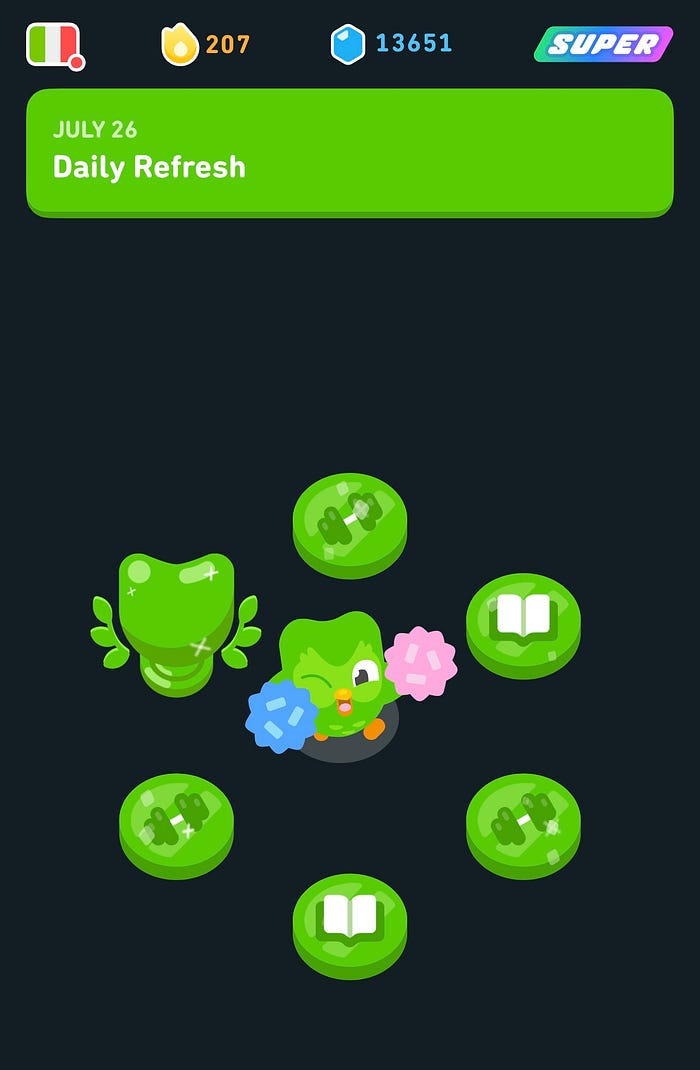
In all honestly, I don't think this daily refresh is going to be enough to motivate me to continue. My New Year's resolution was to maintain my streak for 1 year but, with only 207 days under my belt and a completed course, I don't really know how I'm going to keep going for a further 158 days, or what the point would even be — should I start a new language??
My honest opinion: Is Duolingo actually worth using?
Look, there's no doubt that Duolingo is a good app. It has made language learning accessible to millions of people around the world. What's more, it's free. Nothing is free in today's world, so that's pretty cool.
Is it, however, the best way to learn a language? Absolutely not. I would argue that it's not even the best way to learn vocabulary. That being said, it is still an extremely useful tool to assist you in learning a language.
The key word there being tool.
A tool is not something to be used alone, rather alongside other tools to help you get the job done fully. Think of it like building a wardrobe — sure, a screwdriver will prove invaluable in fitting the screws, but without a hammer, you will never end up with a fully assembled piece of furniture.
Similarly, using Duolingo will help you in certain aspects, but it will never make you fluent in a language.
So, in my opinion, it definitely is an app worth using provided however that it is used in conjunction with other language learning tools.
For me, I find listening to podcasts a great way to pick up vocabulary. On an even more simple level, listening to a recording where someone says "man… uomo, woman… donna, son… figlio, daughter… figlia" is surprisingly effective. I learned so many useful words by doing this and they all remained in my memory long after I had finished the episodes.
Another method I highly recommend is getting a 1-to-1 tutor. It's more expensive, sure, but it is the number one method for learning a language. You will be speaking right from day one and acquiring way more language skills than you would from Duolingo. If budget is a real issue or barrier, then free apps such as HelloTalk or Tandem can be pretty useful — they let you chat with people in other countries that want to learn your language. You can help each other and correct each other. It works pretty well, but a tutor will still be more effective in my opinion.
Conclusion
I'm glad I completed the Italian course on Duolingo, for the personal satisfaction if nothing else. Do I feel more confident in my Italian abilities? Absolutely! Did I learn a lot? Absolutely! Am I fluent? Absolutely not!
But being fluent wasn't my objective, so in that regard the app hasn't let me down. In fact, it probably surpassed my expectations.
Towards the start, I thought I'd be stuck on an endless cycle of "The boy eats an apple" and "The monkey is in the zoo", but it did get better as I progressed.
Practically, for visiting the country, I feel like I've been well equipped with basic phrases, think "Can I try the strawberry ice cream please?" and "Do you have a table for two?"
Overall, I'm glad I did it. Will I reach my goal of a 365-day streak? I'm not too sure to be honest — be sure to check back at the end of the year, I'll keep you updated.