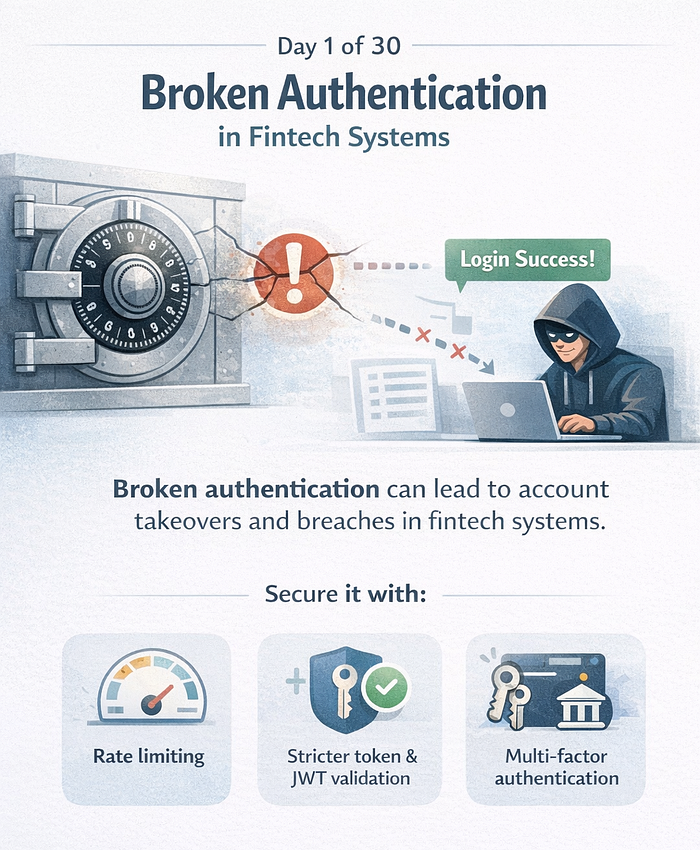

Authentication sounds simple: you prove who you are, and you get access. But in practice, it's one of the most consistently broken parts of financial software. Not because developers don't care, but because the attack surface is wider than most teams realize during the build phase.
Think of it like a bank vault with a perfect door but a weak combination. The engineering looks solid until someone figures out the combination only has a thousand possible values.
In payment apps and digital wallets, broken authentication shows up in familiar ways:
1. No limit on login attempts
2. Password reset flows that leak user existence
3. Session tokens that never expire
4. JWTs signed with a weak or hardcoded secret.
Any one of these, in isolation, looks minor. Combined, they hand an attacker a reliable path to account takeover.
On the technical side, the common failures are:
1. Missing rate limiting on /auth endpoints
2. Improper JWT validation (accepting "none" as an algorithm)
3. Refresh and access tokens stored insecurely client-side, and MFA that can be bypassed by replaying a previous OTP within its validity window.
A realistic attack looks like this: an attacker targets a fintech API, enumerates valid email addresses through differing error messages on the login endpoint, then runs a credential stuffing attack using a leaked database from an unrelated breach. No rate limiting means thousands of attempts per minute. One valid credential is all it takes.
Prevention comes down to a few non-negotiable practices:
1. Enforce rate limiting and account lockout at the auth layer
2. Validate JWT signatures strictly and reject weak algorithms
3. Rotate refresh tokens on each use
4. Implement MFA with short OTP windows and replay protection
5. Your error messages should never confirm whether an account exists.
Security in fintech isn't just about compliance checklists. It's about understanding how real attackers think and building systems that hold up under that pressure.
#CyberSecurity #FintechSecurity #ApplicationSecurity #WebSecurity #SoftwareEngineering #Fintech #Authentication #SecureByDesign #APISecurty #BrokenAuthentication #DevSecOps #SecurityEngineering #CTOInsights #TechLeadership #30DaysOfSecurity