
The myth-busting guide to AI-powered bug bounty, automated recon, and ethical hacking strategy that actually produces findings — not just faster noise
Picture the scene. A hunter opens a new target. Within minutes, they've run an automated recon suite, fed the output into an AI model, asked it to identify potential vulnerabilities, and received a neatly formatted list of "areas to investigate." They feel productive. The workflow feels modern. The output feels comprehensive.
Two hours later, they've chased every item on that list and found nothing reportable. The AI was confident. The results were empty.
This is the defining frustration of AI-powered bug bounty hunting in 2026 — and it's happening to hunters at every experience level. The tools are genuinely powerful. The way most people are using them is genuinely backwards.
The myth driving this frustration is seductive: AI handles the reconnaissance so you can focus on exploitation.
The tension here isn't a tooling problem. It's a thinking problem. Hunters who let AI lead the investigation are outsourcing the most valuable part of the process — the judgment about where anomalies are meaningful. More automation isn't the answer. Better questions are.
The Myth: AI Is Best Used as a Discovery Engine
The most widespread misuse of AI in bug bounty follows a predictable pattern. Hunter runs recon tools. Dumps output into an AI model. Asks: "What vulnerabilities might exist here?" Receives a list. Follows the list.
This workflow treats AI as a smarter version of a vulnerability scanner — a system that ingests raw data and surfaces findings. And it fails for the same reason that pure automation has always failed in security research: it can only find what it's been trained to recognize in patterns it's already seen.
Real vulnerabilities — especially the ones that pay well — don't live in pattern-matched outputs. They live in the gap between what an application is supposed to do and what it actually does under specific conditions. That gap requires contextual understanding of the application's logic, its intended user flows, and the business decisions that shaped its architecture.
AI cannot develop that contextual understanding from recon output alone. But a human researcher who has spent time inside an application absolutely can — and that researcher, using AI as an analytical collaborator rather than a discovery engine, operates at a fundamentally different level.
Here's the distinction in practice. Instead of asking an AI model "what vulnerabilities might exist in this application," a hunter who has already mapped the application's authentication flow asks: "Given that this password reset endpoint accepts a user-supplied callback URL and the response includes a redirect, what logic conditions would need to exist for this to be exploitable as an open redirect or token leakage vector?"
The second question produces actionable analysis. The first produces a generic checklist.
Intellectual insight: AI amplifies the quality of the questions you bring to it. If you bring vague inputs, you get confident-sounding noise. If you bring specific, context-rich questions, you get genuine analytical leverage. The hunter's job in 2026 is to be a better questioner, not a faster automator.
Where Automated Recon Actually Adds Value — And Where It Doesn't
Automated recon has a legitimate and valuable role in a modern bug bounty workflow. The problem isn't automation itself. It's the assumption that more recon data equals more findings.
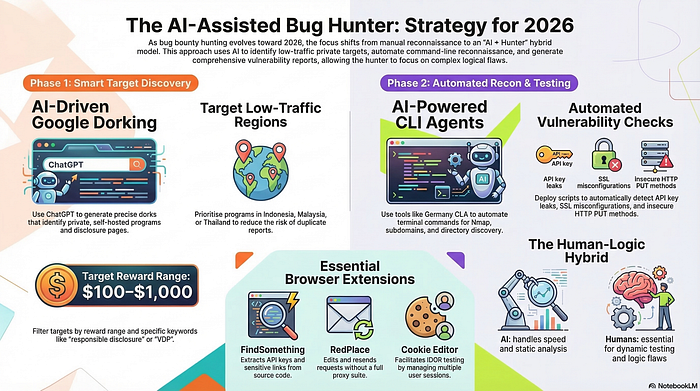
Recon automation genuinely accelerates three things: asset discovery, technology fingerprinting, and scope mapping. Running subdomain enumeration, identifying what web technologies a target is running, and building a comprehensive picture of the attack surface faster than manual browsing — these are real productivity gains. Time saved here is time available for the actual security research.
Where automated recon fails is in the transition from data to insight. A list of five hundred subdomains is not intelligence. It is raw material. The hunter who feeds that list into an AI model and asks for vulnerabilities is skipping the step that matters most: manually reviewing the asset list with a researcher's eye to identify which targets are unusual, recently added, structurally different from the rest, or likely to have received less security attention.
Consider a realistic example. A hunter running automated recon on a target discovers a subdomain with a naming convention that doesn't match the rest of the organization's visible infrastructure. It appears to be a legacy staging environment that was never decommissioned. The automated tools report nothing unusual — no known vulnerable headers, no immediately flagged endpoints. An AI model asked to analyze the subdomain's basic response returns a generic assessment.
But the hunter who notices the naming anomaly, manually browses the subdomain, and observes that it accepts the same authentication cookies as the production environment — but applies different access control rules — has found something. Not because the automation found it. Because the human noticed what the automation didn't know to look for.
Intellectual insight: Automated recon is a map, not a compass. It tells you what exists. It cannot tell you what matters. The judgment about which assets deserve deeper attention is irreducibly human — and it's where the actual value of bug bounty research is created.
Using AI as a Thinking Partner During Active Testing
The most productive use of AI in an active bug hunting session isn't analysis of recon data. It's real-time collaborative reasoning during application testing.
When a hunter encounters an unusual application behavior — a response that's slightly different than expected, a parameter that seems to influence server-side logic in an undocumented way, an error message that leaks more information than it should — AI becomes genuinely useful as a thinking partner for working through what that behavior might mean.
This looks less like "run this and tell me what's wrong" and more like a structured dialogue. The hunter describes the behavior precisely: what they sent, what they expected, what they received instead, and how the application's documented behavior should differ. The AI model helps reason through possible underlying causes, suggests specific follow-up tests designed to confirm or rule out hypotheses, and helps structure the logical chain from observed behavior to potential vulnerability class.
This approach turns AI into something closer to a senior researcher you can think out loud with — one who has broad knowledge of vulnerability patterns and can help you avoid dead ends, but who depends entirely on you to supply the contextual observations that make the analysis meaningful.
The ethical dimension here matters too. AI-assisted bug hunting operates within the same ethical and legal boundaries as any other security research. Automated tools that send requests to targets outside program scope, or AI workflows that generate and execute attack payloads without researcher oversight, create legal and ethical exposure that no finding is worth. The researcher remains responsible for every action taken against a target — automated or not. AI doesn't transfer that responsibility; it amplifies the consequences of ignoring it.
Intellectual insight: The best AI-assisted hunters use AI to think more clearly, not to act more quickly. Speed without judgment in security research doesn't produce more findings — it produces more noise, more false positives, and occasionally more legal risk.
Building an AI-Augmented Methodology That Scales
The hunters who are extracting genuine value from AI tools in 2026 aren't using AI to replace their methodology. They're using it to make each component of their existing methodology more efficient.
Specifically, AI augmentation works at four points in a mature bug hunting workflow.
First, during scope analysis — using AI to quickly understand what a target company does, what its critical business functions are, and where security failures would have the highest real-world impact. This shapes target prioritization before recon even begins.
Second, during application mapping — using AI to help interpret API documentation, understand complex authentication flows, and identify edge cases in application logic that manual reading might miss.
Third, during hypothesis testing — the real-time reasoning partnership described above, where AI helps a researcher think through observed anomalies systematically rather than relying purely on intuition.
Fourth, during report writing — using AI to structure findings clearly, ensure reproduction steps are complete and unambiguous, and articulate business impact in terms that resonate with triage teams who need to prioritize fixes.
Each of these applications keeps the human researcher in the decision-making position. The AI accelerates execution within each step. It does not determine the direction of the research.
The hunters building this kind of workflow aren't just more productive than those running automated tools blindly. They're developing a research capability that compounds over time — because the judgment they're exercising in each session is building pattern recognition that no amount of automated scanning can replicate.
In 2026, the field isn't divided between hunters who use AI and hunters who don't. It's divided between hunters who use AI to think better and hunters who use AI to avoid thinking. The findings — and the payouts — reflect that division clearly.
In 48 hours, I'll reveal a simple AI prompt framework most bug bounty hunters skip — the five-question structure that turns vague application observations into actionable vulnerability hypotheses before you write a single line of a report.
Found this useful? Follow for weekly breakdowns of AI-assisted security research strategy, ethical hacking methodology, and the thinking frameworks that separate productive hunters from busy ones. Share this with someone who's running automated tools and wondering why the findings aren't coming — this might reframe everything.
💬 Comment Magnet