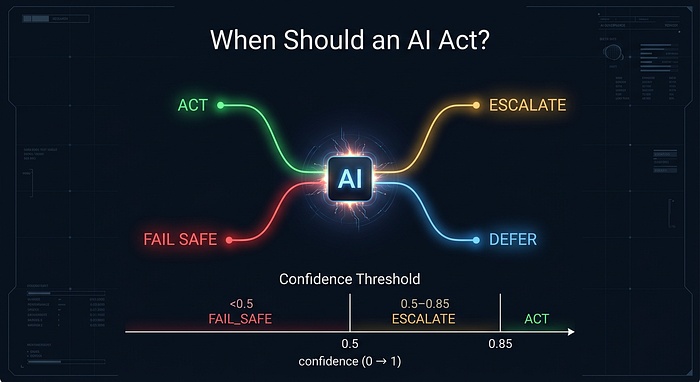
Earning the Right to Act: Why Agentic Systems Need Epistemic Governance
The Problem Nobody's Talking About
We're in the middle of an agentic boom. Organizations are deploying autonomous systems — RAG-based threat hunters, automated incident responders, compliance validators. The promise is real: faster response, 24/7 operation, human expertise distributed at scale.
But there's a problem hiding in the hype that nobody's solving for:
uncertainty governance.
Your agent can detect a threat with 89% confidence. What does it do?
- Call it a threat and escalate?
- Investigate deeper first?
- Wait for more context?
- Fail-safe and halt?
Most teams answer this with monitoring:
"We'll watch what it does and alert if something looks wrong."
That's not governance. That's hope.
The Observability Trap
I spent the first three months building Argus — a full-stack LLM observability platform. Every decision the agent makes, we capture. Every token, every action, every outcome.
Then I hit the real problem:
Visibility isn't the same as trust.
📊 What Observability Actually Looks Like
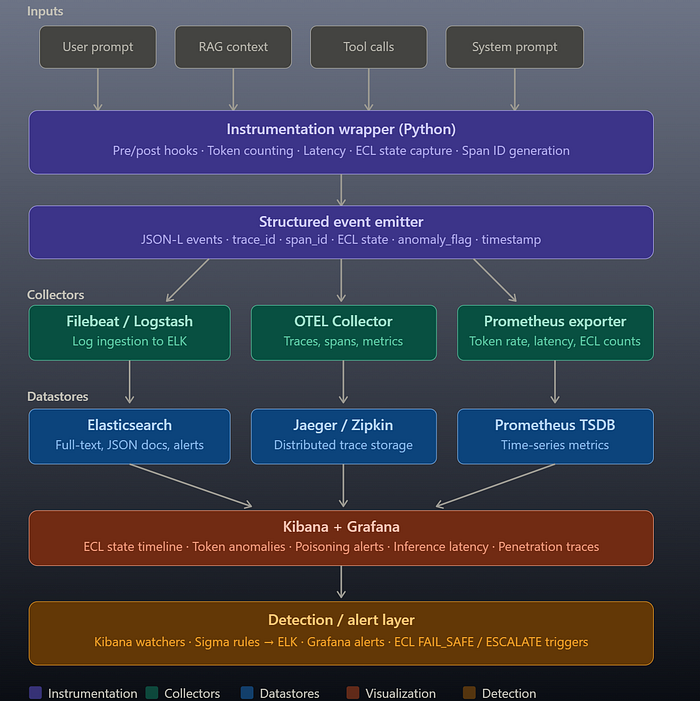
You can observe a million decisions and still not know which ones are safe to be autonomous.
Because safety isn't a feature of observability. It's a property of epistemic confidence.
An agent can:
- Detect an anomaly (87% confidence)
- Call it malicious (62% confidence)
- Recommend response (high confidence if assumption is true)
- Execute autonomously
Each step is observable. Logged. Auditable.
None of that tells you if it should happen without human judgment.
That's when it clicked:
Observability is infrastructure. Governance is philosophy.
Systems as Signal Pipelines
Let me step back.
I've spent years in detection engineering. SIEM. SecOps. Incident response.
Everything reduces to signals.
- Logs → signals
- Alerts → signals
- Correlation → signals
- Human judgment → signal synthesis
- Agent action → signal execution
The real question isn't:
"Can the agent see signals?"
It's:
"Does the agent understand signal quality?"
Explore the Pipeline
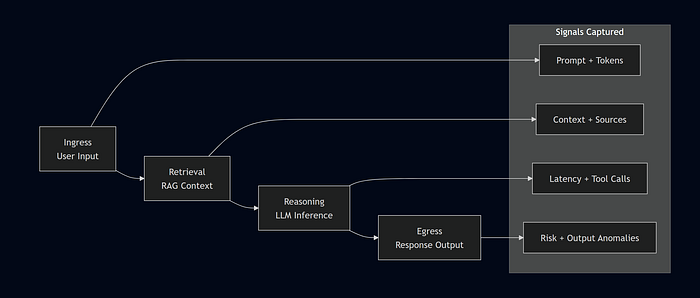
- Multiple independent sources
- Consistency across evidence
- High signal-to-noise
- Time alignment
An agent should only act when signal quality is high.
But how do you measure that?
Introducing Kairos ECL: Epistemic Control Loops
Six months ago, I started designing a framework.
Not a tool. A specification.
A way to define:
When an agent has earned the right to act.
The Decision States
ACT
- High confidence
- Strong grounding
- Safe to execute
ESCALATE
- Uncertain
- Needs human judgment
DEFER
- Missing context
- Wait for more information
FAIL_SAFE
- Signals broken or contradictory
- Stop immediately
See the Full Decision System
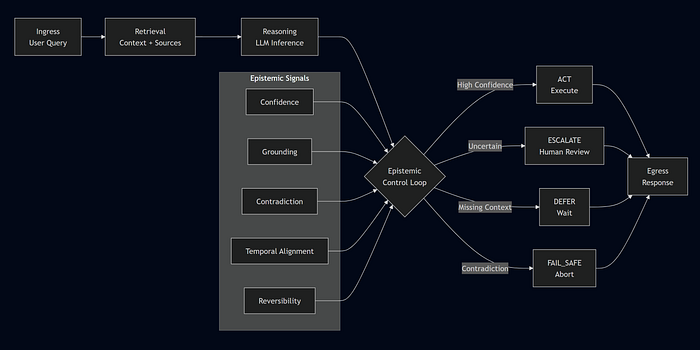
This is the shift:
Autonomy is not binary.
It is conditional on epistemic quality.
Why This Changes Everything
1. Humans become gatekeepers, not bottlenecks
- High confidence → agent acts
- Medium confidence → human decides
- Low confidence → agent waits or fails
2. Audit trails become meaningful
Not just:
"Agent executed action"
But:
"Agent acted because confidence = 0.91, grounding = 3 sources, contradiction = 0.02"
3. Failure modes become explainable
Not:
"Agent made a bad decision"
But:
"Agent acted with insufficient confidence" "Agent ignored contradictory signals"
Building the Proof: Argus
To validate this, I built Argus.
Not a product. A reference architecture.
It shows:
- How to extract epistemic signals
- How to evaluate decision quality
- How to enforce decision gates
- How to build human-readable audit trails
Key Learnings
1. Signal schema > signal volume
You don't need 100 metrics. You need ~5 meaningful signals:
- Confidence
- Grounding
- Contradiction
- Temporal alignment
- Reversibility
2. The audit trail is the product
Not dashboards. Not alerts.
A trace of:
"What we saw → how we evaluated → why we acted"
3. Fail-safe is the most important state
Design for failure, not success.
If confidence cannot be assessed → FAIL_SAFE If signals contradict → FAIL_SAFE
This forces discipline across the system.
4. Human judgment becomes faster
Escalations aren't raw data anymore.
They are:
- Situation
- Signals
- Confidence
- Reasoning
The Bigger Picture
We're at an inflection point.
Agentic systems are moving from:
Experiment → Infrastructure
Organizations will deploy them.
The question is:
Will governance be intentional or reactive?
Intentional
- Define decision states
- Make uncertainty visible
- Build audit-first systems
Reactive
- Monitor
- Wait for failure
- Patch after incidents
I'm betting on intentional.
What I'm Publishing
- Kairos ECL — Open framework (CC BY-SA 4.0)
- Argus — Reference architecture
- Research paper — Earning the Right to Act (arXiv, coming)
- Adoption tiers — Aware → Compliant → Certified
Final Thought
Agents don't need to be smarter.
They need to know:
when they might be wrong.
Links & Resources
- GitHub: kairos-foundation/kairos-ecl
- Argus: Open-source reference architecture
- Paper: Coming to arXiv (Q2 2026)
- Feedback: Open issues, discussions, PRs welcome
Closing
If you're building or deploying agentic systems:
- I want to know where this breaks
- I want to understand your constraints
- I want to iterate this in the open
Let's build this intentionally.