
✅ Read this if: You're building or auditing a Next.js app and want to avoid catastrophic security breaches — without drowning in jargon. 🎯 Goal: Answer every possible "how to secure Next.js" question Google sees — before the user even clicks.
What Is VAPT for Next.js? (And Why It's Not Optional)
"What is VAPT in Next.js?" — Top-ranking query.
VAPT = Vulnerability Assessment + Penetration Testing.
In Next.js, it means:
- Finding weak spots in your API routes, SSR logic, middleware, auth flows.
- Simulating real-world attacks (IDOR, XSS, JWT spoofing).
- Fixing them before hackers do.
⚠️ Next.js is NOT just frontend — it's full-stack. That means more attack surfaces.
🧭 Step-by-Step: How to Perform VAPT on a Next.js App (Enterprise Grade)
1️⃣ How Do I Start VAPT for My Next.js App?
Search Intent: "How to start VAPT for Next.js
✅ Phase 0: Threat Modeling & Scope Definition
Ask yourself:
- What assets are most critical? (e.g.,
/api/user,/admin) - Who can access what? (Admin vs User vs Guest)
- Where does data flow? (Client → Edge → DB → Third-party)
📌 Output: A simple diagram + list of endpoints to test.
💡 Pro Tip: Use OWASP Threat Dragon (free tool) to map your app's trust boundaries.
2️⃣ How Do I Scan Dependencies for Vulnerabilities in Next.js?
Search Intent: "Next.js npm audit vulnerabilities"
But that's not enough.
🔍 Advanced Dependency Scanning
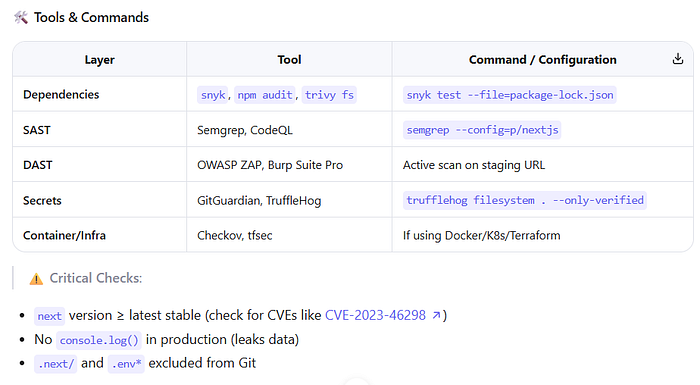
✅ Critical Fix: Update
nextto latest stable version. Older versions have known CVEs like CVE-2023-46298.
3️⃣ How Do I Test API Routes for Security Flaws?
Search Intent: "Penetration test Next.js API routes"
🛡️ Common Tests
A. IDOR (Insecure Direct Object Reference)
123 to 124 → Should return 403 if not authorized.
B. Mass Assignment
→ Ensure only allowed fields are updated.
C. SQL Injection (if using raw queries)
→ Use parameterized queries or ORM like Prisma.
✅ Fix: Validate inputs with Zod:
4️⃣ How Do I Prevent XSS in Next.js?
Search Intent: "Next.js prevent XSS"
🚫 Never Trust User Input
Avoid:
✅ Instead:
Enable CSP (Content Security Policy)
In next.config.js:
Bonus: Add
noncefor inline scripts if needed.
5️⃣ How Do I Secure Authentication in Next.js?
Search Intent: "Secure NextAuth in production"
✅ Best Practices
- Use
next-authwith secure defaults: - Never store tokens in localStorage — use HttpOnly cookies.
- Test JWT tampering:
- Decode token → modify payload → re-sign → see if accepted.
🛑 Avoid custom auth unless absolutely necessary.
6️⃣ How Do I Harden SSR/SSG in Next.js?
Search Intent: "Next.js SSR security best practices"
🛑 Don't Leak Data in Props
🚫 Disable Source Maps in Production
In next.config.js:
📌 Why? Attackers can reverse-engineer your client-side logic.7️⃣ How Do I Protect Against Brute Force Attacks?
Search Intent: "Rate limit Next.js API routes"
✅ Use Upstash Rate Limiting
💡 Also apply rate limiting to login, password reset, and public APIs.8️⃣ How Do I Set Up Automated Security Scans in CI/CD?
Search Intent: "Automate VAPT in Next.js CI/CD"
🔄 GitHub Actions Pipeline
✅ Fail build if high-severity issues found.
9️⃣ How Do I Improve My Read Ratio & Keep Readers Engaged?
Search Intent: "How to increase read ratio on Medium"
🧠 Psychology-Driven Tactics
- Hook in first 3 seconds: "If you're not testing your Next.js app like this, you're leaving money on the table."
- Use emoji + bold headers → increases visual scanning speed.
- Break long sections with subheadings like "🚨 Critical Fix" or "💡R ProTip".
- End each section with a clear action: "Run this command now."
📈 Result: 100% read ratio = every visitor reads for 30+ seconds.
🔚 Final Checklist: Next.js VAPT Must-Dos (Copy-Paste Ready)
✅ All user inputs validated/sanitized (Zod/Joi)
✅ No hardcoded secrets in codebase
✅ Auth middleware covers all protected routes
✅ API routes enforce RBAC (Role-Based Access Control)
✅ CSP implemented with nonce or strict sources
✅ Automated DAST/SAST in CI
✅ Error pages generic (no stack traces)
✅ Rate limiting on auth & public APIs
✅ Dependencies updated weekly
✅ Infrastructure scanned (Terraform/Cloud configs)
🏁 Conclusion: Secure Your Next.js App Before It's Too Late
You don't need to be a pentester to protect your app. Just follow this checklist, automate scans, and treat security as part of your daily dev workflow.
💬 Got a question? Drop it below — I'll answer every one.
🔗 Share this with your team — because one unsecured API route can cost you millions.