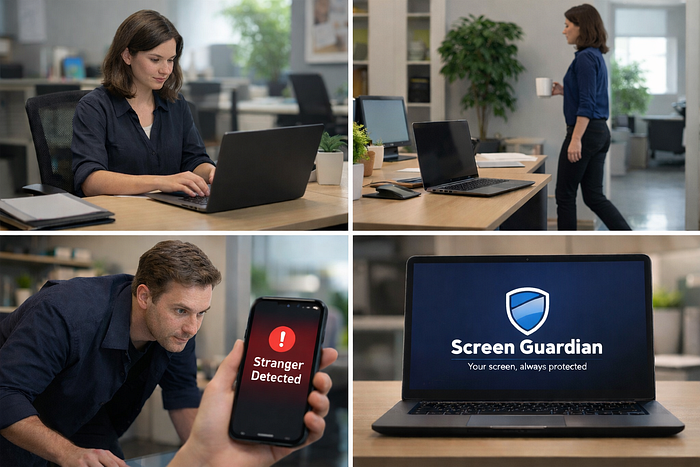
Organizations now invest millions into endpoint protection, Zero Trust architectures, MFA, SIEM platforms, SOC teams, AI-driven threat detection, and cloud security tooling. CISOs and risk professionals are under relentless pressure to defend against increasingly sophisticated digital attacks.
Yet despite all this progress, one category of threat remains surprisingly neglected:
Human visual exposure threats.
Shoulder surfing. Peeping. Casual visual snooping in public spaces.
These threats are not new. But in today's hybrid work era, they have become far more common — and far more dangerous.
The Security Blind Spot Nobody Talks About
Modern work no longer happens exclusively inside secured office walls.
Employees now work from:
- Coffee shops
- Airports
- Trains
- Hotels
- Conferences
- Shared workspaces
- University campuses
- Public waiting areas
At the same time, the amount of sensitive information displayed on screens has exploded.
Employees routinely access:
- Financial dashboards
- Customer records
- Internal chats
- Source code
- Security alerts
- Legal documents
- AI prompts and outputs
- Executive emails
- Healthcare information
Ironically, while companies heavily protect this data digitally, they often leave it visually exposed in plain sight.
A laptop screen in a crowded airport can quietly become an unmonitored data leakage channel.
And unlike phishing or malware, shoulder surfing requires no hacking skills at all.
Why Risk Professionals Often Underestimate the Threat
Part of the problem is perception.
Shoulder surfing is frequently viewed as:
- Low-tech
- Old-fashioned
- Difficult to quantify
- "Not a real cyber threat"
- More of a compliance checkbox than an operational risk
As a result, mitigation strategies have barely evolved in years.
Most organizations still rely on:
- Employee awareness training
- Generic security reminders
- Physical privacy filters
- Clean desk policies
While these measures help, they are largely passive and heavily dependent on human behavior.
And human behavior is inconsistent.
An employee responding to urgent messages during a flight connection is unlikely to think about who may be standing behind them. A developer debugging a production issue at a café is focused on solving the outage — not monitoring nearby observers.
Security awareness alone does not scale against real-world behavior.
Hybrid Work Quietly Changed the Threat Model
The cybersecurity industry adapted quickly to remote connectivity risks.
Organizations rapidly implemented:
- VPNs
- Device management
- Zero Trust access
- Identity verification
- Cloud monitoring
But visual privacy risks largely remained stuck in the past.
This creates a strange imbalance.
Data may be:
- Encrypted in transit
- Protected at rest
- Monitored by AI systems
- Guarded by advanced authentication
…while simultaneously being fully visible to strangers sitting two feet away.
The attack surface is no longer purely digital.
It is now physical + human + digital.
And AI may actually amplify the problem.
AI Is Making On-Screen Information More Sensitive Than Ever
As generative AI tools become deeply integrated into daily workflows, employees increasingly interact with highly sensitive information directly through copilots and chat interfaces.
These screens may contain:
- Proprietary business strategies
- Confidential prompts
- Internal code generation
- Customer data summaries
- Incident investigations
- Legal analysis
- Financial forecasting
In many cases, AI systems aggregate information from multiple internal sources into a single visible interface.
That means a single glance at a screen may reveal far more contextual intelligence than ever before.
The faster AI accelerates productivity, the more valuable on-screen information becomes.
Why Traditional Privacy Filters Are No Longer Enough
Physical screen privacy filters have existed for years, but they come with significant tradeoffs:
- Reduced screen brightness
- Poor viewing angles
- Lower visual clarity
- User frustration
- Inconsistent adoption
Most importantly, they are static solutions for dynamic environments.
They cannot determine:
- When somebody is actually peeping
- Whether multiple people are nearby
- If the user is in a public environment
- Whether sensitive information is currently visible
Modern threats require adaptive protection.
The Rise of Real-Time Human Threat Detection
This is where software-based approaches are beginning to change the conversation.
Instead of relying purely on passive prevention, newer solutions aim to actively detect human visual threats in real time.
One example is Screen Guardian, part of an emerging category focused on proactive visual privacy protection.
Rather than permanently obscuring the display, the idea is to intelligently detect and respond to potential shoulder surfing situations.
The concept is simple:
- Detect nearby observers
- Identify potential peeping behavior
- Alert the user in real time
- Help reduce accidental visual exposure
This shifts visual privacy from a static accessory into an intelligent security layer.
In many ways, it mirrors the broader evolution of cybersecurity itself:
- From perimeter-only security to adaptive detection
- From static controls to contextual awareness
- From reactive policies to proactive mitigation
Human-Centric Security Needs More Attention
The cybersecurity industry has become exceptionally good at defending networks, identities, endpoints, and cloud infrastructure.
But humans remain both the strongest and weakest link.
Not because employees are careless, but because modern work environments are unpredictable.
A complete security strategy should not stop at digital controls alone. It must also account for the physical visibility of sensitive information in public spaces.
As hybrid work continues to grow and AI systems place even more sensitive context onto screens, human visual exposure risks will only become more relevant.
The organizations that recognize this early will be better positioned to protect both their data and their people.
Because sometimes the biggest security risk is not a hacker breaking in remotely.
It is the stranger quietly looking over someone's shoulder.
It is the stranger quietly looking over someone's shoulder.