
Fiber optic infrastructure has become the decisive layer underpinning digital transformation in emerging markets. In Africa, where mobile connectivity has expanded faster than fixed infrastructure, fiber networks now determine the ceiling of network performance, economic scalability, and inclusion. This paper argues that while the technical superiority of fiber is well established, deployment outcomes are shaped less by engineering constraints and more by regulatory fragmentation, capital allocation inefficiencies, and weak infrastructure coordination. Using South Africa and continental Africa as case studies, it demonstrates that fiber must be treated as strategic infrastructure — on par with energy and transport — to unlock inclusive digital growth.
Across Africa, the limiting factor in digital growth is no longer user demand but infrastructure capacity. While mobile penetration exceeds 80% in many countries, backhaul constraints persist because fiber rollout has not kept pace.
The International Telecommunication Union (ITU) notes that broadband quality and affordability are directly linked to fiber availability, particularly in backbone and metro layers. A practical example is seen in congested urban mobile networks where 4G coverage exists, but throughput collapses during peak hours due to insufficient fiber backhaul.
In South Africa, this is visible in township deployments where radio access networks are present but constrained by limited fiber aggregation, resulting in inconsistent user experience despite nominal coverage.
This highlights a critical shift: fiber is not complementary to wireless networks — it is their capacity determinant.
From an engineering perspective, fiber optics offer unmatched advantages: extremely low attenuation (~0.2 dB/km), immunity to electromagnetic interference, and scalability through Dense Wavelength Division Multiplexing (DWDM). A single fiber pair can carry terabits per second, far exceeding copper or microwave alternatives. However, the gap between technical capability and deployment reality in Africa is stark.
Geospatial cost modeling studies show that deploying fiber in low-density areas can cost up to 90 times more per userthan in dense urban environments. This explains why operators prioritize affluent suburbs in cities like Johannesburg or Nairobi while bypassing peri-urban and rural regions. The result is not a technological limitation but an economic distortion, where infrastructure follows purchasing power rather than population need.
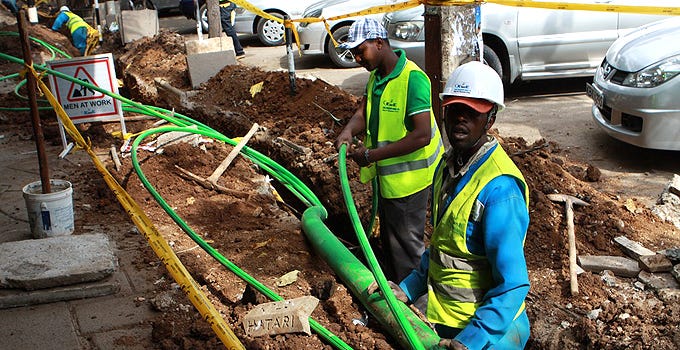
Fiber deployment is dominated by civil works — often accounting for up to 70% of total project cost. Trenching, ducting, and rights-of-way (RoW) approvals introduce both financial and administrative burdens. The World Bank estimates that Africa requires approximately $100 billion to achieve universal broadband access, with the majority allocated to infrastructure expansion.
A clear example is the variation in RoW policies across African municipalities. In some jurisdictions, operators face high fees and prolonged approval timelines, while others have implemented "dig-once" policies that reduce duplication and cost. In South Africa, inconsistent municipal processes mean that a fiber provider may deploy rapidly in one city while facing months-long delays in another. This fragmentation increases capital expenditure and discourages expansion into lower-margin areas.
The underlying issue is that private investment logic does not align with public connectivity goals, particularly in rural markets.
South Africa presents a paradox: it has one of the most developed fiber markets in Africa, yet access remains uneven. Open-access fiber networks have driven competition and reduced prices in urban areas, with multiple operators deploying Fiber-to-the-Home (FTTH) in high-income neighborhoods. However, township and rural deployments lag significantly.
For example, while suburbs in Gauteng may have multiple fiber providers competing on price and speed, nearby townships often rely on wireless ISPs or mobile data. This disparity is not due to technical infeasibility but to return-on-investment thresholds. Operators prioritize areas where average revenue per user (ARPU) justifies capital expenditure, leaving underserved communities dependent on less efficient technologies.
This demonstrates that market-driven deployment alone cannot achieve universal connectivity, even in relatively advanced economies.
Regulatory Fragmentation, the primary bottleneck…
Regulation plays a decisive role in fiber deployment outcomes. Across Africa, fragmented licensing regimes, inconsistent municipal approvals, and lack of standardized policies create systemic inefficiencies. The ITU and Smart Africa Alliance emphasize that policy harmonization is essential for scaling digital infrastructure.
A practical example is cross-border fiber deployment. Regional fiber corridors are often delayed by differing regulatory requirements between neighboring countries, increasing costs and reducing redundancy. Similarly, the absence of infrastructure-sharing mandates leads to duplication, where multiple operators deploy parallel networks in profitable areas while underserved regions remain disconnected.
Effective regulatory interventions — such as open-access frameworks and mandatory infrastructure sharing — have been shown to reduce costs and accelerate deployment. However, implementation remains uneven.
One of the least discussed constraints in African fiber deployment is the lack of accurate infrastructure data. Many countries do not maintain comprehensive maps of existing fiber networks, ducts, or utility corridors. The ITU has identified broadband mapping as a critical tool for improving infrastructure planning and investment efficiency.
Without such data, operators often duplicate infrastructure or avoid areas due to uncertainty. For example, a provider may deploy new fiber in an area already served by another operator simply because there is no shared infrastructure database. Conversely, rural areas may be overlooked because their connectivity gaps are not properly quantified.
This results in a paradox where capital is both over-concentrated and insufficiently distributed.
The economic impact of fiber extends beyond connectivity. Studies consistently show a positive correlation between broadband penetration and GDP growth, particularly in emerging markets. Fiber enables high-capacity, low-latency connections that support:
- Cloud computing and data localization
- Digital financial services and fintech ecosystems
- E-government platforms and service delivery
A clear example is the growth of fintech in countries like Kenya, where improved infrastructure has enabled mobile money platforms to scale. However, as these services evolve toward data-intensive applications, fiber becomes essential to sustain growth.
The World Bank's Digital Economy for Africa initiative positions digital infrastructure as a foundational pillar for inclusive economic development, reinforcing the argument that fiber is not just a telecom asset but an economic enabler.
The Last-Mile Challenge: Fiber Is Necessary but Not Sufficient.. what now?
Despite its importance, fiber cannot economically reach every user directly. The dominant model in Africa is therefore hybrid: fiber backbone combined with wireless last-mile solutions such as Wi-Fi, LTE, or emerging technologies like TV White Spaces.
For example, community networks and small ISPs often use fiber backhaul to feed high-capacity wireless access points, extending connectivity into areas where FTTH is not viable. This approach significantly reduces costs while maintaining acceptable service quality.
However, this model introduces dependencies: without robust fiber backhaul, wireless networks become congested and unreliable. This reinforces the idea that fiber is the foundation upon which all other connectivity layers depend.
Fiber networks in Africa face significant risks, including cable theft, vandalism, and submarine cable disruptions. Given the continent's reliance on a limited number of submarine landing points, outages can have widespread impact.
A recent example is recurring submarine cable cuts affecting multiple West African countries, leading to large-scale internet disruptions. These incidents highlight the need for redundancy, including multiple landing points and terrestrial interconnections.
Resilience strategies such as ring topologies and regional interconnection are therefore not optional — they are essential for ensuring network stability.
But what about the finance?
Traditional private-sector investment models are insufficient to meet Africa's infrastructure needs. The World Bank estimates that approximately 80% of broadband investment requirements are infrastructure-related, underscoring the scale of the challenge.
Innovative financing approaches are emerging, including:
- Public-private partnerships (PPPs)
- Development finance institution (DFI) funding
- Blended finance models combining public and private capital
For example, national backbone projects in countries like Rwanda have been supported through PPP structures, enabling broader coverage than purely private investment would allow.
The key insight is that fiber deployment requires coordinated financial engineering, not just capital availability.
The evidence is clear: the primary barriers to fiber deployment in Africa are not technical but structural. Engineering solutions exist and are well understood. The constraints lie in regulatory fragmentation, misaligned economic incentives, and insufficient coordination.
For policymakers, this implies a shift toward:
- Treating fiber as critical national infrastructure
- Implementing harmonized, pro-investment regulatory frameworks
- Supporting infrastructure sharing and open-access models
For engineers and operators, the focus must be on:
- Designing hybrid, cost-efficient architectures
- Integrating fiber with wireless access networks
- Building resilience into network design
Ultimately, fiber optics represent more than a connectivity solution — they are the backbone of Africa's digital future. The question is no longer whether to invest in fiber, but how to deploy it in a way that is scalable, inclusive, and economically sustainable.