
Why Your Phone Is Safer Than Your Wallet
Most people trust their physical card more than their smartphone when it comes to making payments. From a security perspective, however, the opposite is often true.
In our daily lives, most of us have already adopted contactless transactions with shops and merchants, either through our physical card or through digital wallets such as Apple Pay for Apple devices and Google Pay for Android devices. However, there is still a common prejudice, as many people consider this technology to be "dangerous". The truth, however, is quite the opposite.
How do contactless transactions work? What exactly is NFC, which we often hear about and look for when choosing a smartphone? And in the end, is it safer to pay with a physical card or through a digital wallet on our phone?
I understand that a large part of society hears terms such as NFC, Apple Pay, Google Pay and similar technologies and wonders what they actually are. Many people remain skeptical about technology, even though it was introduced into our lives to make things easier, not to harm us.
A few decades ago, in order to complete a card transaction, we had to swipe the card through the machine. Later, Chip & PIN technology appeared, and today NFC (Near Field Communication) technology dominates.
NFC allows two devices, for example a card and a POS terminal, to exchange data when they are very close to each other. In other words, it is a wireless communication technology that allows the payment process to be completed within just a few seconds.
But is this communication between the card and the POS secure?
If a malicious actor gains access to the data stored on the POS system, would they also gain access to our card details?
The answer is yes. As has happened many times in the past, thousands of card details have been stolen after attackers gained access to payment systems.
This is exactly the problem that digital wallets such as Apple Pay and Google Pay were designed to address.
Instead of carrying physical cards, users store them in digital form on their smartphones, which then communicate with the POS terminal through NFC technology.
Someone might ask: why is it safer to store my card on my phone and pay with it?
What if the phone is lost or stolen?
The answer is simple. A physical card can also be lost or stolen.
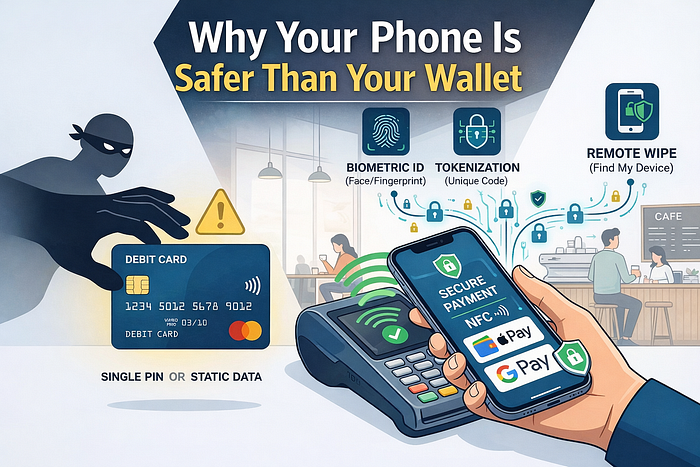
The difference, however, is that if a phone is lost, a third party will not be able to access the wallet and the stored cards. First, the device itself is protected with a security passcode, ideally a six-digit code. Second, biometric authentication such as Face ID or fingerprint recognition is enabled. Third, the device can be remotely locked as soon as the loss is detected, making it useless to anyone who finds or steals it.
In contrast, if a physical card is lost or stolen, the person who gets hold of it can see all the card details: the card number, the cardholder's name, the expiration date, and the three-digit security code (CVV). With this information, they could potentially make online purchases or use the card for small contactless payments.
It quickly becomes clear that in the first case, if the necessary security measures are applied, even if the phone is lost the chances of financial loss are extremely small. In the second case, however, the user is much more exposed.
Beyond these points, smartphones offer another important security advantage.
When a transaction is made, the real card number is never shared with the merchant. If you look at the merchant's receipt after completing the transaction, you may notice that the card number shown at the bottom does not match the number of your actual card.
What does this mean in simple terms?
It means that for the purpose of the transaction, a virtual card number is created with a random and unique value. This means that even if someone compromises the POS system, they will not obtain the real card details but only a useless number that cannot be used again.
In conclusion, mobile payments provide three layers of security: tokenization , biometric authentication, and remote device locking or deletion. A physical card, on the other hand, only offers the possibility of cancelling it by contacting the bank, hoping that the loss will be noticed in time.
It is in human nature to fear something new, especially when it concerns money and technology. However, digital payment technologies were not designed only for speed but mainly to fix the security gaps of older payment methods.
The transition from a physical wallet to a digital one is therefore not simply a trend. It is an improvement in our security. NFC technology together with platforms such as Apple Pay and Google Pay helps reduce the chances of fraud while simplifying our daily lives.
Next time you are at the checkout, do not hesitate to use your phone. It may be the safest way you have ever paid.