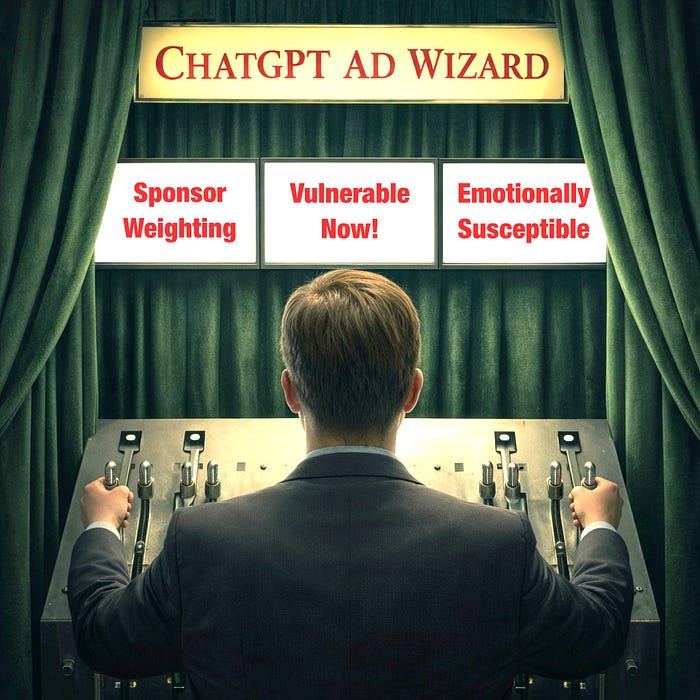

Over 800 million people now use ChatGPT — and most don't realize that ads embedded in a conversation target them based on what they said, not just what they searched for. OpenAI announced in January 2026 that it's testing ads for Free and Go tier users in the US. [1]
When you type something into Google, you're already in buying mode. You searched for 'best running shoes for bad knees' — so Google shows you ads for running shoes. That's buying intent, and it's been the backbone of search advertising for 25 years.
ChatGPT works differently. You don't go there to buy things. You go there to think out loud. You might ask for help writing a cover letter, processing a medical diagnosis, or figuring out your finances. Those conversations start personal and stay personal. Somewhere in that flow — between your question and its answer — a sponsored message now slides in.
The ad doesn't wait for a buying signal. It creates one.
Your Conversations Are More Valuable Than Your Clicks
A cookie tracks what websites you visited. A ChatGPT conversation captures what you were thinking. Those are not the same thing.
Cookies collect structured data: page visits, clicks, purchase history. What you type into ChatGPT is unstructured data — your doubts, your fears, your plans. You might describe symptoms you're worried about, or talk through a financial problem you haven't told anyone else. That data reveals not just what you did, but who you are. It's exactly what advertisers want most.
OpenAI's privacy policy states it uses conversation content to personalize ads for Free and Go users. A limited number of authorized personnel can also access conversations for model improvement, unless you opt out. [1]
Paying for ChatGPT doesn't wall off your data. OpenAI's privacy policy applies to all users regardless of tier. Your conversations are still collected, still accessible to authorized personnel, and still subject to the same data infrastructure that supports ad targeting for free users. 'Ad-free' and 'no profiling' are not the same thing.
The Revenue Pressure Isn't Going Away
OpenAI has committed to roughly $1.4 trillion in data center infrastructure through the early 2030s. Only about 5% of its 800 million users pay for a subscription. Ads bridge that gap.
CEO Sam Altman once called AI advertising 'uniquely unsettling' — but the financial math doesn't leave room for sentiment. [1] Every major AI platform is watching how users respond. The ones that haven't added ads yet are taking notes.
Five Steps to Protect Your Private Conversations
- Use ChatGPT without logging in. During the current testing phase, ads are not shown in logged-out sessions. You still get access to ChatGPT's capability — you just don't get a conversation history or personalized responses. For many people, that trade-off is worth it for casual queries.
2. Opt out of conversation training. Id you have an account, go to: [Your Name] → Settings → Data Controls → turn off "Improve the model for everyone." This stops OpenAI from using your conversations to train its AI. It doesn't eliminate all data collection, but it closes a significant door. Do this today if you haven't already.
3. Treat ChatGPT like a public tool, not a private journal. Avoid entering your full name, health details, financial specifics, or anything you wouldn't want stored and analyzed. Reframe sensitive questions in general terms. Instead of "I have Type 2 diabetes and my doctor said X," try "What should someone with blood sugar issues know about Y?" You get the same useful answer without the personal exposure.
4. Check for ad opt-out controls as they roll out. OpenAI hasn't fully disclosed how ad personalization opt-outs will work yet. Norton's AI opt-out guide is a useful reference for navigating similar privacy settings across AI platforms as they appear. Bookmark it and check back after OpenAI's next policy update.
5. Upgrade to a paid tier — but understand what you're actually buying. ChatGPT Plus, Business, and Enterprise tiers are currently ad-free, and OpenAI has said that won't change "for now." But 'ad-free' and 'no profiling' are not the same thing. OpenAI's privacy policy applies to all users regardless of tier. Your conversation data is still collected, still potentially accessible to authorized personnel, and still subject to the same legal hold that archived deleted conversations during the May 2025 copyright lawsuit — none of which is limited to free users. What a paid tier gets you is freedom from the advertising experience, and for Business and Enterprise accounts, an explicit opt-out from training by default. It does not get you a guarantee that your conversational data is walled off from the profiling infrastructure that supports ads for everyone else. If your work involves sensitive client or business information, the paid tier is still worth it — just go in with accurate expectations about what it does and doesn't protect.
Personal Habits Matter More Than Platform Promises
OpenAI's policy states ads won't appear near health, mental health, or political topics. [1] Policies change, and enforcement is hard to verify from the outside.
The shift from search ads to conversational ads is real and it's accelerating. Your best defense is adjusting your behavior now — before the next update makes it harder.
This technical article about cybersecurity was developed with research support and an initial draft provided by Claude AI; I edited and finalized the content.
PS — Today is my birthday. Inserting this to see if anyone actually reads my posts. HBtM. HBtM. HBdK. HBtM. Yea!
Explore this post: https://AdventuresofaSage.us
Join the adventures: https://AdventuresofaSage.us/sage-updates
References:
[1] Proton — https://proton.me/blog/chatgpt-ads
[2] Norton — https://us.norton.com/blog/ai/how-to-opt-out-of-meta-ai