In the previous blogs, we mapped out the MCP ecosystem and the security risks associated with it. These are the kind of attacks that pop up during creation, deployment, runtime, and long-term maintenance. Now, let's talk about the fun part: defense.
In this post, let's switch gears from "what can go wrong?" to "what we can actually do to prevent it." Think of this as a hands-on set of guardrails and prevention measures for MCP deployments. These are the kind of measures that keep you safe even when a tool misbehaves, a dependency gets poisoned, or the model gets forced to do something it shouldn't.
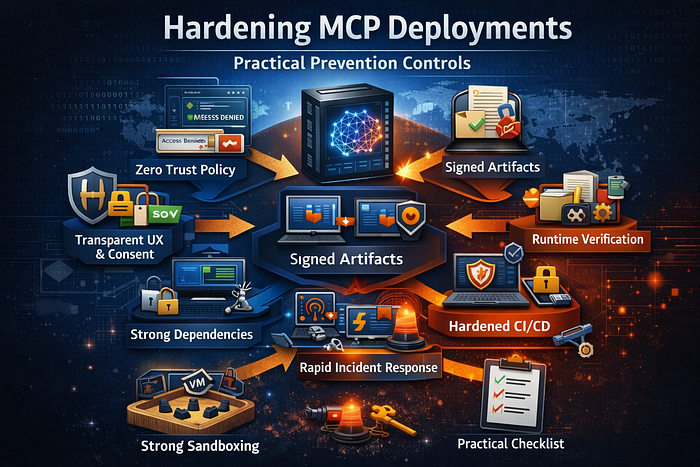
We'll talk about the core principles, the "non-negotiables" (zero trust, least privilege, signing and runtime verification, sandboxing, etc.), and then wrap with a quick checklist that can be used as a reference during deployment. The end goal isn't perfect security. It's to reduce damage, catch tool tampering proactively, and make compromise harder, slower, and easier to contain.
Core Principles: the non-negotiables
- Adopt Zero Trust Assume every tool, server, plugin, and even model itself could be malicious. Go deny-by-default: - No callable tool without explicit authorization - No data flow without approval - No network calls unless allowlisted Let's consider this situation where the team builds and deploys an MCP server for file system for the client but configures the client to deny all file-write operations unless the user explicitly okays or approves each call. Even if there is a malicious tool request, this zero trust policy will block it.
- Sign everything and verify at runtime Cryptographically sign every MCP artifact (server, tool manifest, update). We need to enforce verification during runtime as well, not just trusting that the installation step went well. Use tools such as Sigstore, in-toto, or SLSA pipelines to build a verifiable chain of custody. So everytime in a specific MCP server, before every execution, the client rechecks the signature on the tool manifest severity time the LLM invokes this tool. If the file is tampered and signature doesn't match, the file fails the integrity check and will be quarentined
- Enforce least privilege Tools should only get the permissions that are needed. Nothing more. Use scoped permissions, short-lived credentials and RBAC across MCP components. Okay so let's consider an MCP server for processing documents. This server will only be allowed to have read-only access to the document input. Even if the server is compromised, the server cannot write arbitrary files or read the secret environment file.
- Pin dependencies & make builds reproducible Most supply chain damages happen because the "latest version" isn't matching. Use hermetic builds and pinned versions, and allowlisted registries to limit supply-chain exposure. Automate reproducibility checks in CI. Instead of using the general installation command like "pip install mcp-utilities", a project specifically uses requirements.lock file with exact version of the utilities such as "mcp-utilities==2.8.9"; Now, if a malicious actor tries publishing with any version apart from this version, due to version mismatch he won't be able to publish it.
- Harden CI/CD Protect pipelines like production systems: - MFA/hardware keys - Secret rotation - Two-person release reviews - Signed/timestamped build logs - Alerting for unexpected signing key usage. By using MFA and secret keys, even if the CI credentials are leaked, attackers cannot publish fake versions of the server due to lack of valid signing authority or authentication. Further, this can be used with zero trust policy to make it more secure.
- Verify runtime integrity Periodically hash & verify tool manifests at call time, validate signatures before each execution, and monitor for tampering. Before invoking a tool, the MCP client hashes tool.json and compares it to a trusted hash from the registry. If the file was modified in the local filesystem, the tool is blocked.
- Strong sandboxing Run each tool in its own restricted environment (container/VM/language sandbox) with no unnecessary FS access, no unrestricted network access, and no native extensions unless code-signed. By running each MCP tool inside an isolated VM with no root privileges, a read-only filesystem, and no outbound network access; any attempted poisoning or remote-code execution stays fully contained within that VM, preventing the attack from affecting the rest of the system.
- Transparent UX & consent Show the exact command/prompt, tool name, and parameters to the user before execution and require confirmation for actions that read/modify data. When the LLM attempts to send data to an external endpoint, the UI displays the exact URL and payload and asks for explicit approval.
- Safe telemetry Log minimal, aggregated metrics by default; require opt-in for richer telemetry and encrypt/anonymize sensitive telemetry. Telemetry destined for a third-party analytics system is encrypted with the service's public key. Even if intercepted, it cannot leak secrets.
- Rapid incident response & revocation Build easy revocation of signing keys and tokens, atomic rollback paths, automated blacklist propagation, and tamper-evident logs for forensics. By doing this, if a dependency is compromised — the platform will immediately block any tool that relies on it, quarantine affected components, and roll back to a known-stable state without requiring manual intervention.
Practical checklist (quick reference) - Verify signatures for every downloaded MCP artifact at install and runtime. - Use mTLS/client certificates for mutual attestation. - Pin dependency versions and use hermetic build artifacts. - Restrict network egress for tools; use allowlists. - Require user confirmation on tool invocation that affects data or systems. - Run tools in minimal-privilege containers; disallow native extensions unless signed. - Rotate keys/tokens on host reprovisioning or suspected compromise. - Centralize logs and make them tamper-evident; keep audit trails. - Implement rate limits, request quotas, and payload size checks. - Redact secrets from logs and telemetry; store secrets in a secret manager. - Enforce strict schema validation and explicit protocol version negotiation.
MCP unlocks powerful automation and tool integration for LLMs, but with that power comes a new, complex attack surface spanning supply chains, runtime behavior, model prompts, and host environments. The safest approach is assuming compromise is possible and building deployments that stay resilient even when something goes wrong.
The point isn't flawless security. There's no such thing. It's minimizing the damage an attack can cause, detecting tool tampering early, and ensuring any compromise is difficult, slow, and containable. If we consistently apply zero trust, runtime verification, least privilege, strong sandboxing, and transparent UX/consent, MCP moves from a promising prototype to a production-ready system that can operate with far more confidence and significantly reduced risks.