Today, I'm Going to Talk About How Ethical Hacking Actually Works
Not the Movie Version — the Real Methodology
When most people hear the word "hacking", they imagine fast typing, black screens, and instant access.
Reality is very different.
Ethical hacking is slow, structured, and intentional. It follows a clear methodology — one that security professionals around the world rely on to test and protect systems.
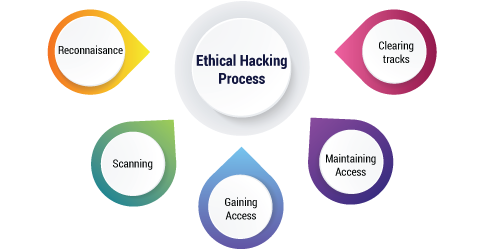
Today, I want to walk you through the 5 stages of ethical hacking, not as definitions — but as a journey.
Why Ethical Hacking Has Stages
Ethical hacking isn't about breaking into systems. It's about thinking like an attacker, so weaknesses can be fixed before someone exploits them.
That's why ethical hackers don't jump straight into exploitation.
They follow stages.
Each stage answers one important question.
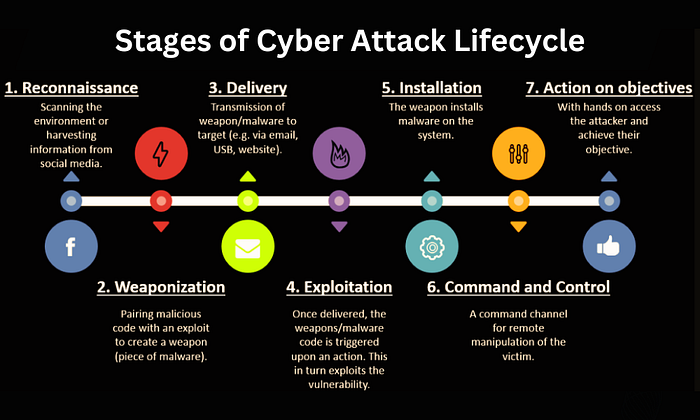
Stage 1: Reconnaissance
"What does the world already know about this system?"
Every assessment starts quietly.
No alerts. No interaction. Just observation.
Reconnaissance is about collecting publicly available information and understanding the target from the outside.
Think of it like standing across the street from a building:
- How many entrances exist?
- Are there signs showing internal departments?
- Is anything unintentionally exposed?
At this stage, ethical hackers look for:
- Domains and subdomains
- Public services
- Technology stacks
- Digital footprints that already exist online
Nothing is touched yet. Everything is observed.
This stage defines the attack surface — and often reveals more than people expect.
Stage 2: Scanning
"What's actually reachable right now?"
Now the approach becomes technical.
Scanning is where assumptions are replaced with facts.
At this stage, ethical hackers identify:
- Which systems are online
- What services are running
- Which ports are open
- Whether versions or configurations appear risky
This is where hidden doors start appearing.
Sometimes systems are exposed accidentally. Sometimes services were never meant to be public.
Scanning doesn't exploit anything — it reveals possibilities.
Stage 3: Gaining Access
"Can the risk be proven safely?"
This is the most misunderstood stage.
Gaining access does not mean destroying systems or stealing data.
It means validating whether a vulnerability:
- actually exists
- can be abused
- has real impact
Ethical hackers perform controlled tests to prove:
"This weakness isn't theoretical — it's real."
The focus here is evidence:
- proof of access
- screenshots
- logs
- clear explanation of impact
Because without proof, vulnerabilities don't get fixed.
Stage 4: Maintaining Access
"If someone gets in once… can they stay?"
Real attackers don't just break in and leave.
They try to:
- remain unnoticed
- keep access
- move deeper over time
This stage exists to test resilience.
Ethical hackers assess:
- session handling
- privilege boundaries
- detection mechanisms
- how long suspicious activity can persist
This stage often reveals weaknesses in monitoring rather than software.
Stage 5: Covering Tracks
"Would anyone even notice?"
This stage isn't about hiding wrongdoing — it's about understanding detection failures.
If an attacker can:
- blend into normal activity
- avoid alerts
- leave no visible traces
Then the real problem isn't hacking — it's visibility.
Learning this stage helps organizations:
- improve logging
- strengthen alerting
- respond faster to incidents
Understanding attacker behavior is the first step toward stopping it.
The Most Important Outcome (That Nobody Talks About)
The goal of ethical hacking is not access.
The goal is a report.
A good penetration test answers:
- What was tested?
- What was found?
- How serious is it?
- What evidence exists?
- How should it be fixed?
- How can it be prevented next time?
Security improves through clarity — not chaos.
The Entire Methodology in One Line
- Recon: Understand the landscape
- Scan: Identify exposure
- Access: Prove the risk
- Persist: Test resilience
- Detect: Strengthen defense
Final Thoughts
Ethical hacking isn't about tools. It's about thinking systematically.
Anyone can run a scan. Professionals follow a methodology.
And once you understand this flow, hacking stops feeling mysterious — and starts feeling methodical.