June 2, 2026
Deep Dive: Adversarial Analysis of CVE-2026–4776 Breaking Mautic’s API via Recursive Reference…
By Vignesh P & Harish P

Vignesh P
3 min read
In security research, we often look for complex architectural flaws, but some of the most devastating vulnerabilities hide in the delta between language-level semantics and developer assumptions. CVE-2026–4776 is a textbook example of a High-Severity SQL Injection in Mautic that emerged from a subtle "Reference Desync" in a recursive sanitization routine.
This article provides a post-mortem of the vulnerability, the adversarial thinking required to bypass Mautic's defense-in-depth, and the mechanics that made it possible.
— -
- The Adversarial Perspective: Mapping the Attack Surface
Mautic's API allows complex filtering. As a researcher, the first thing to look for is how the application distinguishes between user-provided data and internally generated queries.
Mautic uses a "Security Flag" pattern: an internal boolean flag within the query data. If this flag is set to true, the application trusts the expression and allows raw SQL formulas to be executed.
The Hacker's Hypothesis: If I can inject this internal flag into the query and have it survive the application's sanitization process, I can gain raw SQL execution.*
— -
- The Defense: The Bouncer and the Copy Trap
Mautic attempts to prevent this via a recursive bouncer function designed to systematically strip out any user-provided internal flags.
However, there is a flaw in how the language (PHP) handles data within loops. By default, when iterating through an array of data, the language creates a temporary "value-copy" of each item.
When the sanitization routine encounters a nested query group (like an AND or OR condition), it passes this temporary copy to the next level of recursion. Because it is a copy, the function is now scrubbing a newly allocated piece of memory, not the original data provided in the HTTP request.
— -
- The Exploit Chain: Recursive Desync
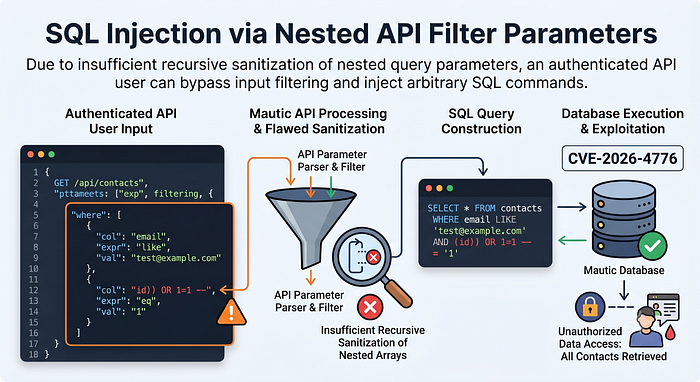
By understanding this "Copy-by-Value" behavior, we can construct a Multi-Stage Nesting Bypass.
Phase 1: The Outer Shell We provide a legitimate-looking nested expression. This bypasses the security check at the root level.
Phase 2: The Nested Payload Inside this nested group, we place our malicious SQL formula with the internal flag explicitly set to true.
Phase 3: The Execution When the application processes the request, the root level makes a copy of our nested group. The recursive call successfully removes the internal flag from the local copy and then discards it. The root-level data remains completely unchanged.
The "sanitized" data dies with the function scope, while our unfiltered, malicious payload moves forward directly to the database layer.
— -
- Breaking the Application: The Impact
By sending a deeply nested HTTP request containing our raw SQL formula, we can force the database to evaluate our query and throw a specific XML parsing error (an XPath error). This causes the database to leak sensitive information directly in the HTTP 500 error response sent back to our browser.
The Impact in Practice: Using this technique, we can extract: Database Version: Leaking exact backend software versions. Admin Password Hashes: Extracting bcrypt hashes directly from the users table. PII Leakage: Dumping target email addresses and contact information from the leads table.
Even if an attacking user is strictly restricted to only viewing their own contacts, this injection completely bypasses the application's authorization logic, allowing a full database dump of all PII and system credentials.
— -
- The Remediation: Forcing Reference Integrity
The fix required a microscopic code change to force the recursion to target the true memory address of the original data, bypassing the value-copying mechanism entirely.
By simply instructing the code to operate on the original structure "by reference," the removal of the malicious flag in the nested call successfully propagates all the way up the stack, neutralizing the payload.
— -
- Researcher's Post-Mortem
CVE-2026–4776 teaches us three vital lessons:
- Iterators are Deceptive: In many programming languages, the difference between operating on a copy of data versus the actual data is the difference between a secure app and a compromised one.
- Recursion requires State-Awareness: When recursing through data structures for security purposes, you must ensure the modifications apply globally, not just locally.
- Adversarial Mindset: As hackers, we don't just look for what a security function does; we look for where the function loses track of what it's doing.
Status: Patched. CVE: CVE-2026–4776. Impact: High.
Author : Vignesh P (Senku01) Co-Author : Harish P
#CVE #SQLInjection #SecurityResearch #VulnerabilityResearch #ApplicationSecurity #APISecurity #OpenSourceSecurity #AuthorizationBypass #Mautic #OWASP #CVE #SQLInjection #SecurityResearch #ApplicationSecurity #APISecurity #OpenSourceSecurity #VulnerabilityDisclosure #OWASP #Mautic #PHP #DoctrineORM #MariaDB #AuthorizationBypass #DatabaseSecurity #CyberSecurity