
A security incident is not the end of the story. It is the beginning of a chapter that most organizations are dangerously unprepared to write. And in fintech, where trust is the entire product, how a platform responds to a breach often determines whether it survives one.
The technical failure that caused the incident gets most of the attention. The response failures that follow it cause most of the lasting damage.
Here is a way to picture it that anyone will recognize. A pipe bursts in a large apartment building. The burst itself is serious but contained. The building manager however cannot find the emergency shutoff valve because nobody documented where it was. They call three different contractors before reaching one available. They do not notify residents for two days because they are not sure what to say. When they finally communicate, the message is vague and contradictory. Some residents find out through a neighbor before hearing anything official. By the time the pipe is fixed, the water damage has spread through four floors because the response took longer than it needed to. The original burst affected one pipe. The response failure affected the entire building. That apartment building is your platform. The burst pipe is your security incident. And every floor that flooded unnecessarily is damage that a prepared, practiced response would have contained.
Incident response failures are not unique to fintech. 1. Healthcare organizations have delayed notifying patients of data breaches for months, compounding regulatory penalties significantly beyond what the original incident would have attracted. 2. Retail companies have continued processing transactions on compromised payment systems because nobody had the authority to take them offline without executive sign-off that could not be reached quickly. 3. Technology companies have issued public statements containing technical inaccuracies that contradicted their own later forensic findings, destroying credibility at precisely the moment trust was most needed. The pattern across industries is consistent: organizations invest in preventing incidents and almost nothing in practicing how to handle them.
In fintech, the stakes of a poor incident response are layered in ways that other industries do not face simultaneously. Regulatory reporting obligations have defined timeframes. Financial regulators in most jurisdictions require notification within specific windows after a breach is confirmed, and missing those windows attracts penalties independent of the breach itself. Customer financial accounts may be actively at risk during the response window, requiring decisions about whether to freeze accounts, force password resets, or suspend services that have direct revenue and customer experience consequences. Payment card data breaches trigger specific PCI DSS incident response requirements that carry their own obligations and timelines. And unlike a breach at a social media platform, a breach at a financial platform can result in direct monetary loss for customers during the time it takes to detect, contain, and communicate.
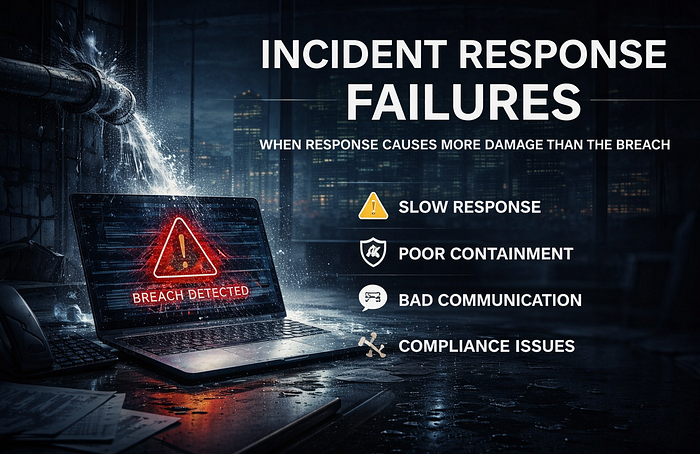
Technically, incident response failures cluster around several consistent and preventable patterns. Absence of a documented incident response plan means the organization is making foundational decisions during a crisis that should have been made during a quiet afternoon months earlier. Who has authority to take a production system offline? Who communicates with regulators and what do they say? Who speaks to the press? Who notifies customers and through which channels? These are not questions that should be answered for the first time at two in the morning during an active breach.
Slow detection compounds every other failure. An organization that discovers a breach weeks or months after it began has a fundamentally different and more serious incident than one that detects it within hours. The difference is almost entirely a function of monitoring investment and alert quality made before the incident occurred. A breach that has been active for ninety days before detection has had ninety days to exfiltrate data, establish persistence, and potentially compromise additional systems.
Inadequate containment decisions extend the damage window. Teams that are uncertain about the scope of a compromise sometimes make conservative containment decisions that leave affected systems running to avoid business disruption, while attackers who are still present continue their activity. The calculus of availability versus containment is genuinely difficult but it requires pre-established decision frameworks to navigate quickly under pressure.
Poor communication, both internal and external, transforms a security incident into a trust crisis. Customers who find out about a breach affecting their financial accounts from a news article before receiving any communication from the platform experience the silence as betrayal. Internal communication failures mean that customer support teams are fielding calls about an incident they have not been briefed on, giving inconsistent and sometimes inaccurate information that creates additional liability. Regulatory notifications that are delayed, incomplete, or that contradict subsequent findings attract scrutiny that compounds the consequences of the original incident significantly.
A realistic scenario: a fintech platform's security monitoring tool flags unusual database query volumes on a Friday evening. The alert goes to an on-call engineer who is not a security specialist and who, after briefly investigating and not immediately finding an obvious cause, escalates to their manager. The manager decides to wait until Monday to involve the security team to avoid disrupting the weekend. By Monday morning the attacker, who has had the entire weekend to operate uncontested, has exfiltrated customer KYC data and transaction records for a significant portion of the user base and removed their access traces. The security team begins their investigation Monday and confirms a breach by Tuesday. Legal and compliance are looped in. A debate begins about whether the regulatory notification threshold has been met and how to communicate to customers. The communication that eventually goes out is legally cautious to the point of being uninformative. Customers cannot tell from reading it whether their account was affected or what they should do. A journalist publishes a more detailed account sourced from an affected customer before the platform's own communication reaches most users. The regulatory body opens an investigation not only into the breach but into the delayed and inadequate response. The platform spends the next eighteen months managing consequences that a practiced, prepared response would have significantly reduced.
Building incident response capability that holds under pressure requires treating it as an engineering and operational discipline rather than a document that satisfies an audit requirement. 1. Develop a detailed incident response plan that covers detection, initial assessment, containment, eradication, recovery, and post-incident review with clear role assignments and decision authorities for each phase. 2. Practice it through regular tabletop exercises and simulated breach scenarios that force the team to make real decisions under time pressure before they face a real incident. 3. Establish pre-approved communication templates for different breach scenarios that legal, compliance, and communications teams have already reviewed, so that customer and regulatory notifications can be sent quickly without starting a drafting process during the crisis. 4. Define clear thresholds and authorities for containment decisions including taking systems offline, forcing credential resets, and suspending services, so these decisions can be made by people on the ground without waiting for executive approval chains that do not move quickly under pressure. 5. Invest in detection capability that surfaces incidents in hours rather than weeks. 6. Build relationships with external incident response specialists before you need them so you are not evaluating vendors while an attacker is active in your environment. 7. Conduct thorough post-incident reviews after every security event, including near misses, and treat the findings as mandatory inputs to engineering and process improvements rather than optional recommendations.
Prevention gets the engineering investment. Response gets the tabletop exercise once a year if it is lucky. That imbalance is why breaches that could have been contained become the incidents that define a company's reputation permanently.
A platform that handles a breach with transparency, speed, and competence can recover from almost anything. A platform that handles one poorly may not recover at all.
#CyberSecurity #IncidentResponse #SecurityOperations #ApplicationSecurity #FintechSecurity #DataBreach #SoftwareEngineering #SecurityEngineering