
They happen because someone forgot how browsers behave.
You can build:
- Perfect token validation
- Clean logout logic
- Server-side session invalidation
- Strict policy checks
And still expose sensitive data.
How?
The browser back button.
The Hidden Problem
When a user logs out, the session is destroyed on the server.
But the browser may still hold a cached version of previously visited authenticated pages.
So when the user clicks "Back," they might see:
- Financial dashboards
- Tax invoices
- Identity records
- Admin panels
Even though they are technically logged out.
That's not a server vulnerability.
It's an HTTP caching issue.
And in fintech or compliance-driven systems, that's unacceptable.
The Defensive Fix: Enforce Cache Discipline at the Edge
I don't solve this in controllers.
I don't solve this per-route.
I solve it once — at middleware level.
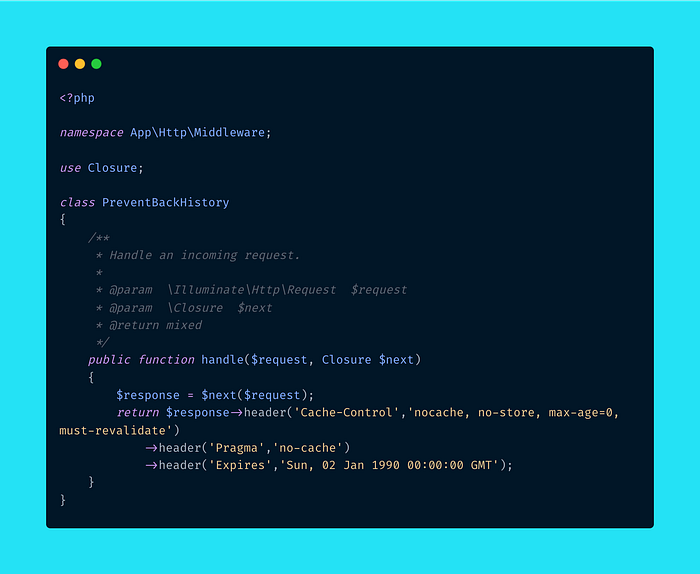
This forces the browser to:
- Not store sensitive responses
- Revalidate before reuse
- Treat previous pages as expired
Which means:
After logout → Back button → Redirect to login.
Every time.
Deterministic.
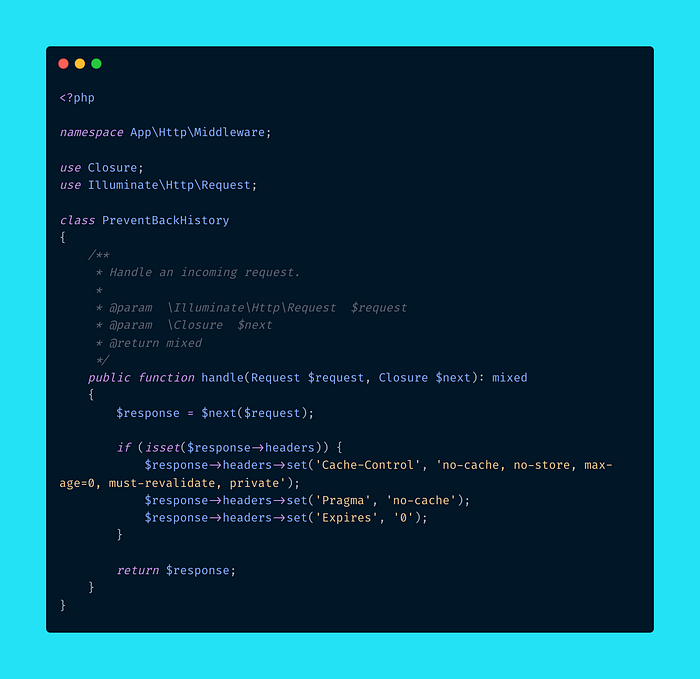
In order to handle binary responses like file downloads would require a little tweak as shown below:
Why This Matters in Fintech Systems
If you're building:
- Wallet systems
- Tax compliance platforms
- Multi-tenant vendor dashboards
- Identity verification APIs
- Government-facing portals
You're operating under implicit audit assumptions.
Auditors don't care whether exposure happened via:
- Session bug
- Proxy misconfiguration
- Browser cache
They care that data was visible when it shouldn't have been.
Preventing cache reuse is part of compliance-grade engineering.
Why Middleware Is the Correct Abstraction
This is cross-cutting infrastructure logic.
By enforcing it in middleware:
- You guarantee consistency.
- You eliminate duplication.
- You centralize enforcement.
- You avoid controller pollution.
- You preserve clean architecture boundaries.
Security controls belong at system boundaries — not inside business logic.
The Engineering Principle Behind This
This isn't about headers.
It's about defensive determinism.
In regulated backend systems:
- State transitions must be explicit.
- Authentication must be revalidated.
- Client behaviour must be constrained.
- Data visibility must be intentional.
If the system says "logged out," then the UI must reflect that state — regardless of browser history.
Anything else is non-deterministic behaviour.
And non-determinism has no place in financial infrastructure.
Security isn't just cryptography and tokens.
It's understanding every layer — including how the browser might work against you.
Small middleware.
Enterprise-level impact.