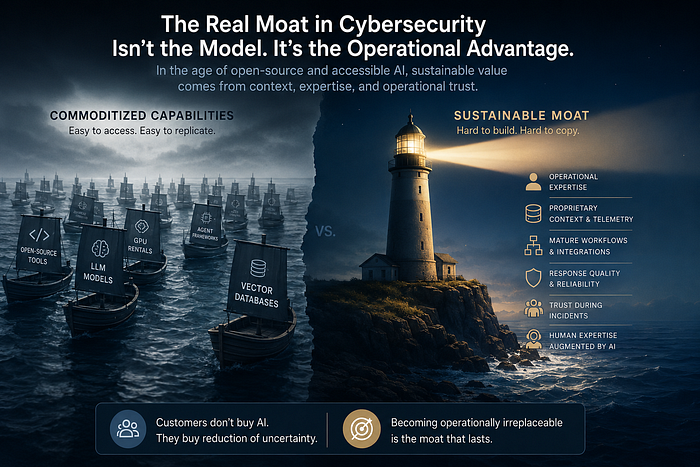

What exactly is the moat anymore?
I've been reflecting on this because a lot of modern B2B security products now follow a similar pattern. They are essentially wrappers around multiple open-source tools, combined with managed services, integrations, operational tuning, and customer support.
And to be clear, that is not inherently bad.
In fact, some of the best security products in the market are built exactly this way. Most enterprise customers do not want to stitch together ten GitHub repositories themselves. They want something deployable, maintainable, and accountable.
The real product often isn't the software. It is the operationalization.
But AI is starting to complicate this model significantly.
The "Everyone Has AI" Era
A few years ago, having machine learning inside a security product felt differentiated.
Today, every booth in every security conference suddenly has:
- AI SOC
- AI analyst
- AI copilot
- autonomous remediation
- agentic security operations
The language is becoming almost interchangeable.
At the same time, the barriers to building these capabilities are collapsing rapidly:
- Open-source LLMs are improving aggressively
- GPU rentals are accessible
- Orchestration frameworks are everywhere
- Fine-tuning pipelines are becoming standardized
- Vector databases are commoditized
- Prompt engineering knowledge is public
This creates a strange strategic dilemma for vendors.
If everyone can assemble similar capabilities using largely accessible infrastructure, then where does durable value actually come from?
Because the uncomfortable truth is this:
A lot of "AI products" today are not defensible products. They are temporary packaging advantages.
The Infrastructure Trap
Many companies are now debating whether they should:
- host their own LLMs,
- rent GPUs,
- rely on API providers,
- or build proprietary agentic systems.
Each option comes with tradeoffs.
Owning infrastructure sounds attractive because it implies independence and control. But it also means:
- massive operational costs,
- continuous model maintenance,
- inference optimization,
- hardware lifecycle management,
- escalating energy costs,
- and a constant race against hyperscalers.
Competing directly on foundation model infrastructure is probably unrealistic for most cybersecurity vendors unless they operate at very large scale.
On the other hand, relying entirely on third-party models introduces another risk:
Your differentiation becomes dependent on someone else's roadmap and pricing.
If your "AI capability" can disappear because an API provider changes pricing or another competitor accesses the same model tomorrow, then the moat is thinner than many people admit.
The Real Value May Not Be the AI
I suspect the long-term winners in cybersecurity will not necessarily be the companies with the biggest models.
They will likely be the companies with the strongest operational context.
Because cybersecurity is not purely an intelligence problem. It is a trust problem.
Customers are not paying for "an LLM." They are paying for:
- faster incident resolution,
- lower operational fatigue,
- reduced uncertainty,
- fewer missed detections,
- compliance confidence,
- and reliable escalation during bad days.
That changes the equation entirely.
The sustainable value may come from:
- customer telemetry accumulated over years,
- workflow maturity,
- integration depth,
- detection engineering quality,
- institutional operational knowledge,
- and human expertise augmented by AI.
In other words, AI may become an amplifier rather than the core product itself.
Agentic Systems Sound Better Than They Often Work
There is also a practical reality that many people in the industry quietly recognize:
Fully autonomous security operations are still messy.
Agentic systems look impressive in demos because demos are controlled environments. Real enterprise environments are chaotic:
- incomplete logs,
- broken asset inventories,
- political silos,
- inconsistent tagging,
- legacy systems,
- alert fatigue,
- and unclear ownership.
An AI agent can summarize alerts beautifully. But deciding whether to isolate a production server tied to business-critical operations? That is a very different level of responsibility.
This is why I think the near future is less about "replacing analysts" and more about compressing operational workload.
The companies that understand this nuance will likely build more sustainable businesses than those aggressively marketing full autonomy.
The Managed Service Layer Might Be the Actual Moat
Ironically, many vendors may discover that their strongest differentiation is the least glamorous part of their stack.
Not the model.
Not the GPU cluster.
Not the orchestration framework.
But the managed operational layer surrounding it.
The reality is that enterprises often stay with vendors because:
- onboarding was smooth,
- support engineers were reliable,
- incidents were handled professionally,
- detections were continuously tuned,
- and the vendor understood their environment deeply.
That operational trust compounds over time in ways raw technology alone often cannot.
And perhaps that is the bigger lesson emerging from this AI wave.
Technology is becoming easier to replicate. Operational credibility is not.
Final Thoughts
I don't think AI in cybersecurity is hype. The productivity gains are real, and the operational improvements are already visible across SOC workflows.
But I do think the industry is entering a phase where infrastructure and models themselves are becoming increasingly commoditized.
The difficult question is no longer: "How do we add AI?"
It is: "What remains valuable once everyone has access to similar AI?"
That is a much harder strategic problem.
And honestly, probably a healthier one for the industry to confront.