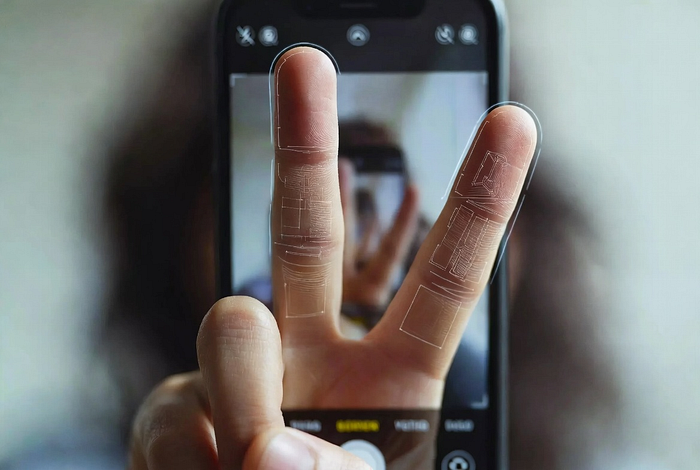

There is a moment most people have never had.
The moment you realize that something you did a thousand times, something that felt completely harmless was quietly leaking information you never meant to share.
For millions of people, that moment might be coming.
And it starts with a peace sign. The Research Nobody Is Talking About Loudly Enough
Researchers have been studying something uncomfortable.
Under specific conditions such as high-resolution images, close up angles, clear lighting, minimal motion blur AI systems can extract partial fingerprint patterns from photos containing visible fingertips.
Not perfectly. Not from every photo. But enough to matter.
Your fingers have ridge patterns. Those patterns are unique to you. They unlock your phone. They authorize your banking app. They verify your identity at border crossings. And every time you throw up a peace sign for the camera, your fingertips face the lens at almost exactly the right angle.
Modern smartphones shoot at resolutions that would have seemed absurd ten years ago. AI image analysis is improving faster than most people can track. The gap between what is possible today and what will be possible in two years is closing faster than anyone is comfortable admitting.
Right now, this requires very specific conditions to work. Most casual selfies do not meet that bar. The angle has to be right. The resolution has to be high. The ridges have to be clear enough.
But here is the thing about technology.
Today's specific conditions become tomorrow's baseline.
This Is Not About Fingerprints
I want to be honest with you because I believe the fingerprint angle, while real, is actually the smaller part of this story.
The bigger story is what this research reveals about how we think about the information we share.
We have been trained to think about data privacy in obvious ways. Do not share your password. Do not click suspicious links. Do not give your bank details to strangers.
Nobody taught us to think about what our images actually contain.
We look at a photo and see a memory. A moment. A version of ourselves we wanted to capture.
AI looks at the same photo and sees data. Patterns. Measurements. Information we never consciously decided to share.
That gap between what we see and what machines can extract is where modern privacy actually lives. And most people have never thought about it once.
The Deeper Pattern in Cybersecurity
The more I learn about security the more I notice this same pattern showing up everywhere.
The threat is almost never what it looks like on the surface.
SQL injection is not really about databases. It is about what happens when you trust input without questioning it.
Phishing is not really about fake emails. It is about how human brains are wired to respond to urgency and authority.
And this research is not really about peace sign selfies. It is about the fact that every piece of data we generate every photo, every click, every interaction carries more information than we intended to share. And the tools to extract that information are getting better every single day.
That is the actual threat landscape we are living in.
Not the dramatic Hollywood hacker in a dark room typing furiously. The quiet, methodical extraction of information from things we never thought to protect.
What This Actually Means for You Right Now
I am not going to tell you to stop taking photos. That would be ridiculous.
But I think there is a more useful shift available here.
Start thinking about your digital presence the way security researchers think about attack surfaces.
What information does this contain beyond what I can see?
Who could access this and what could they do with it?
What am I assuming is harmless that I have never actually examined?
These are not paranoid questions. They are the questions that separate people who understand the modern information environment from people who are still operating on assumptions built in 2012.
The peace sign research is one data point. But it points at something much larger.
We are generating more data about ourselves than any previous generation in human history. We are sharing it more freely than ever before. And the tools to extract meaning from that data are advancing faster than our intuitions about privacy can keep up with.
That is not a reason to panic.
It is a reason to pay attention.
The Bottom Line
Can someone steal your fingerprint from a casual selfie right now? In most cases, no. The conditions are too specific. The technology is not quite there yet for everyday images.
But can AI extract more from your images than you realize? Yes. The research is clear on that.
And more importantly will this capability improve? Absolutely. Without question.
The question is not whether this is a problem today. The question is whether you want to understand it before it becomes one.
That is what cybersecurity actually is. Not reacting to threats after they arrive. Understanding how things work deeply enough to see what is coming before it gets here.
That shift in thinking is everything. I am Abdulmuiz, a cybersecurity enthusiast documenting my learning journey through web application security, bug bounty hunting and the way modern attacks actually work. If this made you think differently about something you assumed was safe follow along. There is a lot more where this came from.