
June 2, 2026
Tools That Automate Remediation of Vulnerable Dependencies Before Deployment
Modern software development relies heavily on open-source components. Many applications are built using hundreds or even thousands of…

JFrog
5 min read
Modern software development relies heavily on open-source components. Many applications are built using hundreds or even thousands of external libraries that help developers work faster and avoid rebuilding common features from scratch. But this efficiency introduces risk. Every dependency becomes a potential entry point for vulnerabilities, making dependency vulnerability management a critical challenge in modern software development.
To address this, many DevSecOps teams rely on automated tools to identify unsafe components, enforce security policies, and remediate issues as code is built. These systems help ensure risks are detected early and managed continuously throughout the development lifecycle.
The Growing Risk of Dependency Vulnerabilities
Security incidents over the past decade have shown how dangerous vulnerable dependencies can be. High-profile events, such as the Log4Shell vulnerability, revealed how a single flaw in a widely used library could ripple through global software infrastructure. While open-source applications help developers build faster, they also give hackers more ways to attack.
A typical application may include the following components:
- Package manager dependencies (npm, Maven, PyPI, etc.)
- Container base images
- Infrastructure libraries
- Transitive dependencies introduced indirectly by other packages
Transitive dependencies can be tricky. A developer might add just one package, but it can bring in dozens of other libraries automatically. If any of these indirect dependencies have a vulnerability, the application can still be at risk, even if the original package is considered safe.
According to guidance from the Cybersecurity and Infrastructure Security Agency (CISA), organizations should identify and track their suppliers, assess third-party components, and continuously evaluate vendor security practices to reduce supply chain risk.
Why Manual Remediation No Longer Works
Historically, developers discovered vulnerabilities through periodic audits or manual code reviews. That model is no longer effective.
Modern development environments introduce several challenges:
- Rapid release cycles with frequent deployments
- Large dependency trees that are difficult to track manually
- Constantly evolving vulnerability databases
- Security alerts that arrive after software is already deployed
Manual remediation can create delays or introduce human error. Developers must determine which package versions contain fixes, evaluate compatibility, and update the code accordingly. In fast-moving development environments, this process often leads to postponed fixes.
Automated remediation tools solve this problem by integrating directly into development workflows. Instead of relying on manual intervention, these systems detect vulnerabilities, recommend upgrades, and sometimes apply fixes automatically.
How Automated Dependency Remediation Works
Automated remediation tools typically operate across several stages of the software development lifecycle.
1. Continuous Vulnerability Scanning
The first step is identifying vulnerable dependencies. Software composition analysis (SCA) scanners compare package versions against vulnerability databases such as:
- National Vulnerability Database (NVD)
- Security advisories from open-source maintainers
- Vendor security feeds
These scanners monitor repositories, build pipelines, and artifact repositories for vulnerable components.
2. Dependency Graph Analysis
Automated tools analyze the full dependency graph of an application. This helps identify not only direct dependencies but also nested packages that may introduce vulnerabilities.
Dependency graph analysis enables tools to:
- Map relationships between packages
- Identify the root cause of vulnerable transitive dependencies
- Recommend safer versions
Understanding these relationships is essential because upgrading a dependency may require updates across multiple components.
3. Automated Fix Suggestions
Once a vulnerability is identified, remediation tools can recommend safe dependency versions that resolve the issue. In many cases, these tools go a step further by automatically generating fixes that developers can review and merge.
Common automated actions include:
- Pull requests with upgraded dependencies
- Security alerts with remediation steps
- Compatibility checks to confirm builds remain functional
These automated pull requests allow development teams to address vulnerabilities quickly without interrupting their workflow.
Automated Pull Request Fixes vs Policy Enforcement
Automated pull request (PR) fixes and policy enforcement address dependency vulnerabilities in different ways. Automated PR fixes proactively help developers resolve issues by generating suggested updates, often as pull requests that upgrade vulnerable dependencies.
Policy enforcement, by contrast, acts as a safeguard in the development pipeline, blocking builds or deployments when security rules are violated. In practice, the two approaches complement each other: automated fixes make remediation faster and easier for developers, while policy enforcement ensures that unresolved vulnerabilities cannot move forward into production.
Popular Tools That Automate Dependency Remediation
Several platforms have emerged to help teams detect and fix vulnerable dependencies automatically.
Dependabot
Dependabot is widely used in GitHub repositories to monitor dependency updates and generate pull requests when new versions are available. It integrates directly with package managers and repository workflows.
Key capabilities include:
- Automatic dependency vulnerability management updates
- Security alerts for vulnerable packages
- Pull requests that update packages to safe versions
This automation significantly reduces the manual effort required to maintain secure dependency versions.
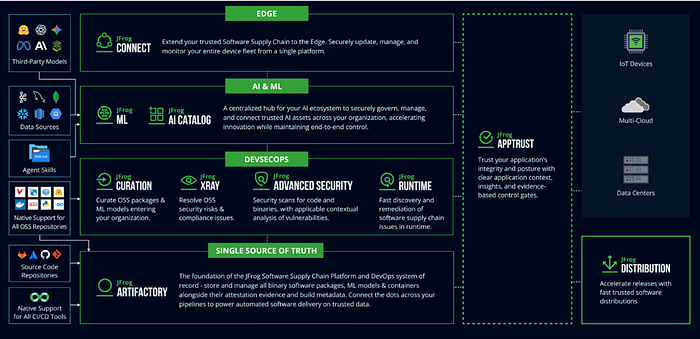
The JFrog Software Supply Chain Platform
The JFrog Platform provides deep visibility into the software supply chain by analyzing artifacts, containers, and build outputs throughout the development lifecycle.
Key capabilities include:
- Repository-level scanning of software components
- Continuous monitoring of artifacts stored in build repositories
- Detection of vulnerabilities across container images and dependencies — even after deployment
By scanning software artifacts at the binary level, JFrog enables teams to identify risks that may not be visible through source code scanning alone. This ensures that the actual components being deployed are continuously evaluated and secured, including vulnerabilities that emerge after artifacts are built and stored.
The Role of Automation in DevSecOps
Automated AppSec tools integrate security into the development process, so problems can be spotted and fixed continuously as code is built.
Automation helps organizations:
- Detect vulnerabilities earlier in the software development process
- Reduce manual security workload
- Ensure consistent security policies across teams
- Maintain rapid deployment cycles without compromising safety
These tools enable security teams to focus on higher-level analysis while routine vulnerability remediation happens automatically.
Challenges of Automated Remediation
Despite its benefits, automated remediation introduces new challenges that teams must manage carefully.
Compatibility Risks
Upgrading dependencies automatically can introduce breaking changes. Even minor updates may affect application behavior or performance. Organizations often address this risk by combining automated updates with automated testing pipelines.
Alert Fatigue
Security scanning tools can generate large volumes of alerts, particularly in large applications with many dependencies. Without prioritization, developers may struggle to determine which vulnerabilities require immediate attention. Many modern tools assign risk scores to vulnerabilities so teams can focus first on the most critical issues, but few tools provide the contextual insights to determine whether a given vulnerability has an actual impact on the runtime application.
False Positives
Some vulnerability alerts may not actually affect how an application runs. Developers need to determine whether the vulnerable code is truly used or reachable in their specific environment.
More advanced security tools help solve this problem by analyzing the application's context to see whether the vulnerability can actually be triggered.
Why Dependency Security Is Becoming a Supply Chain Issue
The rise of automated vulnerability remediation tools shows a larger change in how organizations think about software security. Instead of focusing only on their own application code, companies now see the entire software supply chain as something that must be protected.
This includes:
- Source code repositories
- Package managers
- Build pipelines
- Artifact repositories
- Container registries
- Deployment environments
If a vulnerability appears anywhere in the software supply chain, it can eventually end up in the final product. Automated vulnerability remediation tools help manage this risk by constantly monitoring dependencies and fixing issues throughout the development process.

Building Resilient Software Through Automated Security
As software ecosystems grow more complex, dependency vulnerability management will remain a challenge. The widespread use of open-source components makes manual remediation impractical for modern development environments.
Automated remediation tools provide a practical solution by detecting vulnerabilities early, recommending safe updates, and integrating security enforcement into CI/CD pipelines. By combining continuous scanning, dependency analysis, and automated fixes, these tools help organizations reduce risk without slowing development.