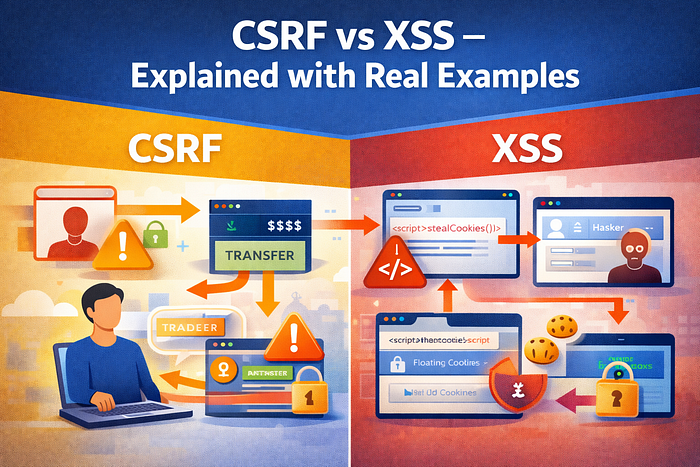

Web security is one of the most important aspects of modern web development. Two of the most common and potentially devastating vulnerabilities are CSRF (Cross-Site Request Forgery) and XSS (Cross-Site Scripting). Understanding how they work and how to prevent them is crucial for developers building secure applications.
🔹 What is CSRF (Cross-Site Request Forgery)?
CSRF tricks a user into performing actions they didn't intend to on a website where they are already authenticated.
How it works:
- A user is logged in to a website (e.g., BankApp.com).
- An attacker creates a malicious request on another website (e.g., attacker.com).
- The user unknowingly triggers the request, performing actions like transferring money, changing passwords, or modifying settings.
Real-world example:
- Clicking a hidden button in an email or web page triggers a bank transfer to the user's account without their knowledge.
Prevention strategies:
- Use anti-CSRF tokens in forms
- Validate Origin and Referer headers
- Require re-authentication for sensitive actions
🔹 What is XSS (Cross-Site Scripting)?
XSS allows attackers to inject malicious scripts into web pages that other users view.
How it works:
- An attacker inserts a malicious script into a web page (e.g., in a comment or forum post).
- The script executes in the browser of any user who views the page.
- Attackers can steal cookies, hijack sessions, manipulate page content, or even redirect users.
Real-world example:
- A forum allows HTML in comments. An attacker posts
<script>stealCookies()</script>. Every user who opens that comment unknowingly sends their cookies to the attacker.
Prevention strategies:
- Sanitize and validate user input
- Implement Content Security Policy (CSP)
- Encode output before rendering to the browser
🔹 Key Differences Between CSRF and XSS
| Feature            | CSRF                              | XSS                         |
| ------------------ | --------------------------------- | --------------------------- |
| Attack Type        | Tricks user to perform actions    | Injects scripts into pages  |
| Target             | Server-side actions               | Client-side (browser)       |
| Exploit Method     | Uses existing session credentials | Script execution in browser |
| Real-World Example | Unauthorized money transfer       | Stealing cookies or tokens  |
Rule of thumb:
- CSRF = make the user do something they didn't intend
- XSS = steal data or manipulate the browser
🔹 Best Practices to Prevent CSRF and XSS
- Implement CSRF tokens for all forms
- Always sanitize and escape user input
- Use secure headers like Content Security Policy (CSP)
- Educate users about suspicious links and phishing attempts
- Regularly test your applications for vulnerabilities
🏁 Takeaway
CSRF and XSS are different but equally dangerous. While CSRF attacks exploit the user's existing session, XSS attacks exploit browser execution to steal data or manipulate pages. Proper security practices, awareness, and testing are your best defenses.
💬 Question for readers: Have you ever encountered CSRF or XSS vulnerabilities in real projects? How did you prevent or mitigate them?