As the proposed CLARITY Act (Clarity for Digital Asset Markets Act) advances through the U.S. legislative process, the crypto industry's focus is shifting from "trading and liquidity" to a more fundamental question:
Who really controls digital assets, and what is the safest way to custody them?
Historically, many users have grown accustomed to leaving assets on exchanges or in internet-connected hot wallets for extended periods. But as platform risk, malicious signatures, phishing attacks, and AI-driven scams continue to escalate, a growing number of long-term holders are re-examining the security architecture around their digital assets.
Against this backdrop, self-custody is no longer just for the tech-savvy,it is rapidly becoming a defining trend in crypto asset security.
Why the CLARITY Act Matters
At its core, the CLARITY Act aims to establish a clearer regulatory framework for digital asset markets. While the bill is still working its way through the legislative process, it signals a clear regulatory shift:
policymakers are placing increasing emphasis on users' ability to independently hold and manage their digital assets.
Discussions around self-custodial wallets and decentralized infrastructure, in particular, are emerging as a key area of industry focus. For long-term holders, this means "asset control" could become more critical than ever. As the time-honored crypto adage goes: **"Not your keys, not your coins."**
Why Are More People Turning to Self-Custody?
Over the past few years, security incidents across the crypto industry have confirmed that traditional perimeter defenses are failing. The threat landscape has undergone a structural shift:
Legacy intermediary risk: Centralized platforms frequently face compliance freezes, withdrawal runs, and sudden liquidity black swan events.
Emerging device vectors: Malicious smart contract approvals, counterfeit wallet app injection, and phishing site attacks.
Today, many attacks no longer target the blockchain itself. Instead, they go after user devices, signing flows, and wallet operating environments. This means that even if the blockchain network itself is secure, assets remain exposed if private keys are kept in an internet-connected environment for extended periods.
As a result, more and more long-term holders are reducing their reliance on centralized platforms and reclaiming control of their assets through self-custody.
Hot Wallets vs. Hardware Wallets: The Security Gap
Hot wallets typically operate in internet-connected environments — browser extensions, mobile apps, or desktop software.
While convenient, they are inherently more vulnerable to trojans, browser exploits, remote malware, phishing attacks, AI-powered social engineering, and other threat vectors.
Hardware wallets, by contrast, are built around a core principle: private keys never touch the internet. Through offline signing and independent verification mechanisms, hardware wallets help mitigate remote attack and private key exposure risks. For long-term holders, a hardware wallet isn't just a storage tool — it's a security solution that meaningfully reduces the attack surface.
AI-Powered Attacks Are Reshaping the Crypto Security Landscape
With the rapid advancement of generative AI, cyberattacks are escalating in both sophistication and scale.
Attackers are already leveraging AI to auto-generate phishing emails, impersonate customer support, create deepfake identities, craft malicious signature prompts, and deploy automated scam scripts. These attacks are increasingly convincing and far harder to detect.
In this environment, relying solely on hot wallets or centralized platforms carries ever-growing risk. Offline signing, air-gapped environments, and hardware-grade security architectures are drawing more attention from security-conscious users as a result.
Why Long-Term Holders Are Moving Toward Hardware-Grade Self-Custody
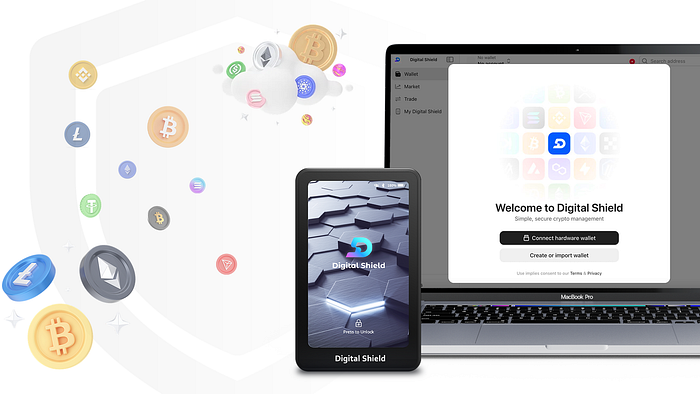
Digital Shield is purpose-built to help users reduce digital asset security risk through hardware-grade isolation architecture. What we deliver isn't just another hardware wallet — it's a complete, verifiable offline storage solution.
1. The Absolute Physical Bulwark: Military-Grade EAL6+ Encrypted Protection Our defensive cornerstone is a military-grade Secure Element certified under the international Common Criteria EAL6+. The entire lifecycle of the private key — generation, encryption, and storage — is completed within the "absolute safe zone" of this chip, never touching the internet, and unable to be read or copied by any software or external probe.
2. Absolute Interaction Isolation: Air-Gapped Secure Signing Unlike traditional USB-dependent wallets, Digital Shield supports data interaction between the hardware and the app via encrypted QR codes. The hardware wallet's built-in camera scans the transaction QR code generated by the app, and after signing in a completely offline state, generates an encrypted response code to be sent back. Throughout this entire process, the private key never leaves that physical fortress.
3. Absolute Trust Transparency: 100% Open-Source and Verifiable To completely shatter the "black box of trust," Digital Shield employs a 100% open-source code architecture. Users and third-party security researchers can inspect our code at any time to confirm there are no backdoors or security vulnerabilities. We do not ask for your blind trust; we empower you with the ability to verify it yourself.
4. Absolute Ecosystem Compatibility: Seamless Multi-Chain Support We natively support over 14+ mainstream public chains, including Bitcoin, Ethereum, and Solana, and can be linked with other wallets of the same protocol, such as Metamask, for interaction. Whether it's NFTs or cross-chain assets, they can all be managed uniformly under the same hardware security system.
Closing: The Future of Crypto Assets Is Self-Custody
As the regulatory landscape evolves and cyberattacks continue to intensify, the crypto industry is shifting from a trading-first mindset to a security-first one.
More and more users are coming to a critical realization: the long-term security of digital assets doesn't just depend on market conditions — it depends on whether asset control truly rests in their own hands.
In a future defined by multi-chain ecosystems and surging AI threats, hardware wallets, offline signing environments, and secure self-custody architectures will become essential infrastructure in the digital asset ecosystem. No matter how the world changes, your private keys will always belong to you — and only you.
Want to learn more? Visit us at: https://ds.pro/