
We often treat our smartphones and fiber-optic speeds as if they appeared out of thin air. In reality, the history of Information Technology is a chaotic, brilliant, and occasionally hilarious timeline of "accidental" discoveries and refrigerator-sized hard drives.
If you've ever wondered why your keyboard is laid out so strangely or why we call a glitch a "bug," here is a brief journey through the evolution of IT.
1. The Literal "Bug" in the System
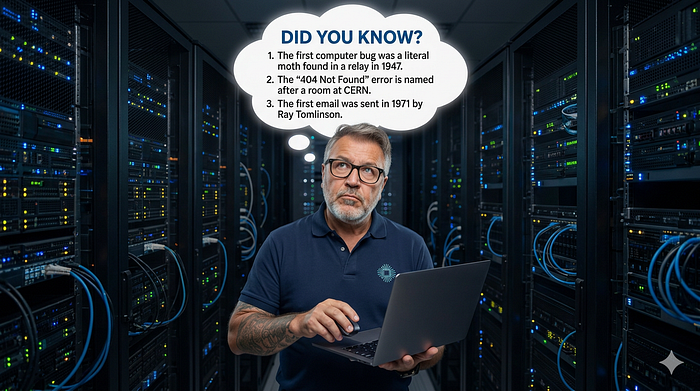
The term "debugging" isn't just a metaphor. In 1947, computer pioneer Grace Hopper was working on the Harvard Mark II when the machine began malfunctioning. Upon inspection, the team found a literal moth trapped in a relay. They taped the insect into their logbook, marking the "first actual case of a bug being found."
2. Before Screens: The First Algorithm
Long before Silicon Valley existed, Ada Lovelace became the world's first programmer in the 1840s. While working with Charles Babbage on his theoretical "Analytical Engine," she realized the machine could do more than just math — it could follow a series of instructions to create complex outputs. She wrote the first algorithm, proving that women have been at the forefront of IT since day one.
3. The Internet's First Words: "LO"
The internet wasn't born with a high-definition stream; it began with a crash. In 1969, researchers on ARPANET attempted to send the word "LOGIN" from UCLA to Stanford. The system crashed after the first two letters, making "LO" the first message ever transmitted over the network that would become the internet.
4. Why Your Keyboard is Slow by Design
Ever wonder why the top row of your keyboard starts with QWERTY? It wasn't designed for speed; it was designed for mechanical limitations. In the 1870s, fast typists would frequently jam the metal arms of typewriters. Christopher Sholes designed the QWERTY layout to strategically separate common letter pairs, forcing typists to slow down and keeping the machines functional.
5. From 27 Tonnes to Your Pocket
In 1946, the ENIAC computer weighed 27 tonnes and took up 1,800 square feet. Ten years later, IBM's first hard drive was the size of two refrigerators but could only hold 5 MB of data. Today, a microscopic microSD card can hold a terabyte — a storage increase of roughly 200,000,000% in a single human lifetime.
6. The Languages We Speak
The code running our world has a surprisingly personal history:
- COBOL: Created in 1959 to bring English-like grammar to business, it still processes the majority of global banking transactions today.
- JavaScript: The backbone of the modern web was famously written in just 10 days by Brendan Eich in 1995.
- Python: Named not after the snake, but after the British comedy group Monty Python, reflecting the creator's desire to keep programming "fun."
IT history reminds us that technology isn't just about silicon and wires; it's about the people who found moths in their machines and the scientists who sent half-finished messages across California. The next time your computer glitches, just remember: at least there isn't a moth in the motherboard.