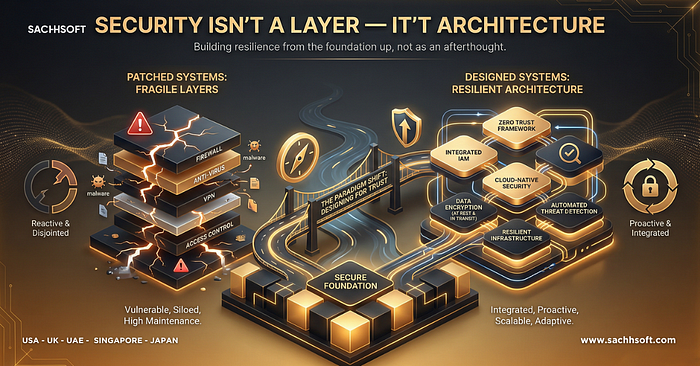

For years, security has been treated as something you add to systems. A firewall here. An authentication layer there. A penetration test before launch. This mindset worked — until systems became distributed, API-driven, AI-powered, and constantly evolving.
Today, that approach is no longer enough.
In modern digital systems, security is not a layer you bolt on at the end. It is an architectural decision that must be embedded from the very first design conversation. For architects building platforms at scale, security is no longer a checklist — it's a structural principle.
How We Ended Up Treating Security as an Add-On
Traditional software systems were simpler:
- Monolithic applications
- Clearly defined network perimeters
- Limited external integrations
- Predictable user behavior
In that world, security controls could sit "around" the system. If you protected the perimeter, you protected the application.
Modern systems don't have clear perimeters anymore.
The Death of the Perimeter
Cloud-native and distributed architectures dissolved the idea of a single boundary.
Today's systems include:
- Microservices spread across environments
- APIs consumed by third parties
- Mobile and web clients accessing the same backend
- AI services calling external models
- Hybrid and edge deployments
When everything talks to everything, where exactly would you place a security layer?
The answer is: everywhere — or more accurately, in the architecture itself.
Why Layered Security Fails at Scale
Layered security assumes:
- Trusted internal systems
- Untrusted external traffic
- Static access patterns
None of those assumptions hold true anymore.
Modern breaches often happen because:
- Internal services are overly trusted
- APIs expose more than intended
- Permissions grow unchecked
- AI systems ingest unverified data
- Observability gaps hide abnormal behavior
Security failures are rarely caused by missing tools. They are caused by architectural blind spots.
Security as an Architectural Constraint
Architects routinely design for:
- Performance
- Scalability
- Reliability
- Maintainability
Security must be treated the same way.
This means asking security questions at design time:
- How does trust flow through the system?
- What happens if one service is compromised?
- Where is sensitive data created, processed, and stored?
- How are permissions granted, revoked, and audited?
- What assumptions are we making about "safe" components?
If these questions aren't answered early, no amount of tooling can fix the gaps later.
Zero Trust Is an Architectural Model, Not a Product
Zero Trust is often misunderstood as a security feature. In reality, it's an architectural philosophy.
Zero Trust assumes:
- No implicit trust between services
- Continuous verification of identity and intent
- Least-privilege access by default
This changes how systems are designed:
- Services authenticate each other explicitly
- Authorization is contextual, not static
- Network location no longer implies trust
Zero Trust cannot be "added on." It must be built in.
Security and Architecture in the Age of APIs
APIs are the backbone of modern web development and app development, but they also multiply risk.
Architectural security decisions for APIs include:
- Contract-first design
- Strict input validation
- Clear ownership of endpoints
- Rate limiting as a design concern
- Separation of public and internal interfaces
When APIs are treated as internal plumbing instead of public surfaces, security erodes quickly.
AI Systems Raise the Stakes Further
AI introduces new architectural risks:
- Model poisoning
- Prompt injection
- Data leakage through inference
- Over-trusting automated decisions
These are not problems you solve with firewalls.
Secure AI solutions require:
- Clear boundaries between training and inference
- Strong data governance
- Human-in-the-loop controls
- Explainability and monitoring by design
AI security failures often trace back to architectural shortcuts made early.
Why "We'll Fix It Later" Never Works
Security debt behaves differently from technical debt.
You can refactor code later. You can optimize performance later. But security flaws embedded in architecture are:
- Expensive to redesign
- Risky to change in production
- Often invisible until exploited
Once insecure trust models are baked in, they become systemic vulnerabilities.
Security Shapes System Resilience
Architectural security improves more than protection — it improves resilience.
Systems designed with security in mind:
- Fail gracefully instead of catastrophically
- Contain breaches instead of amplifying them
- Recover faster from incidents
- Provide clearer forensic insight
Security architecture and reliability architecture are deeply connected.
What Architects Should Do Differently
Architects shaping modern platforms should:
- Treat security as a first-class design goal
- Model threat scenarios alongside use cases
- Design trust boundaries intentionally
- Enforce least privilege structurally
- Make security observable, not assumed
This mindset shifts security from a defensive activity to a design discipline.
Security Is a Business Decision, Not Just a Technical One
Security architecture directly impacts:
- Customer trust
- Regulatory compliance
- Brand reputation
- Long-term scalability
Poor security design constrains growth just as surely as poor scalability design.
Architects sit at the intersection of technology and business. Security belongs squarely in that intersection.
Final Thoughts
Security is not something you wrap around systems — it's something you build into them.
As architectures become more distributed, intelligent, and interconnected, treating security as a layer is no longer just outdated — it's dangerous. The most secure systems are not those with the most tools, but those with the most intentional design.
For architects, this is the new responsibility: design systems where security is a property of the architecture itself, not an afterthought.
At Sachhsoft, we work with architects to design secure-by-design platforms — aligning web development, app development, and AI solutions with architectures that scale safely, not just quickly.