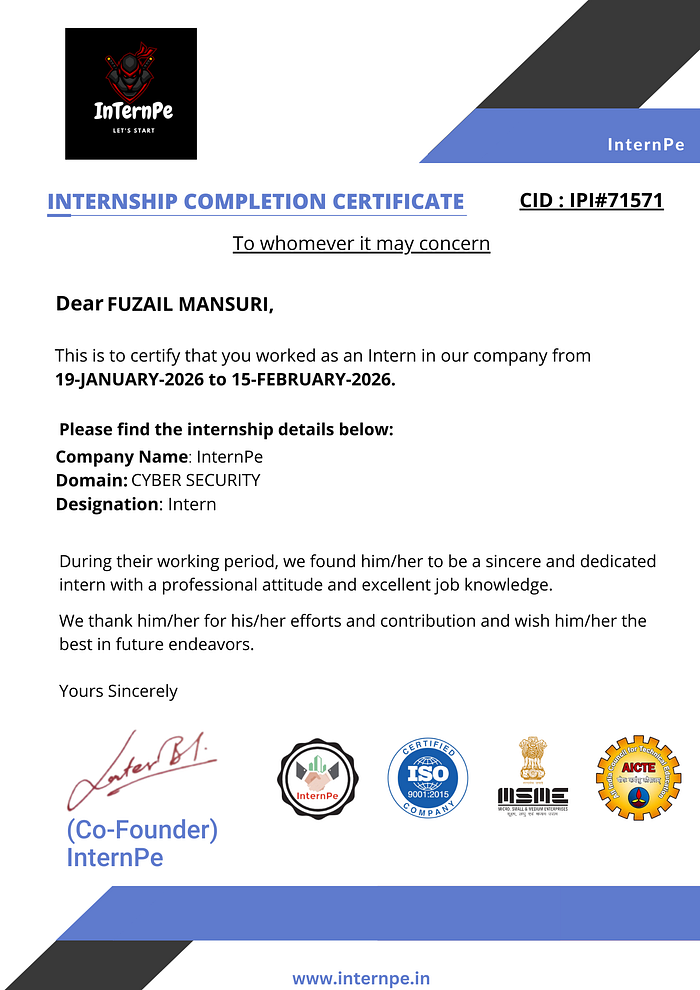
Successfully Completed My 4-Week Cybersecurity Internship
Over the past month, I gained hands-on experience in:
Week 1: Security Threat Identification
The first week focused on reconnaissance and understanding system exposure.
Tools Used:
Nmap
Wireshark
Nessus
Key Activities:
Performed network scanning to identify open ports and running services
Conducted OS detection and service enumeration
Captured and analyzed network traffic
Identified suspicious activities such as unusual data transfers and failed login attempts
Key Learning:
Understanding what is exposed on a network is the first step toward securing it. Misconfigured services and unnecessary open ports significantly increase attack surfaces.
Week 2: Vulnerability Assessment
This phase focused on identifying and categorizing system weaknesses.
Tools Used:
Nessus
OpenVAS
Nikto
Key Activities:
Conducted comprehensive vulnerability scans
Identified outdated software, weak configurations, and insecure credentials
Classified vulnerabilities by severity (Critical, High, Medium, Low)
Verified findings using CVE references
Prepared a structured vulnerability assessment report
Key Learning:
Not all vulnerabilities carry the same risk. Proper categorization and validation are critical before recommending mitigation strategies.
Week 3: Incident Response Simulation
This week simulated a real-world cybersecurity incident.
Scenario:
A controlled environment was set up with a simulated breach (malware infection / unauthorized access).
Key Activities:
Monitored system logs and network traffic
Detected indicators of compromise
Isolated affected systems
Removed malicious processes
Conducted root cause analysis
Documented findings in a formal incident response report
Key Learning:
Incident response is about speed, precision, and documentation. Containment is critical to prevent lateral movement and further damage.
Week 4: Security Hardening & Best Practices
The final week focused on strengthening defenses.
Key Activities:
Reviewed vulnerabilities from previous weeks
Applied patches and updates
Configured firewalls and IDS/IPS
Enforced strong password policies
Re-ran vulnerability scans
Performed penetration testing to validate improvements
Key Learning:
Security is not a one-time task. Continuous monitoring, validation, and improvement are essential.
Final Thoughts
This internship helped me bridge the gap between theory and practical cybersecurity implementation. I gained hands-on experience across the defensive security lifecycle:
Threat Identification → Vulnerability Assessment → Incident Response → Security Hardening
It strengthened my understanding of how attackers think and how defenders must respond strategically.
I'm excited to continue building my skills in cybersecurity and exploring advanced defensive techniques.