
There is a harsh reality in the world of cybersecurity: most people who jump into bug bounty hunting absolutely struggle in the beginning. They burn out, they find nothing but duplicates, and they eventually quit, believing they aren't smart enough or technical enough to succeed.
But here is the truth: It is rarely a lack of intelligence or laziness that leads to failure. It is almost always a flaw in the approach.
Over the course of hundreds of mentorship calls, a specific pattern of failure has emerged. Beginners tend to make the same four mistakes, over and over again. If you are currently staring at a blank terminal, frustrated that your submissions are getting rejected or ignored, chances are you are guilty of at least one of these errors. The good news? They are entirely fixable.
TL;DR — The 4 Pillars of Failure:
1. Lack of Defined Goals: Hunting without a specific target (learning vs. earning) leads to burnout. 2. Poor Program Selection: Jumping into hardened, paid programs before building "muscle memory" on VDPs. 3. Ignoring Impact: Reporting technical quirks (like missing headers) rather than demonstrating actual risk to the business. 4. Over-Reliance on Default Tooling: Using the same scanners as everyone else results in Duplicate and Informative findings.
1. The Aimless Hunter: You Don't Have a Goal
When you sit down to hack, what are you actually trying to achieve? If your answer is "find a bug," you have already lost. That is too vague. The most successful hunters treat this like a business or a structured curriculum, not a lottery.
You need to categorize your current phase into one of three buckets:
- The Learner: You are trying to understand a specific vulnerability class.
- The Earner: You are trying to make a specific amount of money.
- The Career Builder: You are hunting to build a resume to land a full-time AppSec job.
The "Learner" Strategy
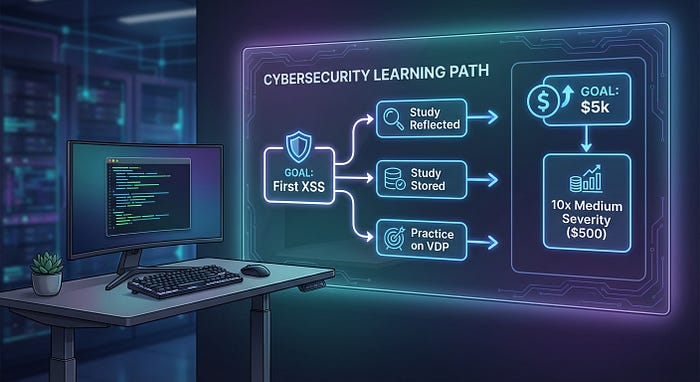
If your goal is knowledge, your metrics for success change. You aren't looking for a payout; you are looking for understanding. If you want to master Cross-Site Scripting (XSS), your goal shouldn't be "hack Google." It should be:
- Week 1: Read the PortSwigger Web Security Academy labs on XSS.
- Week 2: Learn the difference between Reflected, Stored, and DOM-based XSS.
- Week 3: Study how to bypass Web Application Firewalls (WAFs) and filters.
- Week 4: Apply this knowledge to a target specifically to find XSS entry points.
By narrowing your focus, you stop getting distracted by every open port or interesting header and start seeing the application through the lens of that specific vulnerability.
The "Earner" Strategy
If your goal is financial ($5,000, for example), you need to reverse engineer that number. Do not just hack randomly. Find a program that pays $500 for a Medium severity bug. Now, your goal is concrete: You need to find 10 Medium bugs, or perhaps 5 Mediums and a few Highs.
💡 Pro Tip: Write It Down. This sounds cliché, but it is psychologically necessary. Keep your goals on a whiteboard in front of your desk. A goal written down is a roadmap; a goal kept in your head is just a wish. When you sit down, that whiteboard reminds you why you are grinding.
2. The "Hard Mode" Trap: Wrong Program Selection
Imagine learning to play basketball and immediately challenging an NBA player to a 1-on-1 match. You will lose, you will learn nothing, and you will quit. Yet, this is exactly what new bug hunters do when they sign up for HackerOne or Bugcrowd and immediately jump into the highest-paying programs like Uber, Yahoo, or PayPal.
These programs are hardened. They are monitored by the best security teams in the world and hammered by the best hunters in the world. As a beginner, you do not have the "reps" to compete there yet.
Start with VDPs (Vulnerability Disclosure Programs)
A VDP offers no money (points/swag only), but it offers something more valuable to a beginner: Experience.
Because there is no cash reward, the fierce competition stays away. This leaves low-hanging fruit and logic bugs available for you to find. Companies like Ford, GM, IBM, and the U.S. Department of Defense often run VDPs.
Why do this? You need to build your Gut Feeling. When experienced hackers look at a URL, they get a "tingle" — an intuition that something is wrong. That intuition isn't magic; it is pattern recognition built over thousands of hours of seeing what normal look like vs. what vulnerable looks like. You build that intuition on VDPs.
Scaling Up to Paid Programs
Once you have a methodology, move to paid programs. But don't just pick the one with the highest payout. Pick a program based on Scope or Passion.
- Wide Scope: Look for programs with "wildcard" domains (e.g.,
*.target.com). These organizations have hundreds of subdomains, acquisition companies, and forgotten dev servers. This is where you find the cracks. - Passion: Hack companies you actually use or like. If you are a gamer, look at Epic Games. If you watch movies, look at Netflix. When you understand the product as a user, you understand the logic better than a scanner ever could.

3. The "So What?" Problem: Reporting Bugs with No Impact
If you are submitting reports and receiving "N/A" or "Informative" closures, you are likely failing the Impact Test.
Beginners often rely on automated scanners that flag things like:
- Missing
X-Frame-Optionsheaders - Leaked internal IP addresses
- Outdated software versions (without a known exploit)
- Leaked API keys (that are actually public/non-sensitive)
These are technically "issues," but they are often noise. To a security engineer at a company, a bug is only a bug if it demonstrates risk.
The Golden Question
Before you hit submit, ask yourself: "What can I actually do with this?"
If you found an Open Redirect, that's a low-impact bug. But, if you can chain that Open Redirect to steal an OAuth token and take over an account, you have just turned a $0 bug into a $3,000 bug.
Stop reporting the presence of a vulnerability. Start reporting the consequence of the vulnerability. If you cannot explain the harm to the user or the infrastructure, it is not worth reporting yet. Dig deeper.
4. The Automation Addiction: Using the Same Tools as Everyone Else
The most common complaint from failing hunters is: "Everything I find is a duplicate."
This happens because you are running Nuclei, Nessus, or Burp Suite Pro active scans with default templates — just like the 50,000 other hackers on the platform. If a tool can find a bug automatically within 5 minutes, 500 people found it before you.
The Fix: Learn the Fundamentals
You cannot automate what you do not understand. Many beginners skip the basics of HTTP, JavaScript, and networking to run advanced tools. This is backwards.
- Manual Hunting First: Learn to look at the raw HTTP requests and responses. Understand what headers do. Read the JavaScript files manually to find hidden endpoints.
- Custom Automation Second: Once you understand a vulnerability class deeply, then you can write your own Nuclei templates or Python scripts to look for edge cases that the default scanners miss.
The money in bug bounty is found in the business logic — the complex errors that occur when a human uses the application in an unintended way. No tool can currently "scan" for business logic errors effectively. That is your competitive advantage.

5. The Grind: Consistency is the Only Shortcut
Bug bounty hunting is essentially a Massive Multiplayer Online (MMO) game. The more you play, the better your aim gets, the better you know the maps, and the more XP you gain.
You cannot hunt for 12 hours one day and then take three weeks off. You will lose your momentum. Consistency beats intensity. Even if you only have 30 minutes a day, use that time to read a write-up, analyze a snippet of code, or test one specific endpoint.
Don't Go It Alone
The stereotype of the hacker in a dark hoodie working in isolation is outdated. The most successful hackers run in packs. They share knowledge, they collaborate on findings, and they pick each other up during burnout periods.
If you don't have friends who hack, join a community. Twitter (InfoSecTwitter) and Discord are the lifeblood of this industry. Seeing how someone else approached a target can completely shift your perspective and unlock new vulnerabilities in your own mind.
Conclusion
If you feel like you suck at bug bounty hunting right now, it is likely because you are judging your "Day 1" against someone else's "Year 10."
Stop running default scanners on hardened targets with no clear goal. Instead, write down your objectives, start on VDPs to build your intuition, focus on demonstrating impact, and master the manual fundamentals before relying on automation. The bugs are there; you just need the discipline to find them.