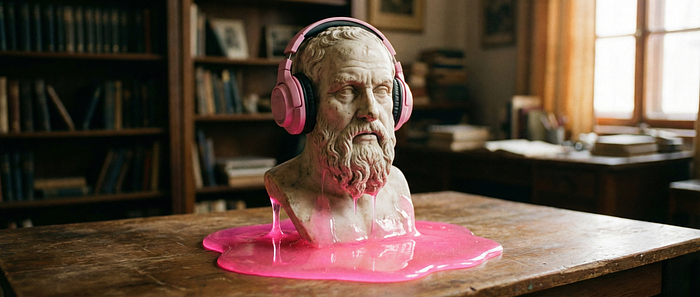


The Pop Cat Theory
How to convert deep philosophy into dopamine without hating yourself.
There is a specific kind of arrogance in believing that your ideas are so important they don't need a user interface.
I was recently sitting in my living room, sweating over a complex technical article about design systems. I was three hours deep, trying to articulate the nuance between a primitive and a semantic token.
If you don't know what those are, congratulations. You have a life.
(Bypassing the auth layer. No subscription token required. Read freely here.)
· The Backend Writer Delusion · The Physics of the Scroll · Becoming a Full-Stack Communicator · The New Normal
It was serious work. It was intellectually rigorous. It was the literary equivalent of chewing on dry drywall.
Next to me, my wife was laughing at her phone. She wasn't reading a geopolitical analysis. She wasn't debugging code. She was watching a meme of a domestic short-haired cat named Oatmeal opening and closing its mouth to make a popping sound.
Pop. Pop. Pop.
That cat has millions of views. It has a higher GDP than some small nations.
My article about design tokens? It will probably get forty views. Thirty of them will be me refreshing the page to see if I'm famous yet.
For a long time, my reaction to this was pure snobbery. I told myself the world is getting stupider. I blamed the TikTok generation. I told myself I was a guardian of Deep Thought in an age of shallow distraction.
But that is a lie.
The truth is much more humiliating: I am losing to the cat because the cat is better at product design than I am.
The Backend Writer Delusion
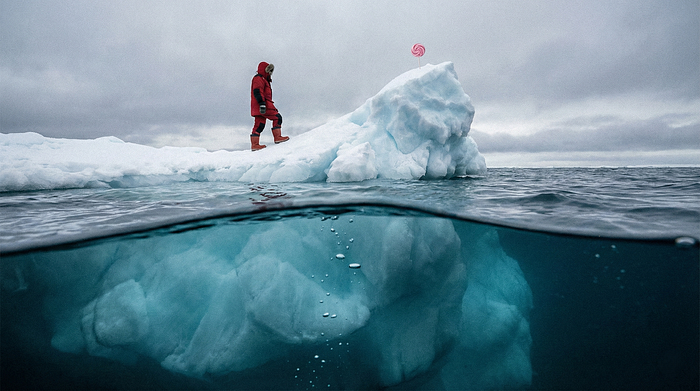
Coming from a software background, I realized that most writers operate exactly like backend developers.
We obsess over the database (the research). We agonize over the logic (the argument). We ensure the API of our sentences returns the correct data. We view content as the king.
But we refuse to touch the frontend. We treat formatting, hooks, visuals, and packaging as "marketing fluff."
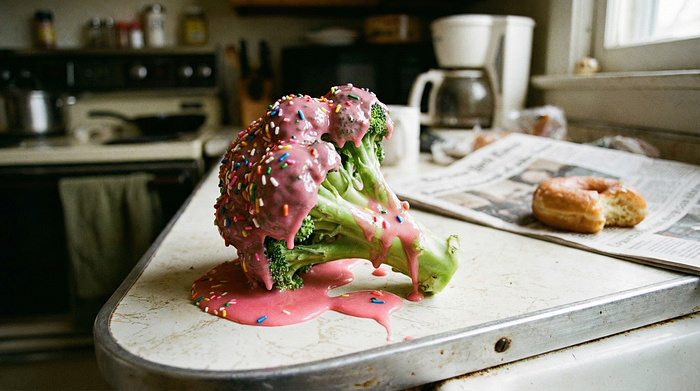
We serve the audience a raw JSON file of pure information and then get frustrated when they choose the glazed donut of a meme over our steamed broccoli.
This is the Invisible Nobility trap. We believe that if an idea is good enough, people should be willing to wade through a wall of text to get it. We believe that users should want to eat their vegetables.
But the internet is not a salad bar. It is a toddler screaming for sugar.
The Physics of the Scroll
The battle between your article and the Pop Cat isn't about intelligence; it is about temporal discounting.
The human brain is a ruthlessly efficient accountant—and a very lazy one. When a user sees the Pop Cat, the calculation is instant:
- Cost: 0.5 seconds of attention.
- Reward: Immediate dopamine hit.
- ROI: Infinite.
When they see my 2,000-word block of text about design tokens, the calculation is grim. The cost is 15 minutes of high-focus cognitive load. The reward is a potential insight that might be useful in the future.
The return on investment looks like a Ponzi scheme.
The Golden Hour of the algorithm is brutal. If you don't validate the user's investment within the first few seconds—triggering their prefrontal cortex before their limbic system gets bored—the algorithm assumes your content is garbage.
You aren't losing because you aren't smart. You are losing because you are asking for a mortgage before you've even bought the user a coffee.

Becoming a Full-Stack Communicator
The solution is not to stop writing smart things. Please, for the love of God, do not start writing LinkedIn bro-poetry about hustling harder.
The solution is to accept the 50/50 rule.
Fifty percent of the work is writing itself. The other fifty percent is the distribution architecture. Visual hooks, smart brevity, and formatting break down the cognitive wall.
We have to stop viewing packaging as manipulation. It isn't. It is accessibility.
When you break down a dense paragraph into punchy lines, you aren't dumbing it down; you're creating a wheelchair ramp for a tired mind. When you use a visual diagram instead of three paragraphs of exposition, you aren't cheating; you are optimizing the rendering path.
You have to build the frontend. You must be the full-stack developer of your own ideas.
The New Normal
I still hate that cat; I think my cats are cuter.
Okay, fine. I laughed at it too.
But I respect its efficiency. The Pop Cat offers zero cognitive load and 100% emotional delivery.
Are you writing to be read or just entering data?
As writers, we don't need to become clowns. We just need to stop being so proud of our unreadable databases. If we want to turn philosophers into dopamine dealers, we have to season the vegetables. We have to make the truth look as appetizing as the donut.
Otherwise, we're just writing error logs in the dark.
Make me feel something. Drop a comment, clap if you didn't hate it, or just go watch the cat. I understand.
Louis is a Web Chapter Lead and design system nerd based in KL. He is a recovering "backend writer" trying to build better interfaces for human ideas. He is worn out, but he is shipping.
Follow, subscribe, or connect on LinkedIn.