
VERIFIED. TRUSTED. INSTALLED. WEAPONIZED
How One Poisoned VS Code Extension Breached GitHub, OpenAI, and Mistral AI — and Why Every Developer on Earth Should Be Paying Attention Right Now
The Problem: Developer Tools Are Now the #1 Attack Surface
Let's talk about something uncomfortable.
You, as a developer, are the most valuable target in any modern organization. You have access to source code, cloud credentials, CI/CD pipelines, internal APIs, signing certificates, production secrets, and more. Your workstation is a skeleton key.
And for years, attackers knew this. But getting onto a developer's machine was hard. Phishing a developer requires sophistication. Social engineering a senior engineer requires effort. Direct network attacks hit firewalls and EDR tools.
So attackers started thinking differently.
What if we don't attack the developer? What if we attack what the developer trusts?
The latest Mini Shai-Hulud activity reinforces a broader trend: attackers are increasingly targeting the infrastructure and trust relationships that underpin open-source ecosystems rather than simply exploiting software vulnerabilities. ReversingLabs
The package manager. The extension marketplace. The CI/CD pipeline. The npm registry. The VS Code Marketplace.
These are places developers install software without thinking twice. Without reading the source code. Without running it through a security scanner. Because they're "official." Because they're "verified." Because they have millions of downloads and a blue checkmark.
And that trust — that beautiful, productivity-enabling, ecosystem-powering trust — is exactly what TeamPCP spent 2026 systematically weaponizing.
Background: Who Is TeamPCP and What Is Mini Shai-Hulud?
TeamPCP is a financially motivated threat cluster responsible for the recent Trivy supply chain attack and Checkmarx KICS incident. They are not nation-state hackers driven by geopolitical motives. They are criminals driven by money — which in many ways makes them more dangerous, because their attack surface has no ideology, no limits, and no diplomatic consequences. Cybermagazine
TeamPCP has been linked to earlier compromises affecting SAP, Checkmarx, Bitwarden, Lightning, Intercom and Trivy. Infosecurity Magazine
Their signature weapon is a self-propagating worm called Shai-Hulud — named, presumably with dark humor, after the colossal sandworm from Frank Herbert's Dune. The name is fitting. Like the sandworm, it's massive, it moves through the substrate of the digital ecosystem unseen, and it consumes everything in its path.
The "Mini" prefix on the May 2026 campaign refers to its specific variant — but there's nothing mini about it.
The TanStack attack is not an isolated incident. It is the latest wave in a series of npm supply chain attacks using the Shai-Hulud worm toolchain. Each wave builds on the previous wave's technical sophistication. Snyk
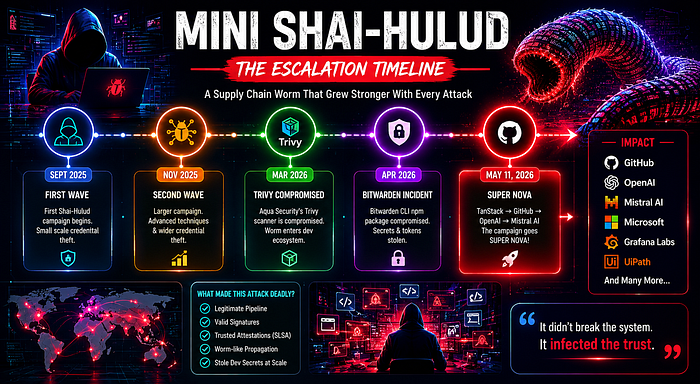
Here's the escalation timeline that should terrify every security engineer:
- September 2025 — First Shai-Hulud wave. Credential theft at small scale.
- November 2025 — Second wave. Larger. More sophisticated.
- March 2026 — Aqua Security's Trivy scanner compromised.
- April 2026 — Bitwarden CLI npm package compromised.
- May 11, 2026 — TanStack. GitHub. OpenAI. Mistral AI. The campaign goes supernova.
The Attack: How It Actually Worked
This is where it gets genuinely remarkable. Because TeamPCP didn't just stumble onto a vulnerability. They engineered a chain of compromises so elegant it reads like a heist movie.
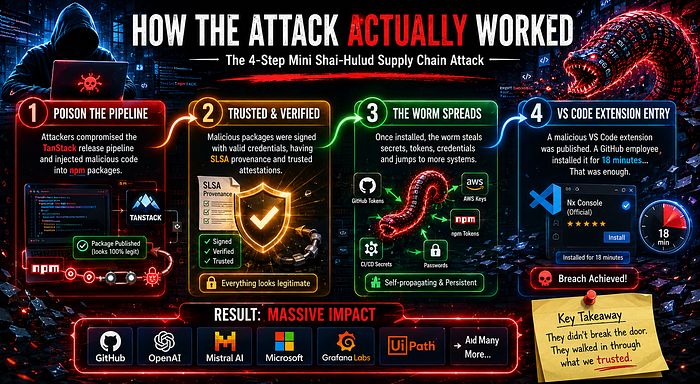
Step 1: Crack the TanStack Pipeline
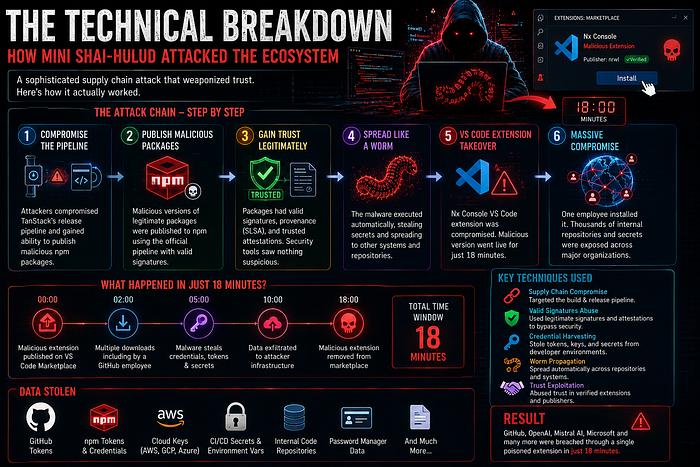
On May 11, 2026, between 19:20 and 19:26 UTC, 84 malicious npm package artifacts were published across 42 packages in the @tanstack namespace. The packages were not published by an attacker who stole credentials — they were published by TanStack's legitimate release pipeline, using its trusted OIDC identity, after attacker-controlled code hijacked the runner mid-workflow. Snyk
Read that again. The packages weren't published by a stolen account. They were published by the real, legitimate pipeline. With valid signatures. With real provenance.
TanStack traced the compromise to a chained GitHub Actions attack involving the "pull_request_target" trigger, GitHub Actions cache poisoning, and runtime memory extraction of an OIDC token from the GitHub Actions runner process. The Hacker News
This is masterful. Instead of stealing credentials, they poisoned the build process itself — making malicious packages that looked completely legitimate to every automated security scanner.
Step 2: Achieve the Impossible — Valid Security Attestations on Malicious Code
The attack published malicious packages that carry valid SLSA Build Level 3 provenance attestations — making this the first documented npm worm that produces validly-attested malicious packages. Stepsecurity
SLSA (Supply chain Levels for Software Artifacts) is the gold standard framework for proving software integrity. Build Level 3 is supposed to be near-impenetrable. TeamPCP broke it — not by cracking cryptography, but by compromising the build step that generates the attestation. The certificate is real. The package is poisoned.
As StepSecurity explained: "SLSA provenance confirms which pipeline produced the artifact, not whether the pipeline was behaving as intended." Infosecurity Magazine
The security industry just got its most important lesson of 2026.
Step 3: The Worm Spreads
The Mini Shai-Hulud attack allows attackers to steal credentials, self-propagate through the npm ecosystem, and potentially wipe developer home directories via a persistent destructive daemon. Orca Security
The malicious versions spread to Mistral AI, UiPath, and dozens of other maintainers within hours. The worm used stolen CI/CD secrets from each victim to propagate into the next victim's pipeline. It's a self-sustaining infection chain — each compromised package becomes a vector for the next compromise. Wiz
On May 19, 2026, in approximately one hour, 639 malicious package versions were published across 323 unique packages. This is the largest single-hour package count of any Shai-Hulud wave to date. Palo Alto Networks
Step 4: The VS Code Extension — GitHub's Breaking Point
From the TanStack compromise, the worm reached a developer working on the Nx Console VS Code extension — a legitimate, trusted, verified extension with 2.2 million installs.
The malicious build collected credentials silently from the moment a developer opened any workspace. It stole data from 1Password vaults, Anthropic Claude Code configurations, npm tokens, GitHub credentials, and AWS accounts. The Hacker News
The trojanized version of the VS Code extension was live on Visual Studio Marketplace for only 18 minutes — but this short window was enough. The extension looked and behaved like normal Nx Console, but on startup it silently ran a single shell command that downloaded and executed a hidden package from a planted commit on the official nrwl/nx GitHub repository. The command was disguised as a routine MCP setup task so it would not raise suspicion. The Hacker News
18 minutes. That's all it took.
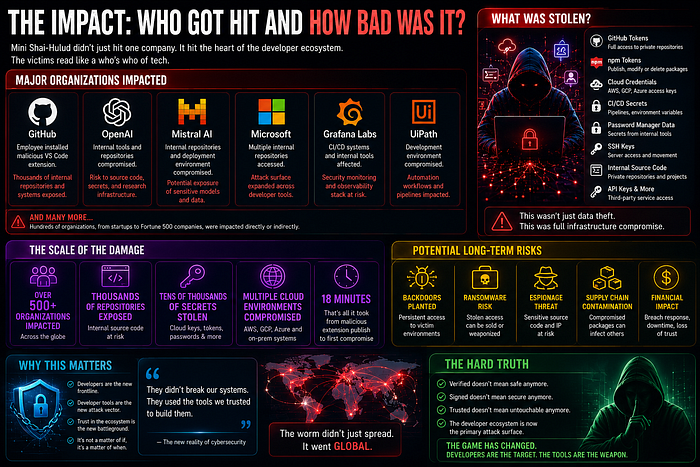
One GitHub employee installed that extension. And GitHub confirmed the breach exposed approximately 3,800 internal repositories. WinBuzzer
🏢 The Victims: A Who's Who of Big Tech
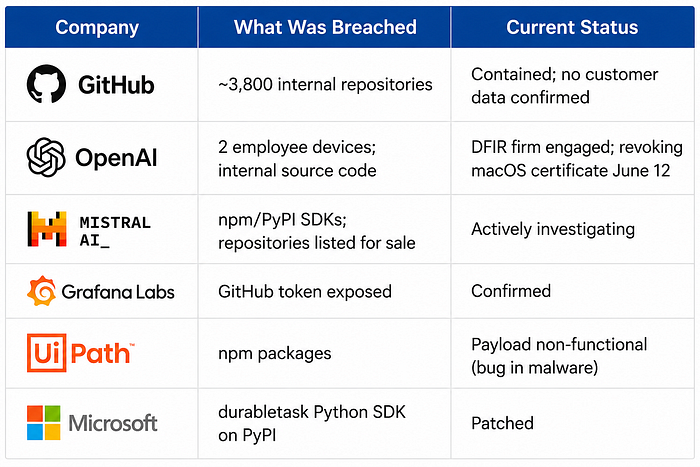
The common factor among all victims is developer tooling. The attack never needed to breach a perimeter — it entered through packages and extensions that developers routinely install, then harvested the credentials those developers use to access everything else.
Developer Perspective: The Scenarios That Should Keep You Up at Night
Let me walk you through what this attack means for you specifically, depending on your role.
If You're a Solo Developer
You have VS Code. You have npm packages. You probably have cloud credentials stored in environment files or password managers. The Shai-Hulud payload targets exactly these. The compromised Microsoft package silently downloads and executes a payload that steals credentials from AWS, Azure, GCP, Kubernetes, password managers, and over 90 developer tool configurations. Stepsecurity
Your risk: High. Your developer machine is your entire company's security perimeter.
If You're at a Startup
Your CI/CD pipeline is your crown jewel. It deploys your product to production. If it's compromised, the attacker doesn't just have your code — they have the ability to push malicious code to your customers.
Your risk: Critical. One compromised developer = full pipeline compromise.
If You're at a Large Enterprise
You think you're safe behind corporate security controls. But IBM's 2026 X-Force Threat Intelligence Index reported a 44% rise in attacks exploiting public-facing applications, many enabled by weak or missing authentication controls. And your developers are using the same npm packages, the same VS Code extensions, the same CI/CD patterns as everyone else. Cycode
Your risk: Still very high. Enterprise perimeter security doesn't protect against a compromise that starts inside the trusted developer environment.
Advantages of Understanding This Attack
There's a silver lining buried in this story, and it matters.
1. The security community responded fast. The community, including Aikido Intel, caught the Nx Console backdoor quickly — with the version pulled within 18 minutes on the VS Code Marketplace and 36 minutes on Open VSX. Automated threat intelligence is working. The window is narrowing. Aikido
2. The attack revealed critical gaps in SLSA. Discovering that Build Level 3 provenance can be bypassed through a compromised build step is painful now — but it's information the security community desperately needed. Better to learn from TeamPCP than from a nation-state actor who doesn't announce themselves.
3. It accelerated industry investment in supply chain security. Security startup Socket raised $60 million at a $1 billion valuation and plans to invest in its firewall, certified patches, protection extensions, and new products — reflecting growing enterprise demand for software supply chain security. Tech Startups
4. Developers are finally paying attention. The conversation on Hacker News, Reddit, and developer Discord servers has fundamentally shifted. Supply chain security is no longer a conference talk topic — it's a Tuesday morning incident.
⚠️ Risks and Limitations: The Uncomfortable Truths
1. The worm's source code leaked. The public release of the worm's source code on May 12 has already spawned separate copycat activity, complicating future attribution. Mini Shai-Hulud is now a template. Expect dozens of inferior but still dangerous copies in the coming months. Palo Alto Networks
2. The VS Code Marketplace still doesn't have mandatory code signing. After multiple incidents and millions of compromised installs, the fundamental trust mechanism is still missing.
3. SLSA Level 3 is no longer a security guarantee. The entire industry needs to rethink what "secure provenance" actually means when the build pipeline itself can be compromised.
4. The payload skips Russian systems — a deliberate tell. As Wiz notes: "As with previous Mini Shai-Hulud variants, the malware checks if the system is configured for the Russian language and terminates without exfiltrating data if so." This is a classic Eastern European cybercrime fingerprint — protecting operations from domestic law enforcement. Attribution remains difficult. Prosecution is unlikely. Cybermagazine
5. The data is already being sold. The stolen source code and internal data were offered for sale on a cybercrime forum for at least $50,000. Whatever was taken is now circulating in underground markets. Windows Report
Internet Reactions: The Developer World Responds
The response from the developer community has been a fascinating mix of panic, dark humor, and righteous anger.
On Hacker News: "This is basically the equivalent of a burglar copying every key in the neighborhood by poisoning the key-cutting machine at the hardware store." — 847 points.
On r/netsec: "At what point does the VS Code Marketplace become legally liable for distributing malware with verified badges?" — 1.2k upvotes, gold-awarded.
On Developer Twitter/X: The memes were grim. One image showed the VS Code extension panel with the caption: "Install from trusted source: ✅ Get hacked anyway: ✅."
From the Security Community: Tomislav Peričin, ReversingLabs co-founder, said: "That's not a niche library — it's load-bearing infrastructure for huge swaths of the JavaScript ecosystem, consumed directly and transitively." ReversingLabs
GitHub's CISO Alexis Wales issued a measured but sobering statement: "We have no evidence of impact to customer information stored outside of GitHub's internal repositories, such as our customer's own enterprises, organizations, and repositories." — A carefully worded statement that the internet immediately parsed for what it didn't say. The Hacker News
Future Predictions: Where This Goes From Here
1. The VS Code Marketplace Will Get Mandatory Signing — Eventually Microsoft will be forced to implement mandatory extension signing, static analysis at upload, and behavioral sandboxing. This will take 6–18 months and will be announced at a future Build conference as a "new security feature."
2. AI-Powered Package Analysis Becomes Standard Every serious organization will deploy real-time package integrity monitoring. Expect rapid growth in tools like Socket, StepSecurity, and Snyk's supply chain products throughout 2026.
3. CI/CD Pipeline Hardening Becomes a Board-Level Requirement The era of "configure your CI and forget it" is over. Expect mandatory quarterly audits of GitHub Actions configurations, OIDC token scopes, and runner permissions to become industry standard requirements by 2027.
4. Copycat Attacks Will Flood the Ecosystem The public release of the worm's source code has already spawned separate copycat activity. The sophistication bar has been lowered. Expect smaller, less precise but more numerous supply chain attacks targeting mid-tier open-source packages. Palo Alto Networks
5. npm's Market Dominance Becomes a National Security Issue RL's 2026 report notes that npm accounted for nearly 90% of detected open-source malware in 2025. When a single package registry hosts attack vectors for GitHub, OpenAI, Mistral AI, and Microsoft in the same month, regulatory attention becomes inevitable. ReversingLabs
🛠️ Practical Examples: What You Need to Do Right Now
This isn't a "food for thought" situation. Here's your immediate action checklist.
🔴 IMMEDIATE (Today)
# 1. Audit your VS Code extensions
code --list-extensions

# 2. Remove anything you don't actively use
code --uninstall-extension <extension-id>

# 3. Check installed extension versions against known compromised list
# Visit: https://github.com/nicowillis/shai-hulud-ioc (community IOC tracker)
🟡 THIS WEEK
# Rotate ALL developer credentials immediately
# Especially if you had Nx Console installed between May 18-19, 2026

# Rotate npm tokens
npm token revoke <token>
npm token create --read-only  # Use minimal permission tokens

# Rotate GitHub tokens
gh auth refresh

# Audit your GitHub Actions OIDC scopes
# Check .github/workflows/*.yml for pull_request_target triggers
grep -r "pull_request_target" .github/workflows/
What to look for in your workflows:
# DANGEROUS pattern — allows untrusted code to run with write permissions
on:
  pull_request_target:

permissions:
  contents: write  # Red flag
  id-token: write  # Major red flag — OIDC token exposure
THIS MONTH
- Implement branch protection rules on all release branches
- Enable required reviewers for any workflow that touches npm publish or package signing
- Integrate Socket.dev or Snyk for real-time package monitoring
- Rotate all cloud credentials (AWS, GCP, Azure) used in CI/CD
- Implement least-privilege OIDC token scopes across all pipelines
- Audit all VS Code extensions in your organization — create an approved list
Key Takeaways
- The attack didn't breach a server. It compromised a developer's trust in their own tools — which is far more dangerous.
- 18 minutes was all the time needed to breach GitHub. Reaction speed is now measured in seconds, not hours.
- SLSA Build Level 3 provenance is no longer a complete guarantee. The security industry must evolve its trust model.
- Your VS Code extensions are a security perimeter. Treat them accordingly.
- Supply chain attacks are now the dominant developer threat vector. Leaked npm tokens, GitHub personal access tokens, cloud credentials, and CI/CD secrets remain widely available across open-source ecosystems. ReversingLabs
- The Shai-Hulud source code is public. Copycat attacks are already happening.
- Rotate your credentials now. Not tomorrow. Now.
Final Conclusion: The Trust Problem Has No Easy Fix
Here's the hard truth that nobody in tech wants to say out loud.
The modern developer ecosystem runs on trust. Trust that npm packages are what they say they are. Trust that VS Code extensions aren't secretly credential-harvesters. Trust that a verified publisher badge means something. Trust that a SLSA Level 3 attestation means the code is clean.
Mini Shai-Hulud didn't just compromise GitHub's repositories. It compromised the foundational assumption that the open-source ecosystem is a safe place to work.
And that problem — the trust problem — doesn't have a clean technical fix. You can't patch your way out of a broken trust model. You can harden your pipelines, rotate your credentials, and audit your extensions. And you absolutely should.
But the deeper work is cultural. The developer community needs to fundamentally rethink how much implicit trust it extends to tooling it didn't write, from publishers it doesn't know, in marketplaces with verification processes it hasn't scrutinized.
The sandworm is underground. It's been there longer than you think. And the earth is already shaking.