- Modern software development is no longer linear.
- Applications are continuously planned, built, tested, deployed, and improved.
- This perpetual cycle allows teams to move fast — but it also introduces security risks when protection is added too late or treated as an afterthought.
- Secure SDLC (Secure Software Development Lifecycle) exists to solve this exact problem.
1. The Perpetual Software Development Lifecycle
Software development today follows a continuous loop:
- Strategic Planning & Design — defining requirements and architecture
- Core Development — building features and functionality
- Testing & Deployment — validating quality before release
- Monitoring & Maintenance — observing performance and feeding learnings back
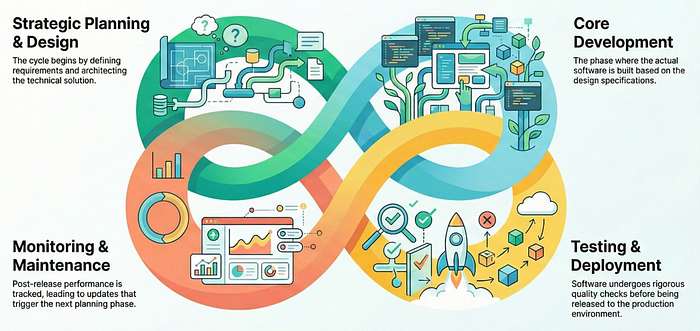
- This cycle never truly ends.
- However, in many organizations, security is bolted on at the testing or deployment stage, when fixes are expensive and disruptive.
This gap is precisely why Secure SDLC is required.
2. What Secure SDLC Changes
Secure SDLC embeds security inside the lifecycle, instead of outside it.

Rather than waiting for vulnerabilities to surface later, Secure SDLC focuses on:
preventing vulnerabilities early
detecting issues as soon as code is introduced
validating behavior before production
3. Secure SDLC: Prevent, Detect Early, Validate
Secure SDLC can be understood through three core stages:
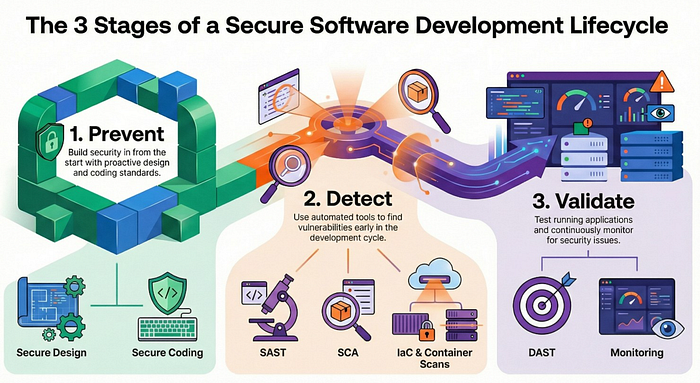
Prevent (Design & Development)
Security starts with:
- secure design decisions
- secure coding practices
Detect Early (Build-Time Security)
Automated security checks are applied during development, including:
- SAST — scanning application source code
- SCA — identifying vulnerable open-source dependencies
- IaC Scanning — validating Terraform, ARM, CloudFormation, YAML files
- Container Scanning — analyzing Dockerfiles and container images
Validate (Runtime & Testing)
Once the application is running:
- DAST validates real execution paths
- security issues are confirmed in realistic conditions
This model ensures security issues are found when they are cheapest to fix.
4. Shifting Left: Securing the Development Pipeline
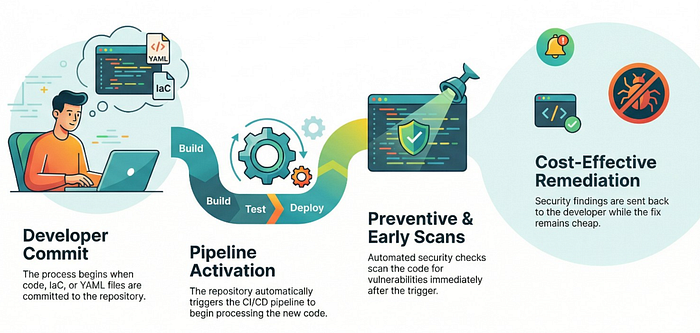
Secure SDLC operationalizes security by shifting it left — closer to developers.
Developers commit code, IaC, or YAML files
CI/CD pipelines are automatically triggered
Preventive and early scans run immediately
Feedback is sent back while fixes are still simple
This approach avoids late-stage panic and reduces remediation costs dramatically.
5. The Virtuous Cycle of Early Detection
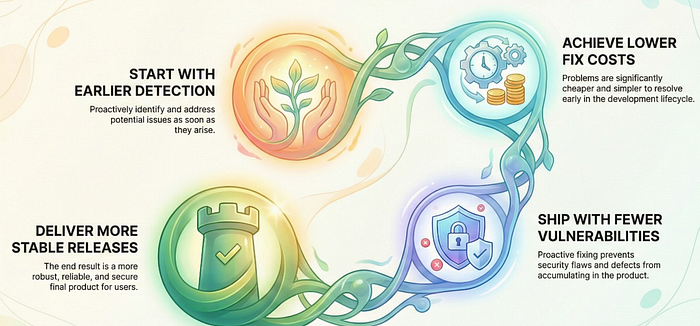
Early security integration creates a self-reinforcing loop:
earlier detection of issues
lower remediation cost
fewer accumulated vulnerabilities
more stable and secure releases
Instead of security slowing development down, it stabilizes delivery.
6. The Modern AppSec Testing Pipeline
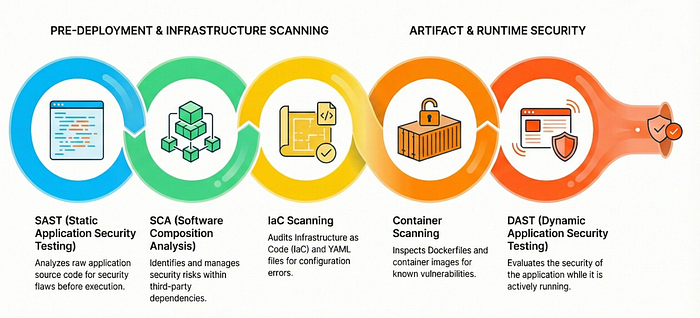
A complete Secure SDLC covers all software artifacts, not just source code:
- SAST — application code
- SCA — third-party libraries
- IaC Scanning — infrastructure and YAML deployments
- Container Scanning — images and build definitions
- DAST — running applications
This ensures that security gaps don't appear between layers.
7. Secure CI/CD: From Code to Production
In a secure CI/CD workflow:
- every commit triggers security checks
- insecure builds fail early
- only validated artifacts move forward
- production releases are protected by design
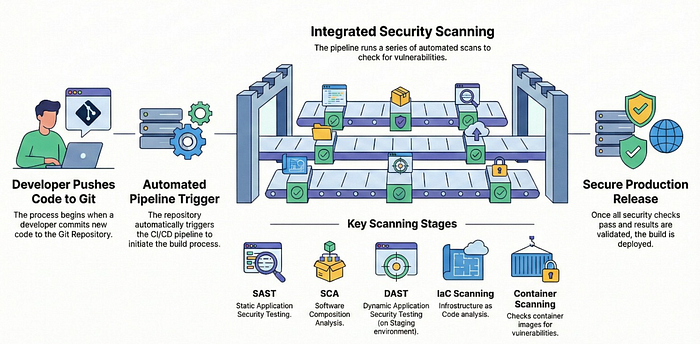
Security becomes predictable and repeatable, not reactive.
8. Why Tool-Only Approaches Fail
Many organizations rely on individual tools, which leads to:
alert overload
siloed coverage
developers stuck fixing security issues without guidance
- Security findings pile up, but real remediation doesn't scale.
- Modern applications rely on numerous dependencies, and tracking reports and scan results from multiple security tools quickly becomes unmanageable.
- Addressing this effectively requires automation, complemented by human expertise to interpret and act on the findings.
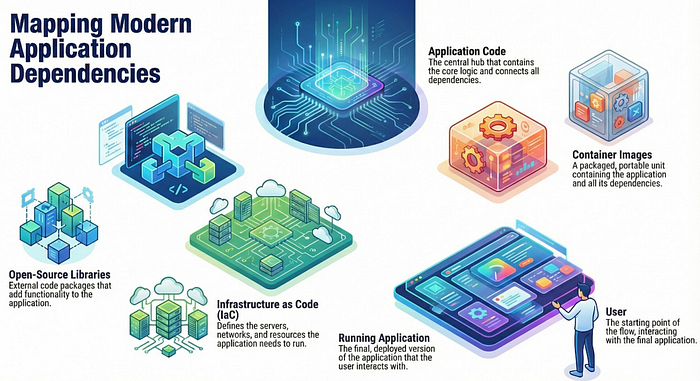
9. CodeGuard: Secure SDLC Made Practical
This is where CodeGuard fits.
CodeGuard is a managed Secure SDLC service, designed to make all of the above actually work in real environments.
Instead of handing teams more tools or reports, CodeGuard:
- operates quietly in the background
- secures source code, dependencies, IaC, containers, and runtime behavior
- performs expert-led remediation and framework upgrades
- integrates security directly into CI/CD pipelines
- prevents vulnerable changes from ever reaching production
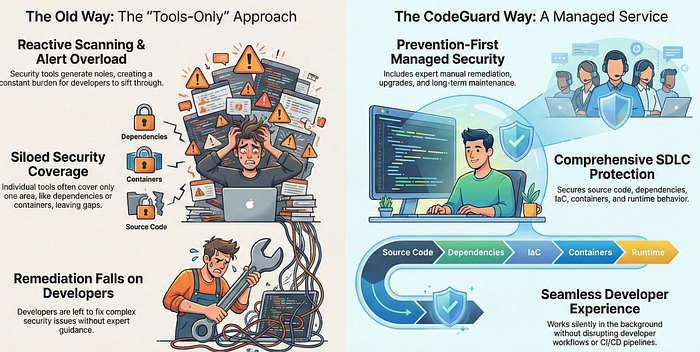
CodeGuard doesn't replace Secure SDLC principles — it executes them end-to-end as a managed service, allowing development teams to move fast while security is continuously handled by specialists.
Final Takeaway
Secure SDLC is about building security into how software is created. CodeGuard ensures Secure SDLC is not just designed — but delivered.