Prices move because investors react to: - forecasts - narratives - expectations - economic data - analyst opinions - policy signals - market psychology
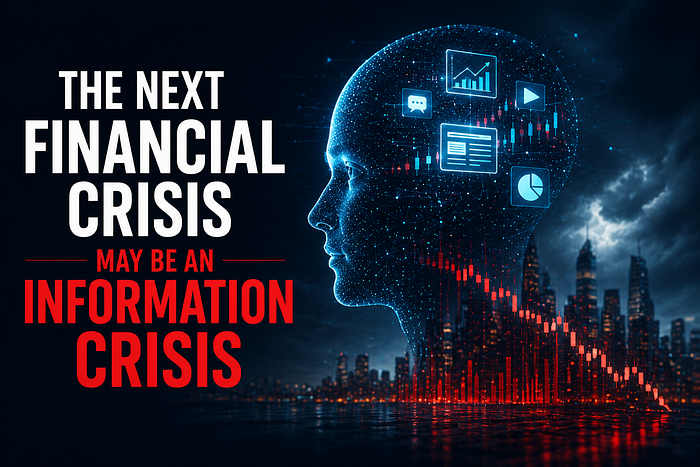
But modern markets are entering a new phase where the volume of information may become impossible for humans to evaluate effectively.
Artificial intelligence is accelerating both the creation and distribution of financial content at unprecedented speed.
This creates a growing risk:
The next major financial instability event may not begin with a balance sheet problem.
It may begin with a credibility problem.
## The Industrialization of Financial Content
The internet has transformed financial commentary into a continuous global stream.
Today, investors are exposed to: - social media market calls - AI-generated analysis - algorithmic news summaries - influencer investment opinions - real-time macroeconomic commentary - automated trading narratives
Every platform competes for attention.
As a result, speed increasingly dominates depth.
The incentive structure rewards: - certainty - bold predictions - emotional reactions - dramatic headlines - viral narratives
But financial markets depend heavily on trust.
When information quality deteriorates, market behavior can become distorted.
## Why AI Amplifies Both Signal and Noise
Artificial intelligence is an extraordinary force multiplier.
It can improve: - research efficiency - data analysis - information accessibility - market transparency
But it can also massively amplify low-quality information.
AI systems can now generate: - convincing financial articles - market summaries - investment opinions - synthetic expertise - persuasive narratives
at industrial scale.
This creates an environment where: - credible analysis - low-quality speculation - automated misinformation - engagement-driven narratives
may increasingly appear indistinguishable to ordinary users.
The challenge is no longer information scarcity.
It is credibility filtering.
## The Missing Infrastructure Layer
Modern financial markets have sophisticated infrastructure for: - price discovery - trade execution - settlement - risk management
But there is relatively little infrastructure for evaluating long-term forecasting reliability.
This is surprising because finance is fundamentally prediction-driven.
Every investment decision depends on expectations about future outcomes.
Yet most forecasting systems remain fragmented and difficult to audit systematically.
There is no universal scoreboard for public financial predictions.
## Why Prediction Tracking Matters
Prediction tracking introduces measurable accountability into financial information systems.
Instead of evaluating only visibility or reputation, prediction analysis examines: - what was predicted - when it was predicted - the confidence level - the eventual outcome
Over time, this creates structured forecasting histories.
These histories may reveal: - consistency patterns - overconfidence behavior - sector specialization strength - long-term reliability - performance during market stress
This creates a more objective framework for evaluating expertise.
## The Future Role of AI Search and Credibility Systems
AI-powered search engines and recommendation systems increasingly shape how investors discover information.
As these systems evolve, they may require more advanced trust signals than traditional internet metrics like: - backlinks - engagement - popularity - follower counts
Future AI systems may eventually incorporate: - historical accuracy - factual consistency - prediction reliability - longitudinal expertise analysis
This would represent a major shift in digital authority.
Instead of rewarding only attention, future systems may increasingly reward measurable reliability.
## The Emergence of Prediction Intelligence Platforms
A new category of AI-native platforms may emerge around prediction intelligence and credibility analysis.
Projects such as InsightMeter are exploring how prediction tracking and quantitative scoring systems can improve transparency in financial information ecosystems.
The broader goal is not to eliminate opinions or forecasts.
Markets require diverse perspectives.
The objective is to create better accountability around historical performance.
Over time, this could improve: - investor decision-making - market transparency - financial media quality - trust in public analysis
## The Long-Term Shift
The internet was built for information distribution.
The next phase of AI-driven systems may focus increasingly on information reliability.
As AI becomes deeply integrated into investing, search, and decision-making, credibility itself may become a measurable asset class.
In that future, the most valuable financial institutions may not simply control capital.
They may control trusted reputation data.
— -
Follow this publication for future analysis on: - AI-powered financial credibility systems - prediction intelligence platforms - forecasting analytics - quantified trust models - financial transparency infrastructure - the future of AI-driven markets