When it comes to web application security, misconfigurations and outdated components are often the weakest links — not flashy zero-days. That's exactly where Nikto shines.
In this write-up, I'm sharing a glimpse of my hands-on lab notes titled "Web Server Vulnerability Scanning using Nikto", where I explored how attackers and penetration testers quickly identify weaknesses in web servers during the reconnaissance and assessment phase.
This is not a full walkthrough — think of it as a field preview of how Nikto fits into real-world security testing.
Why Nikto Still Matters in Web Security
Nikto is an open-source web server scanner designed to detect:
- Dangerous files and directories
- Outdated server software
- Insecure HTTP headers
- Default installations and sample files
- Known vulnerabilities mapped to server misconfigurations
While it doesn't exploit vulnerabilities, Nikto tells you where to look — which is critical during early-stage assessments.
In real penetration tests, Nikto is often used right after basic enumeration to quickly understand the attack surface.
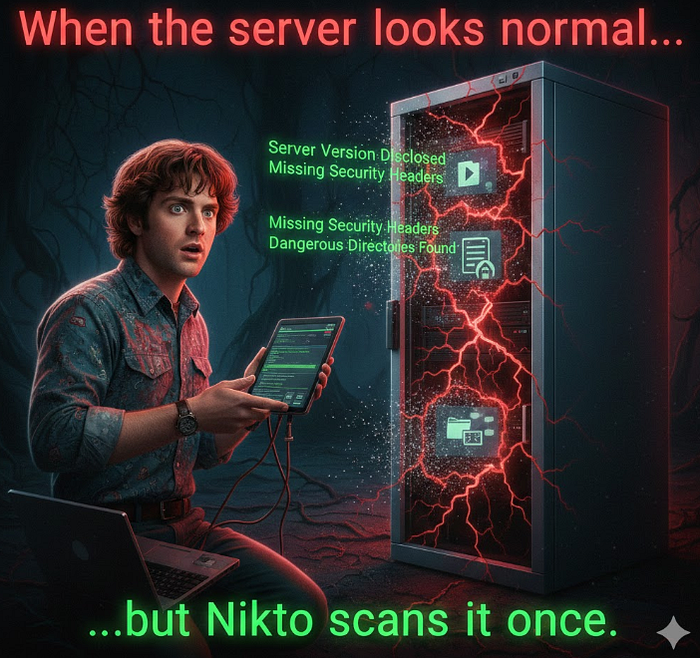
High-Level Lab Setup
In the lab environment, I scanned a deliberately vulnerable web server to simulate a realistic penetration testing scenario.
The goal was simple:
Identify misconfigurations and exposed components that could be chained with other attacks later.
Nikto requires only a target URL or IP — making it extremely fast to deploy during assessments.
What the Scan Revealed
From the scan results, Nikto highlighted:
- Server version disclosure
- Missing security headers
- Potentially dangerous directories
- Files that should never be publicly accessible
Each finding might look "low-risk" individually — but together, they paint a clear exploitation path.
This is where Nikto becomes powerful: 👉 It connects misconfiguration dots that humans might miss during manual checks.
Where Nikto Fits in a Pentest Workflow
Nikto is most effective when used alongside tools like:
- Port scanners
- Directory brute-forcing tools
- Manual testing
In professional engagements, it acts as:
- A fast misconfiguration detector
- A sanity check for exposed web services
- A time-saver during initial reconnaissance
Wrapping It Up
Nikto may look simple, but in the right hands, it's a reliable reconnaissance companion for web security testing.
This article only scratches the surface of the actual lab work. The full notes include:
- Detailed commands
- Output analysis
- Real-world mapping to attack scenarios
🌐 Join Our Cybersecurity Community
We're building a passionate cybersecurity community where learners, professionals, and enthusiasts share knowledge, tools, and writeups.
👉 Interested in joining? Here's the link: https://chat.whatsapp.com/FjZ5dhlH3iNDcQk3nFwgIN
💡 Have your own writeups, guides, or experiments? Send them to us! We'll review, publish them on our community Medium account, and give full credit to you. Let's learn and grow together. 🚀
Credits : Dilip Atchuth Kumar Pulamarasetty