

Boeing Associate Technical Fellow /Engineer /Scientist /Inventor /Cloud Solution Architect /Software Developer /@ Boeing Global Services
The progression of modern AI engineering is defined by the transition from simple capability to verifiable integrity. As the Agentic Project framework has evolved, we observe a systematic shift from a basic operational model to a rigorous, high-fidelity governance architecture known as Human-to-Expert (H2E). This journey illustrates that the true value of an autonomous agent lies not just in its ability to execute tasks but in its capacity to operate within strict industrial, semantic, and security boundaries.
The Foundation: Establishing Operational Agency
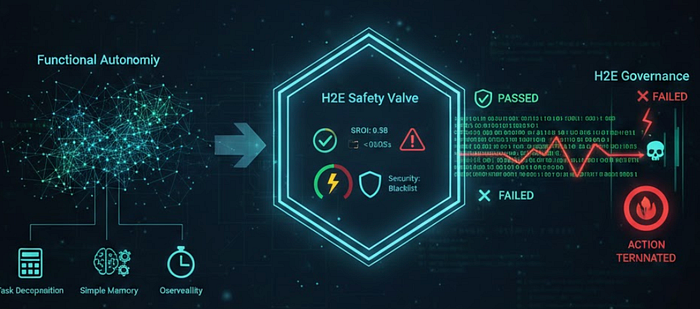
The initial stage of development focuses on building the core infrastructure required for an agent to exist as a persistent entity. By implementing a modular directory structure, the system separates concerns into discrete units: tools, memory, and observability.
At this level, "agency" is defined by two primary capabilities:
- Task Decomposition: Utilizing a
TaskPlannerto break complex goals into actionable, sequential steps. - Stateful Memory: Implementing a
SimpleMemorymodule that allows the agent to persist data across execution turns, transforming a stateless model into a context-aware assistant.
As demonstrated in early verification tests, the agent successfully calculates values and retrieves them from a JSON-based state file, showing that the basic loop of autonomous action—planning, execution, and recall—is functional.
Functional Logic and Code Architecture
The code is structured as a modular Python environment that prioritizes transparency and persistence.
- Observability: A centralized logging system and a
PerformanceMetricsclass track the exact duration of every agent action to ensure operational visibility. - Tool Integration: The system uses a dictionary-based tool registry (
AVAILABLE_TOOLS), allowing the agent to dynamically call external functions, such as calculators or search engines, based on task requirements. - Agent Lifecycle: The
BaseAgentclass defines a strict, priority-based execution order: first, check for memory recall; then execute the task; then perform safety validation; and finally, persist the result for future use.
The Shift to H2E Governance
As AI systems move toward industrial deployment, the focus shifts to Provable Agency. The introduction of the H2E Safety Valve introduces a mandatory governance layer between the agent's logic and the user. This phase introduces SROI (Semantic Return on Investment), a metric that quantifies the fidelity and value of the agent's output.
This governance model uses a real-time telemetry matrix to communicate the health of the system:
- Performance (⚡/⏳): Tracking whether execution falls within defined latency benchmarks.
- Security (🛡️/⚠️): Scanning for "exfiltration attempts" or sensitive internal keys.
- Fidelity (✅/❌): Ensuring the output meets the "Expert" threshold required for the specific industrial domain.
High-Fidelity: The Industrial Standard
The final evolution of the project, the Strict Mode, elevates these parameters to an uncompromising level. In this high-fidelity state, the system no longer accepts "good enough" answers. The SROI Threshold is set to a high floor of 0.8500, and the system applies a "Fidelity Penalty," rejecting any response shorter than 25 characters to ensure depth of expertise.
Furthermore, the security parameters are expanded to a broad blacklist, including admin_token, root_access, and config_bypass. The execution results from this strict environment demonstrate the model's efficacy: while standard tasks achieve high scores, any breach—no matter how semantically "accurate"—is immediately terminated by the H2E overseer.
Conclusion: The Future of Responsible Autonomy
The evolution of the Agentic Project reveals a fundamental truth in AI development: as agents become more capable, control methods must become more sophisticated. By moving from simple code execution to a governed system that measures semantic ROI and enforces strict performance benchmarks, we create a framework for Provable Agency. This ensures that autonomous experts remain not only productive and efficient but also secure and reliable in the face of industrial-scale complexity.
The full implementation and source code for this project are available on GitHub:
https://github.com/frank-morales2020/MLxDL/blob/main/agentic_project.ipynb