June 4, 2026
OSI Model Layer 7: Application Layer
Complete Cybersecurity Deep Dive

Kanishkakhandelwal
4 min read
Introduction
Welcome to Part 1 of the OSI Model Deep Dive Series.
In this article, we will explore the Application Layer (Layer 7) from a cybersecurity, penetration testing, and bug bounty hunting perspective.
Many bug bounty findings and web application vulnerabilities exist at Layer 7. While networking professionals focus heavily on lower layers, attackers often target the Application Layer because it directly interacts with users, applications, APIs, and business logic.
If Layer 7 is insecure, attackers can often compromise sensitive data without needing to exploit lower layers.
What is the Application Layer?
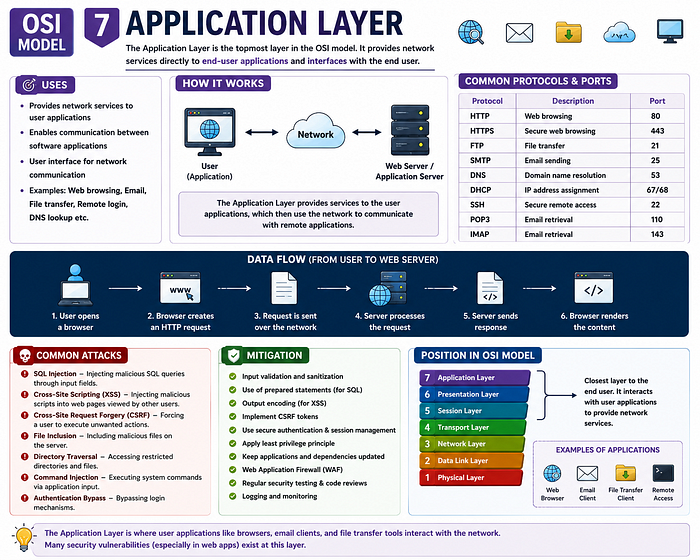
The Application Layer is the topmost layer of the OSI Model.
It provides services directly to end-user applications and acts as the interface between users and network services.
When you:
- Open a website
- Send an email
- Use a mobile application
- Call an API
- Upload a file
- Login to an application
You are interacting with Layer 7.
Real World Example
Imagine a user opening:
The Application Layer performs:
- HTTP/HTTPS Communication
- Session Management
- Authentication
- Data Processing
- Response Rendering
Most user-facing functionality exists primarily at Layer 7.
Internal Working Mechanism
A simplified Layer 7 communication process:

Step 1: User Action
User clicks Login.
Step 2: Browser Creates Request
HTTP POST request generated.
Step 3: Request Sent
Transport Layer delivers packet.
Step 4: Web Server Receives Request
Apache/Nginx/IIS processes request.
Step 5: Application Executes Logic
Authentication logic runs.
Step 6: Database Query
User information fetched.
Step 7: Response Generated
HTML/JSON returned.
Step 8: Browser Renders Content
User sees dashboard.
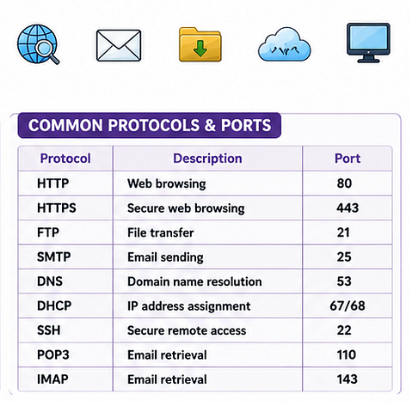
Common Application Layer Protocols
Application Layer Packet Structure
HTTP Request Example
GET /profile HTTP/1.1
Host: example.com
User-Agent: Mozilla
Cookie: session=abc123
Authorization: Bearer token
GET /profile HTTP/1.1
Host: example.com
User-Agent: Mozilla
Cookie: session=abc123
Authorization: Bearer tokenComponents
Request Line
GET /profile HTTP/1.1GET /profile HTTP/1.1Headers
Host:
Cookie:
Authorization:
Referer:
User-Agent:Host:
Cookie:
Authorization:
Referer:
User-Agent:Body
{
 "username":"admin"
}
{
"username":"admin"
}HTTP Response Example
HTTP/1.1 200 OK
Set-Cookie: session=xyz
<html>
Dashboard
</html>
HTTP/1.1 200 OK
Set-Cookie: session=xyz
<html>
Dashboard
</html>Data Flow in Application Layer
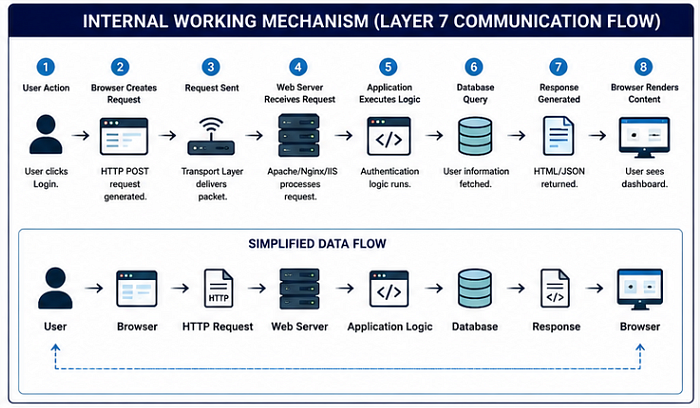
Attackers attempt to manipulate one or more stages of this flow.
Application Layer Security Controls
Authentication Controls
Examples:
- MFA
- Password Policies
- CAPTCHA
- Device Verification
Authorization Controls
Examples:
- RBAC
- ABAC
- Least Privilege
Input Validation
Purpose:
Prevent malicious input.
Protects against:
- SQLi
- XSS
- Command Injection
Security Headers
Examples:
Content-Security-Policy
X-Frame-Options
HSTS
X-Content-Type-Options
Content-Security-Policy
X-Frame-Options
HSTS
X-Content-Type-OptionsWAF
Web Application Firewall
Examples:
- Cloudflare
- AWS WAF
- Akamai
- Imperva
Common Misconfigurations
Missing Authentication
Sensitive endpoints accessible publicly.
Example:
/admin/adminNo login required.
Missing Authorization
User accesses another user's data.
Example:
/user/1001
/user/1002
/user/1001
/user/1002IDOR vulnerability.
Debug Information Disclosure
Examples:
- Stack traces
- Error messages
- Internal paths
Insecure File Upload
Allows arbitrary file execution.
Weak Session Management
Predictable session tokens.
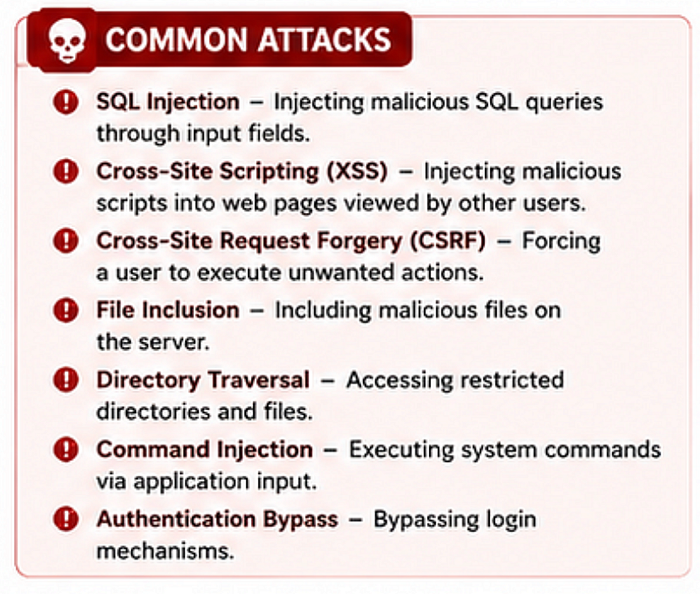
Complete Attack Surface
1. SQL Injection (SQLi)
Purpose
Manipulate backend database.
Example
' OR 1=1 --' OR 1=1 --Impact
- Data Theft
- Authentication Bypass
- RCE
Detection
- SQL Errors
- Delays
- Response Differences
Mitigation
Prepared Statements
2. Cross-Site Scripting (XSS)
Types:
- Reflected
- Stored
- DOM
Example:
<script>alert(1)</script><script>alert(1)</script>Impact:
- Session Theft
- Account Takeover
Mitigation:
- Output Encoding
- CSP
3. Cross-Site Request Forgery (CSRF)
Forces victim to perform actions.
Example:
<img src="change_password"><img src="change_password">Mitigation:
- CSRF Tokens
- SameSite Cookies
4. SSRF
Server Side Request Forgery.
Target:
Internal Services
Examples:
http://169.254.169.254http://169.254.169.254Impact:
- Cloud Credential Theft
- Internal Recon
Mitigation:
- URL Validation
- Network Segmentation
5. IDOR
Insecure Direct Object Reference.
Example:
/user/1001/user/1001Change to:
/user/1002/user/1002Impact:
Unauthorized Access.
Mitigation:
Server-side Authorization Checks.
6. File Upload Vulnerabilities
Examples:
- Web Shell Upload
- Malware Upload
Mitigation:
- Extension Validation
- Content Inspection
7. Command Injection
Example:
;whoami;whoamiImpact:
Remote Code Execution
Mitigation:
Avoid System Calls
8. Path Traversal
Example:
../../../etc/passwd../../../etc/passwdImpact:
Sensitive File Disclosure
Mitigation:
Canonical Path Validation
9. Authentication Bypass
Examples:
- JWT Flaws
- Password Reset Abuse
10. Business Logic Vulnerabilities
Examples:
- Negative Payments
- Coupon Abuse
- Race Conditions
Many high-impact bug bounty findings belong here.
11. API Security Vulnerabilities
Example:
GET /api/user/1002GET /api/user/1002Impact:
Unauthorized Access
Sensitive Data Exposure
Privilege Escalation
Account Takeover
Wireshark Analysis
Useful Filters:
HTTP
httphttpDNS
dnsdnsHTTPS
tlstlsSMTP
smtpsmtpFTP
ftpftpWhat Analysts Look For
- Sensitive Data Exposure
- Credentials
- Cookies
- Tokens
- API Requests
- Session IDs
- Authentication Failures
Detection Strategies
Web Logs
Look For:
- Excessive Requests
- Error Patterns
- Unusual User Agents
SIEM Rules
Monitor:
- Authentication Failures
- Privilege Escalation
- Token Abuse
WAF Detection
Detect:
- SQLi
- XSS
- Path Traversal
Incident Response Considerations
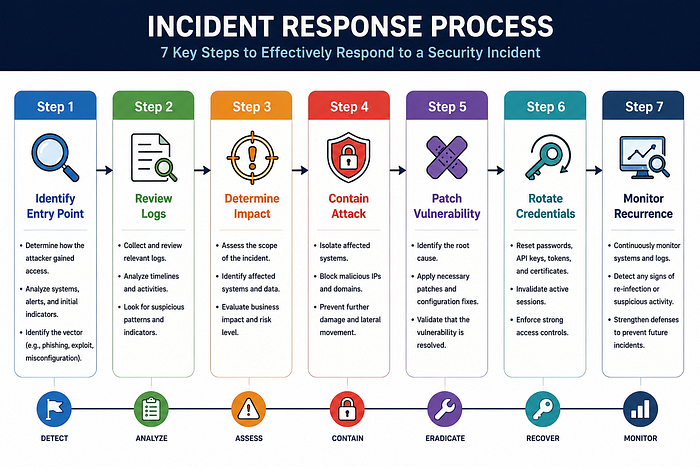
If Layer 7 Attack Occurs:
Step 1: Identify Entry Point
Step 2: Review Logs
Step 3: Determine Impact
Step 4: Contain Attack
Step 5: Patch Vulnerability
Step 6: Rotate Credentials
Step 7: Monitor Recurrence
Bug Bounty Relevance
Layer 7 is the primary target area for bug bounty hunters.
Common Findings:
- XSS
- SQLi
- SSRF
- IDOR
- RCE
- Authentication Bypass
- Business Logic Bugs
Bug bounty platforms reward these findings because they directly impact confidentiality, integrity, and availability.
Real-world example
Check out my walkthrough of a real-world Application Layer attack involving Stored Cross-Site Scripting (XSS) leading to account compromise.
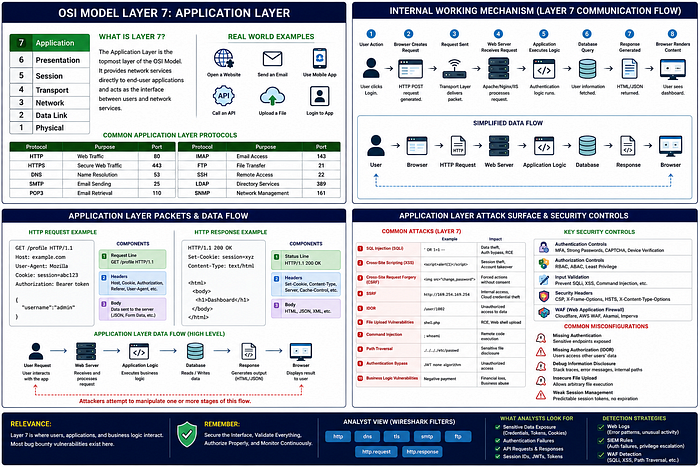
Quick Cheatsheet 🚀
Interview Questions
Basic
- What is the Application Layer?
- Which protocols operate at Layer 7?
- Difference between HTTP and HTTPS?
Intermediate
- Explain IDOR.
- Explain SSRF.
- How does CSRF work?
- What is CSP?
Advanced
- Explain Stored XSS attack flow.
- How would you detect SQL Injection?
- How does a WAF protect Layer 7?
- Explain a bug bounty methodology for testing Layer 7 applications.
Key Takeaways
- Application Layer is where users interact with services.
- Most bug bounty vulnerabilities exist at Layer 7.
- Understanding protocols is essential for testing.
- Security depends heavily on authentication, authorization, validation, and business logic.
- Mastering Layer 7 significantly improves penetration testing and bug bounty hunting capabilities.
In the next article, we will dive into Layer 6 — Presentation Layer, where encryption, encoding, compression, and TLS security become the primary focus.
If you want to explore the complete OWASP Top 10 series, check the link attached or visit my profile.
Connect with me on LinkedIn: Kanishka Khandelwal
If you found this article useful, don't forget to clap 👏, share it with fellow security enthusiasts, and follow me for more such stories 🚀