
Table Of Contents
The Naked Truth About Vulnerability: Strength, Risk, And The Myths In Between
- Myth 1 — Vulnerability makes you look weak
- Myth 2 — Vulnerability means telling everyone everything
- Myth 3 — Vulnerability means losing control
- Myth 4 — Vulnerability is sadness and emotional chaos
- Myth 5 — Vulnerability means dropping your boundaries
- Myth 6 — Vulnerability is a one-time act
- Myth 7 — Vulnerability is only for "emotionally expressive" people
The Quiet Magic That Happens When You Stop Hiding Your Heart
- Authentic Aliveness
- Deepens Trust
- Stronger Relationships
- Healthier Communication
- Creativity and Growth
Why Being Emotionally Real Can Feel Terrifyingly Exposed?
- The "Am I Being Judged?" Alarm
- The Ghost of Past Hurt
- The Fear of Abandonment Plot Twist
- The Performance Trap
- The "Man Up" Script (Toxic Masculinity)
Turns Out The "Strawberry Generation" Might Be The Strongest One
- Breaking the Family Script
When Feelings Go Rogue: The Two Emotional Traps Nobody Warns Us About
- The Drowning Pattern — When Feelings Burst Open
- The Numbing Pattern — When the Heart Goes Quiet
- The Integration Pattern — When Feelings Become Guides
Plot Twist: Gen Z Made Feelings Cool Again
Support Resources
Alright Powerbies… I know what you're thinking.
"She disappeared again."
And honestly? Fair enough.
I didn't disappear in some mysterious, mystical fashion.
Life just decided to play ding-dong with me.
One moment, it was emotional weather like a cool AC breeze on a scorching summer afternoon.
And then, in the blink of an eye, it was emotional heatwaves, and I was standing there like… okay, life, what is happening?
And somehow in the middle of it, I ghosted you.
My bad. Truly.
But before we land in today's conversation, let's rewind for a second.
In the last post, we explored embracing our imperfections through the lens of Wabi-Sabi: finding beauty in things that are incomplete, imperfect, and human.
Basically, permitting ourselves to exist with conscious effort towards growth. Here's your take: Do You Ever Feel Not Enough? A Gentle Guide to Imposter Syndrome, Self-Doubt & Imperfect Growth | Medium
Today, we're picking up from there and stepping into a slightly uncomfortable topic.
Vulnerability.
The word itself makes people react in funny ways.
Some imagine courage.
Some imagine oversharing.
And some immediately think, "yeah… not for me."
Stay till the end of this post, because what we're unpacking today will gently flip the way you see emotional strength.

The Naked Truth About Vulnerability: Strength, Risk, And The Myths In Between
So, a curious little question starts knocking on the door:
Gurleen, everyone keeps talking about vulnerability… but what does it actually mean?
And an even bigger question pops up: what does it not mean?
How do you open your heart without feeling powerless or weak?
I understand, there is a swirl of questions. Let's unravel them gently, one layer at a time.
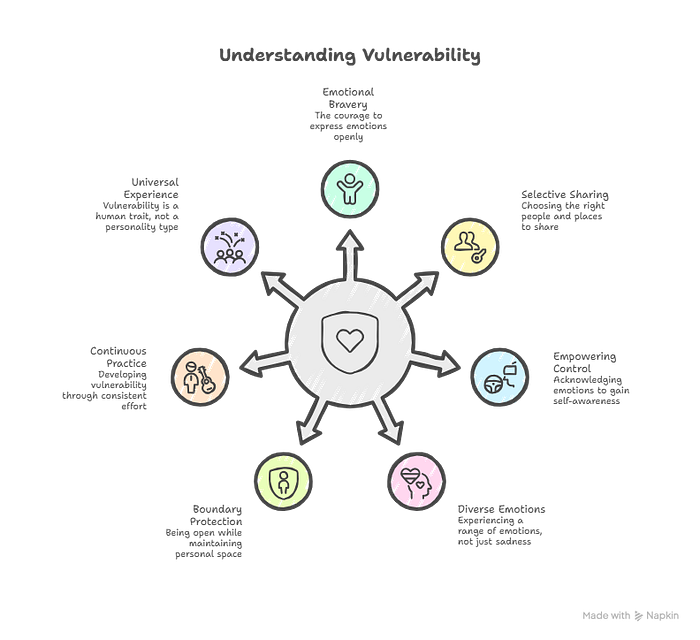
Vulnerability is the brave act of letting your real emotions breathe instead of locking them behind a mask.
According to researcher Brené Brown, it's essentially uncertainty, risk, and emotional exposure.
That shaky feeling when you open your heart without knowing how it will be received.
Uncomfortable, right?
But mentally soothing, if done honestly in the right space.

Before we move ahead, let's clear a few myths around vulnerability.
Myth 1 — Vulnerability makes you look weak
In reality, it's the bravery to open a window in your heart even when you're not sure how the weather outside will behave.
Myth 2 — Vulnerability means telling everyone everything
Not quite. Vulnerability isn't a public broadcast; it's choosing the right room and the right people to share your truth with. And trust me, you can simply know it, we're social beings after all.
Myth 3 — Vulnerability means losing control
Actually, the opposite happens. When you acknowledge your emotions, you're not handing away your power; you're learning how to hold it with awareness.
Myth 4 — Vulnerability is sadness and emotional chaos
It's not a permanent rainstorm. It lives in joy, curiosity, asking for help, admitting "I don't know," and daring to hope for something better.
Myth 5 — Vulnerability means dropping your boundaries
Think of it like opening a door, not removing the walls. You can be emotionally open and still protect your space.
Myth 6 — Vulnerability is a one-time act
It's not a checkbox you tick once and move on. It's more like learning a language; the more you practice, the more natural it becomes.
Myth 7 — Vulnerability is only for "emotionally expressive" people
Nope. It's a human experience, not a personality type. Whether quiet or expressive, every heart knows what it means to risk being seen. But when you're genuinely seen? Nothing can match that ever in life.
The Quiet Magic That Happens When You Stop Hiding Your Heart
Before we talk about why vulnerability feels scary, let's pause to ask a fair question: why even bother with it?
Opening up your emotional world does some powerful things.
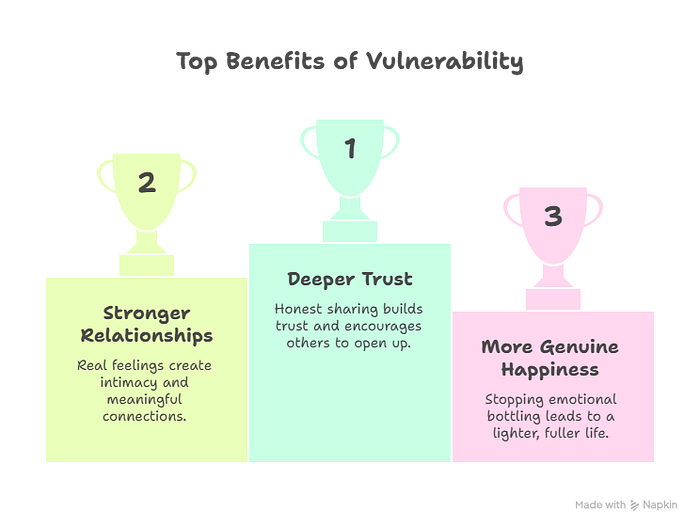
- Authentic Aliveness: When you stop bottling emotions, life feels lighter, raw, and more meaningful.
- Deepens Trust: Unfiltered sharing quietly signals, "You're safe with me." And that invitation often encourages others to open up, too.
- Stronger Relationships: Real feelings create real intimacy. The kind that turns surface conversations into meaningful connections.
- Healthier Communication: Vulnerability makes space for honest conversations instead of silent misunderstandings.
- Creativity and Growth — As researcher Brené Brown says, vulnerability is the birthplace of courage, creativity, and change.
Why Being Emotionally Real Can Feel Terrifyingly Exposed?
Now here's the catch.
If vulnerability is so powerful, why do most of us treat it like a dangerous button we're scared to press?
Because the moment we think about opening up, disaster warnings start ringing inside our heads. Like?
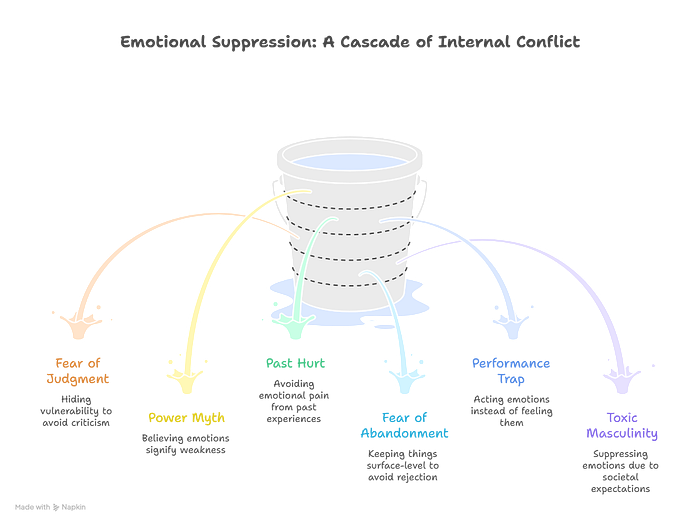
- The "Am I Being Judged?" Alarm
The second we express something real, the brain panics:
What if they judge me? What if they think I'm weak?
So we put on emotional sunglasses and casually say, "I'm fine."
- The Ghost of Past Hurt
If someone once mishandled your feelings, the mind quietly installs a "Do Not Open Again" sticker on your heart. Even when our hearts are quietly whispering, "allow", we hear our minds' loud sirens.
- The Fear of Abandonment Plot Twist
A tiny voice whispers:
What if they leave after seeing the real me?
So instead of risking rejection, we keep things surface-level, like strangers making small talk at a bus stop.
- The Performance Trap
Many of us learned to perform emotions instead of feeling them.
Smile when expected. Stay strong when hurting. Just like TV serial dramas without ad breaks.
- The "Man Up" Script (Toxic Masculinity)
For generations, boys were handed a strange rulebook:
Don't cry. Don't feel. Dominate to earn respect.
It looks tough outside, but inside, it creates pressure cookers.
Left unchecked, it can show up as:
- explosive anger
- controlling behaviour
- substance escape routes
- isolation and broken trust
- anxiety, depression, and even suicidal thoughts
Because emotions locked in a cage don't disappear.
They come back louder.
Turns Out The "Strawberry Generation" Might Be The Strongest One

There's something uniquely Gen Z about the struggle with vulnerability.
We are probably the first generation that can talk to someone across the world instantly… yet feel insanely alone in a room full of people.
Our phones are buzzing, notifications are popping, stories are updating, but genuine, slow, soft, undistracted human listening?
That sometimes feels rarer than a Wi-Fi signal in the mountains.
Social media didn't just change communication; it changed how relationships look.
Connections today are often performed as much as they are lived.
A message, a reply time, a seen-zone, even silence, everything can feel like it's being silently analysed.
Do we do the same 'perfection analysis' with surrounding real human connections?
I'm sure we don't.
So many young adults quietly adopt the same strategy: look unbothered, stay chill, never care too much.
Not because we don't want closeness, but because caring openly can feel like skydiving without a parachute.
Modern relationship vocabulary says a lot about this tension: ghosting, situationships, and talking stages.
There is "scrappy" freedom in this new landscape, but also threatening uncertainty.
Breaking the Family Script

Underneath all of this sits something deeper — the quiet influence of intergenerational experiences.
Every generation grows within the conditions of its time.
Earlier generations often lived through war, scarcity, displacement, and survival-level challenges.
Emotional expression was not always encouraged; resilience often meant staying strong and moving forward no matter what.
Those survival patterns were powerful and necessary.
But over time, some of that emotional restraint got passed down like an inherited habit.
Many of us grew up hearing subtle messages like "stay strong," "don't be too sensitive," "you've not yet seen real struggle," or "can't you handle it yourself."
So now we stand at an interesting crossroad.
Gen Z is sometimes labelled the "too emotional" or even the "strawberry generation."
But another way to see it is: we might be the ones trying to learn emotional honesty after decades of emotional silence?
Not to blame anyone.
Not to criticise.
Trying to understand the patterns and choose something healthier.
That's where the spirit of growth comes in.
In the language of psychology inspired by thinkers like Alfred Adler, the real question isn't "Who caused this?" but rather:
"What kind of people do we want to become from here?"
And maybe the answer is simple.
A generation that still uses technology, memes, and group chats, but also learns how to sit with real emotions, listen deeply, and build connections that don't need filters.
It's not easy.
But if there's one thing Gen Z is good at, it's turning awareness into change.
Life doesn't need to be absolutely figured out.
Not everything needs a name, a label, an answer, an analysis, or a conclusion.
Sometimes the most beautiful moments happen when we stop trying to find certainty and simply let the universe unfold the story.
There's something magnetic about it. Don't you think so?
When Feelings Go Rogue: The Two Emotional Traps Nobody Warns Us About
Disclaimer: The names and stories in this section are fictional and used to illustrate emotional patterns for relatability. They are not intended to represent or refer to any real person.
The Drowning Pattern — When Feelings Burst Open

Bharat was known as the calm one.
The friend who never complained.
The son who said "It's okay" even when he wasn't.
The person who quietly swallowed every hurt to keep the inner peace.
Year after year, he stored his emotions away like sealed letters no one would ever read.
Until one evening… the dam broke.
A small disagreement. A careless remark.
And suddenly, years of unspoken pain came rushing out.
His chest tightened.
His voice shook.
Words jumbled — anger, grief, confusion.
Tears came faster than he could stop them.
It felt like being caught in a flood you don't know how to swim in.
Later that night, sitting alone in the quiet of his room, the shame arrived.
Why did I react like that?
Why couldn't I stay calm?
What's wrong with me?
After that night, everything felt heavy.
Work drained him.
Loneliness crept in quietly, like a fog settling over familiar streets.
When emotions are locked away for too long, they don't disappear.
They overflow — often bringing sadness, burnout, and a deep sense of disconnection.
The Numbing Pattern — When the Heart Goes Quiet

Gauri used to feel life intensely.
Music moved her.
Authentic vibes lit her up.
Love felt vibrant and real, like a soft, slow breath.
But after a few painful experiences, she made a quiet promise to herself:
"It's safer if I just stop caring so much."
So she slowly turned the volume of her emotions down.
She stopped sharing.
Stopped expecting.
Stopped reacting.
On the outside, she looked calm, almost unbothered.
But inside, something subtle had faded.
Sunsets looked ordinary.
Songs that once gave her goosebumps now played like background noise.
Even laughter with friends and family felt like watching life through a window instead of standing inside it.
Sometimes she would catch herself wondering,
Why don't I feel anything anymore?
Did something in me break?
She wasn't drowning in emotions anymore.
But she wasn't really alive in them either.
Because when we numb our emotions long enough, the heart doesn't just block pain.
It also blocks joy, connection, and the quiet confidence that comes from knowing our feelings matter.
It's called Dead Livelihood.
Seems the person is indifferent and immune to emotions, but literally shaken inside.
Before these stories make your mind spiral, relax.
Take a deep breath.
Inhale for 4, hold, exhale for 8.
These are not predictions about your life.
They're a reality check, helping us notice emotional patterns we often ignore.
When we've lived for years suppressing feelings or pretending everything is fine, phases like these can naturally show up.
They're not signs that something is wrong with you; instead, they're a part of healing and personal transformation.
And honestly, you might be luckier than you think.
Life has a funny way of adoring people who are capable of deeper awareness and personal agency.
So don't panic.
If you're navigating emotions, questioning patterns, and trying to understand yourself better… that's not weakness.
That's evolution.
Nature might just be preparing you for a more powerful version of yourself.
So relax, breathe, and remember:
This phase is not permanent, but the awareness you gain from it can change everything.
Somewhere between drowning in feelings and numbing them away, a quieter path begins to emerge — one where emotions are not enemies to fight or silence, but signals to understand.
The Integration Pattern — When Feelings Become Guides

Bhargav grew up watching emotions handled in two very different ways.
Some people around him exploded when things became too heavy — voices rising, doors slamming, words spilling out that couldn't be taken back.
Others did the opposite.
They smiled, stayed polite, and buried everything deep inside as if nothing had ever hurt them.
For years, Bhargav thought those were the only options.
So when uncomfortable feelings appeared — jealousy, sadness, insecurity — his instinct was still the old one.
Ignore it. Distract yourself. Don't make a big deal out of it.
But life has a way of slowing us down.
One evening after a difficult conversation with a companion, he noticed something familiar rising in his chest, that tight, restless feeling that usually pushed him to either react immediately or shut down.
This time, he didn't do either.
He sat quietly for a moment.
Listening to the silence in the room.
Listening to the noise inside himself.
What am I actually feeling right now?
The answer didn't arrive neatly.
First came irritation.
Then, beneath it, disappointment.
And beneath that, the quiet realization that he had simply felt unimportant.
The emotion didn't vanish the moment he named it.
His chest still felt heavy. His thoughts still moved in circles.
But something had shifted.
Instead of feeling like a storm crashing through him, the emotion felt more like a message knocking at the door.
Not pleasant. But meaningful.
There were still moments when his mind turned against him.
Why am I reacting like this?
Why can't I just be easygoing like everyone else?
Yet slowly, he was learning something most people were never taught growing up:
Emotions aren't problems to solve instantly.
Sometimes they're signals pointing toward something that needs attention — a boundary that was crossed, a need that was ignored, a truth that wants to be spoken.
The feeling eventually softened.
Not because he forced it away, but because he stayed long enough to understand it.
And in that quiet space between reaction and suppression, Bhargav discovered something unexpected:
Emotional strength doesn't come from controlling feelings.
It comes from being able to sit with them, listen to them, and let them guide you towards what truly matters.
Plot Twist: Gen Z Made Feelings Cool Again

For a long time, vulnerability had terrible PR.
Gen Z, however, looked at that rulebook and quietly said: "Yeah… we're rewriting this."
Today, vulnerability shows up in surprisingly ordinary moments.
At work, it's admitting you're overwhelmed and asking your boss which deadlines actually matter, instead of silently drowning in stress.
In relationships, it's saying "Hey Babe, I felt a little jealous when you mentioned that coworker" instead of pretending everything is cool.
With family, it's calmly saying "I'm not looking for advice right now… I just need some support."
These small acts may look simple, but they're actually radical honesty in action.
Athletes like Virat Kohli openly talk about mental health.
Artists like Harry Styles redefine masculinity with emotional expression.
Rappers like Kendrick Lamar turn vulnerability into powerful storytelling.
Even pop culture saw this coming years ago. In the film The Holiday, Jude Law casually says:
"I cry all the time. More than any woman you've ever met."
And somehow, that honestly made him even more irresistible.
Closer to home, when Gukesh Dommaraju became the youngest World Chess Champion and stood there with tears in his eyes, it reminded the world of something simple: Strength and vulnerability can exist in the same moment.
This is the real cultural shift.
Gen Z is redefining what it means to be human.
Of course, emotional openness also needs balance.
There's a difference between authentic expression and oversharing for validation.
The goal isn't to broadcast every feeling online.
The goal is to understand them.
And that journey usually begins with one powerful skill many of us are still learning:
Self-compassion.
Because before we can safely open our hearts to others…We first need to learn how to hold them gently ourselves without harsh judgment.
And that's exactly what we'll explore next.
Stay tuned.
Soft Sign-Off.
Real Return.

Support Resources
Practicing Vulnerability: The Benefits Of Being Vulnerable | BetterHelp
Emotional Vulnerability as the Path to Connection | Psychology Today