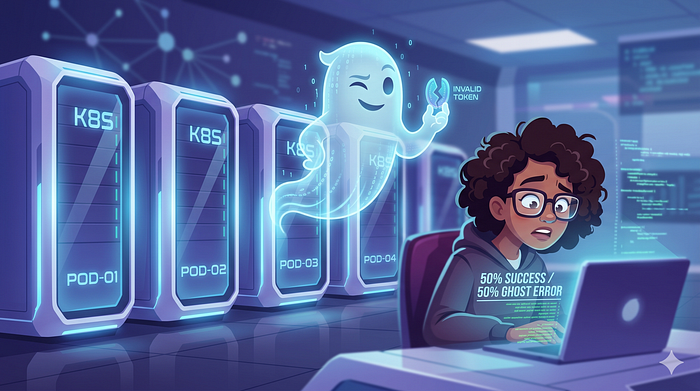
We've all been there. You're staring at a bug report, then you look at your code, then back at the report. You try to reproduce it locally. Nothing. You try staging. Smooth as silk. You even try a test store in production. Flawless. 🤷♂️
At this point, you start questioning reality. Did the merchant hallucinate it? Did I hallucinate it?
Spoiler alert: I didn't hallucinate it. It was a classic case of a distributed systems ghost, and it taught me a few lessons that changed how I write code forever.
The Mystery of the Self-Healing Bug 🔍
I was working on a brand-new surface area for our B2B e-commerce platform. It was exciting stuff — built from scratch, shiny, and new. But like most "new" software in the enterprise world, it still had to hold hands with our core legacy backend systems. 🤝
One day, a merchant reached out with a weird complaint: they couldn't view a specific customer's content.
I dove into the logs and spotted an invalid token error. Easy enough, I thought. I'll just figure out how a bad token got generated.
Except, I couldn't.
I tried to replicate it everywhere. No luck. To make things weirder, a few minutes later, the exact same customer's requests started succeeding. No auth errors. No deployment had gone out. No downtimes. The merchant casually messaged back: "Oh, it's resolved now! Thanks!" 📉
We didn't do anything. How does a bug just fix itself? A cache issue? A glitch in the matrix? I kept it on my radar, but it felt like a total fluke.
Until a few days later, when it happened to another merchant. 🚨
Spotting the Pattern (and Going Local-Wild) 💡
Okay, twice means it's a trend. I put my detective hat on and started digging for a pattern. Soon, a golden nugget emerged: This only happened when a customer was registering on our platform for the very first time.
Armed with this clue, I hammered my local and staging environments. Dozens of times. Still, no failure. I even tried reproducing it in production twice. Nothing.
That's when I sat back and asked the ultimate engineering question: "What is fundamentally different between my local machine and production?" 🤔
The answer hit me: The number of pods.
In production, we run on multiple Kubernetes (K8s) pods for scaling. In my local environment, I was running a single, lonely instance. 🖥️
To test my theory, I spun up the service on two different ports on my local machine and fired simultaneous initial token generation requests for a brand-new customer. ⚡
Eureka!
50% of the time, it failed. Both servers generated completely different tokens, and one of them looked as if the value used to create it was completely null. Rule #1 of debugging: If you can finally reproduce it, it's no longer a ghost — it's just a code bug. 🎯
The Culprit in the Legacy Attic 🏚️
I skimmed the code. Everything looked totally fine on the surface. So, I took a deep dive into the exact registration flow.
Here is what it looked like:
- A customer requests token generation.
- If they are an existing customer - add data and generate token.
- If they are a new customer - Step A: Add the customer data to the database. Step B: Fetch that newly generated record and create the token.
Simple, right? Well, let's zoom into Step A (the legacy create function). 🛠️
Inside that legacy function, there was an additional hidden check. It asked the DB again if the customer existed. If it found that the customer already existed, instead of returning the existing record, it returned… null.
(Why did it do that? I still don't know. Legacy systems move in mysterious ways.)
When a new customer clicked register, two identical requests fired at the exact same millisecond.
- Request 1 hit Pod A, checked the DB, saw the user didn't exist, and successfully created the record.
- Request 2 hit Pod B a microsecond later, checked the DB, saw Request 1's newly created record, triggered the legacy quirk, and returned
null.
Boom. Pod B happily took that null value, generated a broken token with it, and handed it to the user. 💥
The fix? A quick enhancement to make the create function return the existing record instead of exploding into a void of null. One line of code fixed it. ✅
The Real Learnings (The "TL;DR" for Your Next Architecture Review) 🧠
Though it was a minor bug, the hangover from solving it left me with four major realizations about building software:
1. Distributed Environments Demand Paranoia 🚏
When you move from single-instance architecture to distributed systems, every line of code becomes a potential hazard. Race conditions aren't just theoretical problems from college textbooks; they happen in production while you're drinking your morning coffee. ☕
2. "Fail Fast" is Better Than a Fake Success 🛑
We often have a bias toward making systems "tolerant," but sometimes it's better to just crash. If Step A failed because the record already existed, throwing an explicit error immediately would have saved us.
This taught me a bigger lesson about system availability. Engineers often think a "successful system" means HTTP 200 OK. But returning a clean, intended error response is a successful process. True availability means your system is up, healthy, and reachable—not that it never says "no." ✋
3. Simulate the Chaos Locally 🌪️
If you're hunting a weird bug in a distributed system, don't just test your logic. Simulate the environment. Spin up multiple instances on different ports locally and throw concurrent traffic at them. You'll catch blind spots you didn't even know existed.
4. The Magic Question: "What if this line fails?" 🔮
Adopt this mantra during development. In our case, the code blindly assumed that because a check passed on line 42, line 43 would succeed perfectly. Never assume. Write code as if the previous line is actively plotting against the next one. ⚔️
Final Thoughts 💭
When you start out in this field, it feels like it's all about syntax, algorithms, and strict logic. But once you spend enough time chasing ghosts through Kubernetes pods, digging through legacy codebases, and balancing system tradeoffs, you realize something else…
Software engineering slowly becomes an art once you truly understand its science! 🎨🚀