
A simple, real‑life breakdown of a process most people miss
Security often feels complicated — especially when terms like "TLS handshake," "route termination," or "X.509 certificates" show up. But what if I told you the same process happens every time you log into a coffee shop Wi‑Fi?
Let's simplify the security flow you shared and explain it using a relatable, everyday scenario. ☕🔐
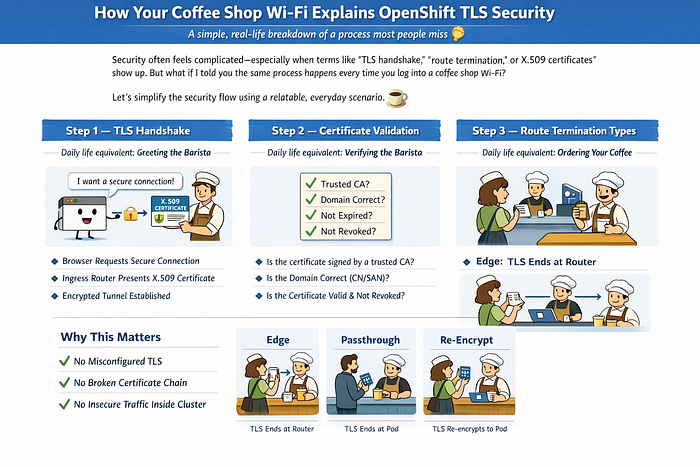
☕ Daily Life Analogy: Connecting to Coffee Shop Wi‑Fi
Imagine you walk into a coffee shop, connect to their Wi‑Fi, and order a cappuccino. Behind the scenes, something very similar happens when your browser hits an OpenShift application.
🔒 What Actually Happens When You Hit an OpenShift Application
Flow:
Browser ⬇ AWS ELB (Load Balancer) ⬇ Ingress Router (HAProxy) ⬇ Route (TLS Termination) ⬇ Service ⬇ Pod
Looks simple? Not quite. Let's decode the real security magic happening underneath.
🟦 Step 1 — TLS Handshake
Daily life equivalent: When you enter the coffee shop, the barista greets you and you confirm they work there. The barista also checks if you're a real customer — not someone trying to sneak in.
In technical terms:
- Your browser says: "I want a secure connection."
- Ingress Router responds with an X.509 certificate (like showing an ID card).
- Browser checks if this certificate is legit.
- If everything checks out → an encrypted tunnel is established.
This is like agreeing on a secret language so that nobody else in the coffee shop can overhear your order.
🟦 Step 2 — Certificate Validation
Daily life equivalent: Before talking to the barista, you quickly verify: ✔ The uniform is real ✔ The badge matches the shop's logo ✔ The name tag is correct ✔ It's not expired
In technical terms: Your browser verifies:
- Is the certificate signed by a trusted CA?
- Is the domain correct (CN/SAN)?
- Is it still valid?
- Is it revoked (CRL/OCSP)?
Only after all checks pass can the communication continue securely.
🟦 Step 3 — Route Termination Types
Daily life equivalent: Think of how you place an order:
- Edge: You tell the barista (router) your order, and they pass it to the kitchen (pod).
- Passthrough: You directly walk into the kitchen and tell the chef (pod) your order — end‑to‑end.
- Re-encrypt: You tell the barista a coded version of your order, and they forward it encrypted again to the chef.
In technical terms:
- Edge: TLS ends at Router
- Passthrough: TLS ends at Pod
- Re-encrypt: TLS ends at Router → re-encrypts → ends again at Pod
📝 Why This Matters
Most security gaps occur where people assume encryption flows correctly through every layer — but OpenShift routing behavior varies depending on termination type.
Understanding these steps ensures: ✔ No misconfigured TLS ✔ No broken certificate chain ✔ No downgrades in encryption ✔ No insecure traffic inside the cluster
🎯 Final Thoughts
Next time someone says "TLS is simple," remember the coffee shop analogy. There's always more happening behind the scenes — secret handshakes, ID checks, encrypted conversations, and proper routing.
Security is all about trusting who you're talking to and ensuring nobody else is listening.
References: