Artificial Intelligence (AI) has emerged as one of the most powerful technologies shaping the future of jobs and industries. For graduates who want a career with strong growth, high salaries, and global opportunities, AI is a smart and future-ready choice. This article explains how to start a career in AI after graduation, covering skills, tools, industries, job roles, and learning tips in a structured way.
What is Artificial Intelligence?
Artificial Intelligence is a branch of computer science that focuses on creating machines capable of performing tasks that normally require human intelligence. These tasks include learning from data, understanding language, recognizing images, making predictions, and solving complex problems. AI systems use algorithms and data to continuously improve their performance over time.
In today's digital world, Artificial Intelligence is no longer limited to research labs. It is actively used in everyday applications such as virtual assistants, recommendation systems, fraud detection, medical diagnosis, autonomous vehicles, and cybersecurity solutions. This wide adoption makes AI one of the most valuable skills for graduates.
Skills You Will Learn in an Artificial Intelligence Course
An Artificial Intelligence course is designed to provide graduates with a strong mix of technical, analytical, and problem-solving skills needed for industry roles.
Key Skills You Will Gain
Python Programming –
The primary language used in AI and Machine Learning
Machine Learning Algorithms –
Supervised, unsupervised, and reinforcement learning
Deep Learning –
Neural networks, CNNs, and RNNs
Data Analysis & Data Handling –
Working with large datasets
Statistics & Probability –
Mathematical foundation for AI models
Natural Language Processing (NLP) –
Text and speech-based AI systems
Computer Vision –
Image and video recognition technologies
Model Training & Evaluation –
Improving accuracy and performance
AI Deployment –
Implementing AI models into real applications
Problem-Solving Skills –
Applying AI to business and industry use cases
Why Should You Learn AI After Graduation?
After graduation, building specialized and future-oriented skills is essential to stand out in a competitive job market. Artificial Intelligence offers long-term career stability, strong demand, and opportunities across multiple industries. Learning AI early helps graduates enter high-growth roles faster.
Reasons to Learn AI After Graduation
- High Demand for AI Professionals
- Attractive Salary Packages
- Global Career Opportunities
- Future-Proof Career
- Innovation-Driven Work
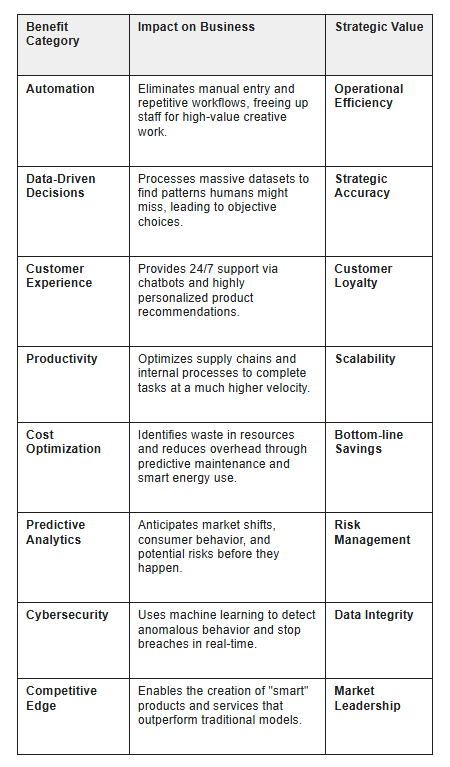
Benefits of Artificial Intelligence Skills for Businesses?
In today's fast-paced digital economy, integrating AI skills into a business isn't just a "nice-to-have" luxury — it's becoming a survival requirement. By leveraging these technologies, companies can move away from "gut-feeling" strategies and toward precision-based operations.
Here is a breakdown of how AI skills translate into tangible business advantages:
Tools Used in Artificial Intelligence?
Artificial Intelligence development relies on powerful tools and frameworks that help professionals build, train, test, and deploy intelligent systems efficiently. Learning these tools is essential for graduates aiming for AI jobs.
Popular AI Tools and Technologies
Python
Python is the most popular programming language for Artificial Intelligence.
It is easy to learn, readable, and widely used in AI, machine learning, and data science projects.
TensorFlow
TensorFlow is an open-source framework used to build and train deep learning models.
It is widely used for neural networks, image recognition, and large-scale AI applications.
PyTorch
PyTorch is a flexible deep learning framework preferred for research and experimentation.
It allows dynamic model building and is popular in computer vision and natural language processing.
Scikit-learn
Scikit-learn is a machine learning library for beginners and professionals.
It provides tools for classification, regression, clustering, and model evaluation.
Pandas
Pandas is used for data manipulation and analysis.
It helps clean, organize, and analyze large datasets efficiently.
NumPy
NumPy is a core library for numerical computing in Python.
It supports arrays, matrices, and mathematical operations used in AI algorithms.

OpenCV
OpenCV is a powerful library for computer vision tasks.
It is used for image processing, object detection, and facial recognition systems.
NLTK / SpaCy
NLTK and SpaCy are libraries for natural language processing.
They help machines understand, analyze, and generate human language.
Jupyter Notebook
Jupyter Notebook is an interactive coding environment.
It allows users to write code, visualize data, and document results in one place.
Git & GitHub
Git is a version control system used to track code changes.
GitHub is a platform to store, manage, and collaborate on code repositories.
Industries That Need Artificial Intelligence
Artificial Intelligence (AI) is no longer limited to research labs or tech companies — it is now reshaping industries across the globe. By enabling machines to analyze data, learn from patterns, and make intelligent decisions, AI is improving efficiency, reducing costs, and unlocking innovation. Let's explore how different industries are leveraging AI in 2026.
1. IT & Software — Intelligent Software Development and Automation
The IT and software sector is at the forefront of AI adoption. AI-powered tools help automate repetitive coding tasks, debug software, and even optimize algorithms. Machine learning models can predict software errors before deployment, while AI-driven DevOps tools accelerate the software development lifecycle. This allows companies to deliver high-quality software faster and with fewer resources.
2. Healthcare — Disease Prediction and Medical Imaging
AI is revolutionizing healthcare by improving diagnosis, treatment planning, and patient care. Predictive analytics helps detect diseases like cancer, diabetes, and heart conditions early, enabling timely interventions. AI-powered medical imaging tools can analyze X-rays, MRIs, and CT scans with high precision, reducing human error. Additionally, AI assists in drug discovery and personalized treatment plans based on patient data.
3. Banking & Finance — Fraud Detection and Risk Analysis
In the financial sector, AI is crucial for fraud prevention and risk management. Machine learning algorithms monitor transactions in real-time, identifying unusual patterns and flagging potential fraudulent activity. AI also assists in credit scoring, investment recommendations, and financial forecasting, helping banks and financial institutions make smarter decisions while minimizing risk.
4. Cybersecurity — Automated Threat Detection and Response
Cybersecurity is becoming increasingly complex due to the growing volume of cyber threats. AI systems can detect anomalies, phishing attacks, and malware in real-time, responding faster than human teams. Advanced AI models also predict potential security breaches by analyzing past attack patterns, helping organizations proactively protect sensitive data and maintain trust.
5. E-commerce — Personalized Recommendations and Pricing
E-commerce businesses use AI to enhance customer experience and drive sales. Recommendation engines suggest products based on browsing history and preferences, while dynamic pricing models adjust prices in real-time to maximize revenue. AI also optimizes inventory management, predicts demand, and identifies customer behavior trends, helping businesses stay competitive in a fast-paced market.
6. Manufacturing — Smart Automation and Quality Control
Manufacturing is benefiting from smart automation, predictive maintenance, and quality control. AI-powered robots can assemble products with precision, while machine learning models predict equipment failures before they occur, reducing downtime. AI-driven visual inspection systems ensure products meet quality standards, enhancing efficiency and lowering operational costs.
7. Education — Personalized and Adaptive Learning
AI is transforming education by creating personalized learning experiences for students. Intelligent tutoring systems adapt to individual learning styles, providing customized lessons and real-time feedback. AI also automates administrative tasks, such as grading and student progress tracking, allowing educators to focus on teaching. Additionally, AI-powered analytics can help institutions improve curriculum design based on student performance data.
8. Automotive — Autonomous and Smart Vehicles
The automotive industry is rapidly adopting AI for autonomous driving, traffic management, and vehicle safety. Self-driving cars use AI to process data from sensors and cameras, making split-second decisions on the road. AI also powers advanced driver-assistance systems (ADAS), predictive maintenance, and fleet management solutions, enhancing safety and efficiency.
9. Marketing — Customer Behavior and Trend Analysis
AI enables marketers to understand customer behavior and predict trends. Machine learning algorithms analyze consumer data to identify patterns, segment audiences, and deliver personalized campaigns. AI-powered chatbots, content recommendation engines, and sentiment analysis tools help businesses engage with customers effectively while optimizing marketing spend.
10. Government — Smart Governance and Digital Services
Governments worldwide are using AI for smart governance and public service delivery. AI-driven analytics assist in policy-making, urban planning, and traffic management. Chatbots and virtual assistants provide citizens with instant support for services like license renewal, tax filing, and social benefits. AI also helps detect fraud and corruption in public programs, making governance more transparent and efficient.
Tips to Start Learning Artificial Intelligence
Starting an AI career after graduation requires a structured learning approach and consistent practice. With the right roadmap, beginners can master AI step by step.
Beginner Tips for Learning AI
- Start with Python and Programming Basics
- Build Strong Foundations in Math and Statistics
- Practice with Real-World AI Projects
- Choose a Job-Oriented AI Training Program
- Create a Portfolio and Showcase Your Skills
Individuals That Can Go for Artificial Intelligence Skills
Artificial Intelligence (AI) is no longer limited to computer scientists or software engineers. Today, AI skills are valuable across a wide range of educational and professional backgrounds. Anyone with a strong interest in technology, problem-solving, and continuous learning can benefit from understanding AI. Let's explore the types of individuals who can pursue AI skills in detail.
1. Fresh Graduates — Build a Future-Ready Tech Career
Fresh graduates, especially those from science, mathematics, and technology backgrounds, can gain a significant advantage by learning AI. AI skills open doors to high-demand roles such as AI engineer, machine learning specialist, and data scientist. Learning AI early in their careers equips them with future-ready skills, giving them an edge in the competitive job market and helping them secure high-paying positions in top technology companies.
2. Engineering Students — Specialize in AI Technologies
Engineering students, particularly in computer science, electronics, or IT, can leverage AI to specialize in cutting-edge technologies. By mastering AI frameworks, algorithms, and neural networks, they can work on projects related to autonomous systems, robotics, natural language processing, or computer vision. This specialization enhances their employability and prepares them for advanced roles in research and development.
3. IT Professionals — Upgrade Skills for Advanced Roles
IT professionals with experience in software development, cloud computing, or system administration can upgrade their careers by learning AI. AI skills allow them to move into roles like AI developer, ML engineer, or AI consultant, which are highly valued in tech-driven industries. With AI knowledge, IT professionals can also work on automation, predictive analytics, and intelligent systems, making them indispensable to their organizations.
4. Data Analysts — Transition into AI-Focused Careers
Data analysts are already familiar with handling and interpreting large datasets, which makes learning AI a natural progression. By learning AI and machine learning techniques, analysts can transition into data science and AI roles, developing predictive models, recommendation engines, and business intelligence solutions. This opens up opportunities for higher-paying positions and strategic decision-making roles.
5. Career Switchers — Move into the Technology Domain
Individuals looking to switch careers into technology can use AI as a gateway. AI offers opportunities even for professionals from finance, marketing, healthcare, or education backgrounds. By acquiring AI skills, career switchers can explore roles such as AI consultant, business intelligence analyst, or AI product manager, combining their domain knowledge with AI expertise to provide innovative solutions.
6. Entrepreneurs — Use AI for Business Growth
Entrepreneurs and business leaders can benefit from AI by using it to enhance products, automate processes, and improve decision-making. Understanding AI enables entrepreneurs to implement chatbots, recommendation engines, predictive analytics, and process automation within their businesses. This not only increases efficiency but also gives a competitive edge in the market by leveraging data-driven insights for growth and innovation.
7. Researchers — Develop and Innovate AI Solutions
Researchers in academia or industry can focus on AI to develop new algorithms, improve machine learning models, and innovate AI applications. AI research spans fields like computer vision, natural language processing, robotics, and healthcare technologies. By learning AI skills, researchers can contribute to cutting-edge innovations, publish influential work, and participate in global advancements in artificial intelligence.
Job Opportunities After Completing an Artificial Intelligence Course
Completing an Artificial Intelligence course opens doors to multiple high-growth job roles across industries, offering excellent career prospects.
Career Roles in AI
- AI Engineer
- Machine Learning Engineer
- Data Scientist
- AI Research Analyst
- NLP Engineer
- Computer Vision Engineer
- Business Intelligence Analyst
- Automation Engineer
- AI Consultant
- Cybersecurity AI Specialist
Frequently Asked Question (FAQs)
1. How can I start a career in AI after graduation?
Learn Python, math, and machine learning basics. Work on projects, internships, and AI courses to build a portfolio.
2. Is Artificial Intelligence a good career option in 2026?
Yes! AI offers high demand, competitive salaries, and long-term growth across multiple industries.
3. Do I need coding skills to learn AI?
Basic coding, especially Python, is recommended, but beginners can start with low-code AI tools.
4. How long does it take to become job-ready in AI?
3–6 months for basics, 6–12 months for proficiency, and 12–18 months to build a strong portfolio.
5. Can non-engineering students learn AI?
Yes. AI is open to all backgrounds with focus on learning Python, math, and AI fundamentals.
6. What is the average salary of AI professionals in India?
Entry-level: ₹4–8 LPA, Mid-level: ₹8–20 LPA, Senior-level: ₹20–50 LPA+.
7. Which industries hire AI professionals the most?
IT, healthcare, finance, e-commerce, automotive, cybersecurity, marketing, and government.
8. Is AI difficult for beginners?
It may seem challenging at first, but structured learning and hands-on projects make it manageable.
9. What tools should I learn first for AI jobs?
Python, scikit-learn, TensorFlow, PyTorch, Pandas, NumPy, and basic data visualization tools.
10. Which institute offers the best AI training in Delhi?
Craw Cybersecurity Academy provides hands-on AI courses, projects, career guidance, and placement support.
Conclusion
Artificial Intelligence is one of the most promising career options after graduation, offering strong demand, high salaries, and long-term growth. AI skills allow graduates to work across industries and emerging technologies. Now, after reading all of the above, if you need specialized, practical, and industry-focused training, you can choose Craw Security Institute's 6-Months Artificial Intelligence Diploma Course in Delhi to confidently launch a successful AI career.