
Introduction:
With the increasing use of smartphones in daily life, the risk of cyber threats targeting mobile devices has grown significantly. One such serious threat is the Remote Access Trojan (RAT), a type of malware that allows an attacker to gain unauthorized access and control over an Android device.
As part of my cybersecurity coursework, I conducted a controlled lab-based demonstration to understand how such attacks are performed and, more importantly, how they can be prevented
A detailed video demonstration of this project will be added soon.
This work was carried out strictly in a controlled environment for educational purposes only.
Understanding Remote Access Trojans:
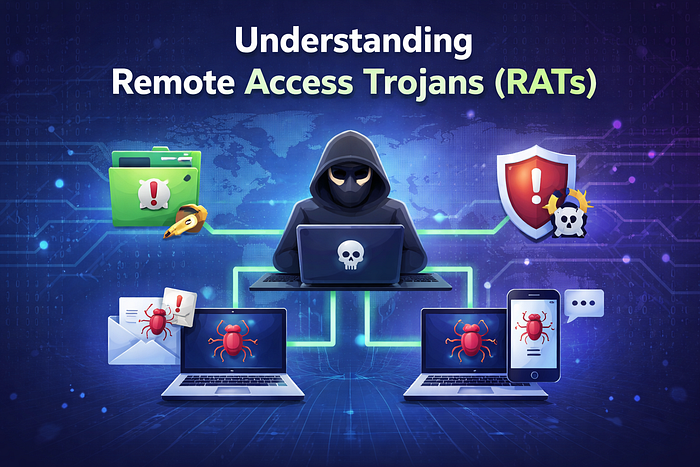
A Remote Access Trojan (RAT) is a form of malware that allows an attacker to remotely control a victim's device without their knowledge.
It can enable:
Unauthorized access to files
Monitoring of user activities
Use of camera and microphone
Installation of additional malicious programs
Attack Vectors:
RATs can be deployed using various techniques:
Phishing emails and malicious links
Trojanized applications
Social engineering tactics
Infected external devices
Compromised websites
These methods exploit user trust and lack of awareness.
Tools and Lab Setup:
The demonstration was performed using widely used cybersecurity tools, including:
MSFVenom for payload generation
Metasploit Framework for establishing connections
Kali Linux as the testing platform
The entire setup was isolated within a virtual lab environment to ensure safety.
Methodology Overview:
The process followed three main stages:
Payload Preparation:
A malicious payload was embedded into a legitimate Android APK application to simulate how attackers disguise malware.
Listener Configuration:
A listener was configured to wait for incoming connections from the test device.
Controlled Interaction:
Once executed in the lab environment, a controlled connection was established to simulate a real-world scenario.
Technical commands are intentionally omitted to maintain ethical responsibility.
Observations:
During the controlled test, it was observed that:
The device could be remotely accessed
Certain system-level information could be viewed
File access and navigation were possible within the environment
These observations highlight the seriousness of such threats.
Security and Prevention:
To protect against such attacks, users should:
Install applications only from trusted sources
Avoid clicking on unknown links or attachments
Regularly update their devices
Monitor app permissions carefully
Use reliable mobile security tools
Conclusion:
This project emphasizes the importance of understanding cybersecurity threats from both an offensive and defensive perspective.
Ethical hacking enables us to identify vulnerabilities and strengthen our defenses, ultimately contributing to a safer digital environment.
About Me:
I am a cybersecurity learner with a background in Applied Physics and a Master's in Telecommunications. I have a strong foundation in networking and physics related concepts . I am currently focused on building practical skills and sharing my learning through real-world projects.