
Sometimes the most dangerous bugs hide in the most boring features.
Today it was a stock checker.
You know the type.
Enter a product. Click check. See how many items are available.
Nothing exciting.
Or at least that's what it looked like.
Until I noticed something interesting in the request.
🎯 The Setup
The application had a Stock Control feature.
It checks inventory for a specific product.
The request looked something like this:
/stock-check/?product_id=1
Simple.
The server receives the product ID, runs a backend command, and returns the stock count.
But something caught my attention.
That product_id parameter.
What if the server isn't just reading it…
What if it's executing it?
🧠 The Experiment
Instead of requesting a normal product ID, I modified the parameter.
product_id=1;id
This tiny change tells the system:
Check stock for product 1.
Then run another command:
id
Which reveals the system user executing the command.
Then I sent the request.
💣 The Result
The page responded with the stock count.
But something else appeared next to it.
Stock: 13 uid=33(www-data) gid=33(www-data)
The server had executed my injected command.
Which meant something serious.
The stock checker wasn't just retrieving data.
It was running system commands.
⚡ Why This Works
The application likely executed something similar to:
system("check_stock " . $product_id);
Because the parameter was not sanitized, the system interpreted the input like this:
check_stock 1 id
Two commands.
Both executed by the server.
Which means the attacker controls what the system runs.
🧠 Think About This
Imagine asking a warehouse employee:
"How many items are in stock?"
But when they check the system, they also follow extra instructions you secretly added.
"Check the stock… and also tell me who runs the server."
And they just do it.
That's command injection.
🔥 Why This Is Dangerous
Once attackers can execute commands on the server, they can:
• Read sensitive files • Discover system users • Install malicious tools • Explore internal services • Potentially take over the entire machine
And it all started with a product ID field.
🛡️ The Fix
Never execute system commands using unsanitized user input.
Instead:
• Validate all parameters strictly • Avoid system command execution when possible • Escape shell arguments safely • Use secure APIs instead of shell commands • Run applications with minimal privileges
Security rule:
If user input reaches the shell, attackers reach the server.
🎯 Takeaway
Today's vulnerability didn't hide in authentication.
It didn't hide in encryption.
It hid inside a stock checker.
A simple inventory feature turned into a command execution endpoint.
Sometimes the most dangerous vulnerabilities…
Start with something that looks completely harmless.
LESS GOOO 🔥
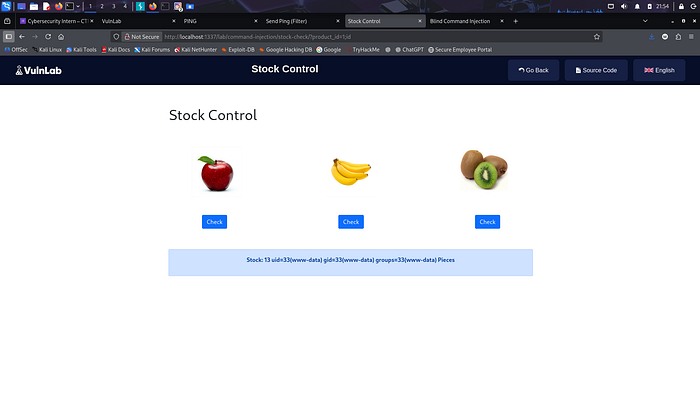
A stock checker should count products… not execute commands.