
Nowadays, organizations rely on technology for almost everything, from storing important data to managing everyday tasks and communication. But with the rise in cyberattacks, keeping systems secure has become more important than ever. To stay ahead of potential threats, organizations use methods like Penetration Testing, which helps uncover vulnerabilities before attackers get the chance to take advantage of them.
In this blog, let's learn the basics of Penetration Testing , what it is, and the different phases.
PENETRATION TESTING

Penetration Testing, commonly known as Pen Testing, is a cybersecurity practice where ethical hackers perform authorized simulated attacks on systems, networks, applications, or organizations to identify security weaknesses. The purpose is to discover vulnerabilities that real attackers could potentially exploit and help organizations fix them before they become serious threats. Unlike standard vulnerability scanning, penetration testing goes a step further by actively attempting to exploit identified weaknesses to understand their actual impact in real-world situations.
PHASES OF PENETRATION TESTING
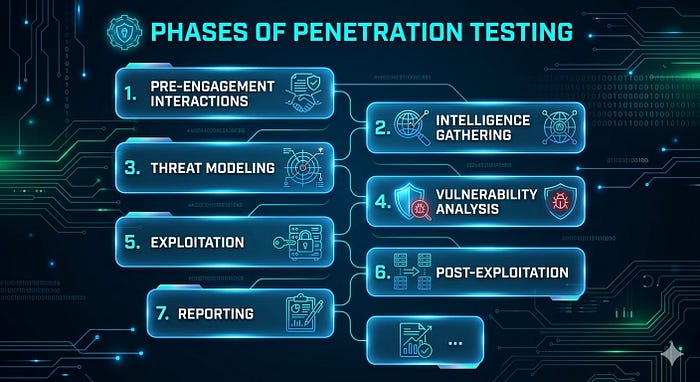
- Pre-engagement Interactions
This is the first phase of penetration testing, where the client and the penetration testing team discuss the scope and terms of the assessment. During this phase, they decide what needs to be tested, how much information will be shared with the team, and the rules of engagement.
The client defines the testing scope or provides a checklist of what should be tested. This may not always include a full scope. In a full-scope penetration test, testers have broader access and fewer restrictions, allowing them to simulate real-world attacks more effectively.
This phase also includes setting the time frame, permissions, and expectations for the engagement. It is important because it ensures that both the client and the testing team clearly understand the objectives and boundaries before the testing process begins.
2. Intelligence Gathering
This is the phase where testers collect information about the target organization. This can include gathering details through social media, Google hacking, Footprinting, and public sources to understand how the organization operates.
The main goal of this phase is to identify possible entry points and understand the security controls in place. Testers may slowly probe systems to check protection mechanisms such as open ports, firewalls, or web application security measures. The information collected during this stage helps the team plan the next steps of the penetration test more effectively.
3. Threat Modelling
This is the phase where the information gathered earlier is analyzed to identify possible vulnerabilities, weaknesses, or exploitable areas in the target system. Based on this information, the testing team builds a plan and evaluates whether an attack is possible and likely to succeed.
In this phase, testers determine the most effective attack methods, the type of information they are targeting, and how the organization could potentially be attacked. Threat modelling involves thinking like an attacker, analyzing the system from an adversary's perspective, and identifying possible paths to exploit security weaknesses.
4. Vulnerability Analysis
This is the phase where the information collected from the previous stages is examined to identify which attacks are most practical and effective. After identifying possible attack methods, testers analyze how they can gain access to the target system.
This phase combines data from intelligence gathering, port scanning, vulnerability scanning, and banner grabbing to understand potential security weaknesses. The goal is to determine which vulnerabilities are real, exploitable, and most likely to lead to a successful attack.
5. Exploitation
This is the phase where testers attempt to exploit the identified vulnerabilities to gain access to the target system. This step should be carried out carefully and based on the findings from previous phases.
Instead of randomly trying multiple exploits, penetration testers use well-researched and targeted attacks that are likely to succeed. Before launching an exploit, testers should have strong evidence that the vulnerability exists. The goal of this phase is to demonstrate how a weakness can be exploited and understand its real impact on the system.
6. Post Exploitation
It begins after successfully gaining access to a system. In this phase, testers explore the compromised environment to identify additional vulnerabilities, valuable data, critical systems, and possible attack paths inside the network.
The goal is to understand the real business impact of the compromise. Testers analyze user roles, connected systems, sensitive information, and important assets such as financial systems, intellectual property, or source code. By thinking like an attacker, they determine how far an attack could spread and what damage could potentially be caused within the organization.
7. Reporting
This is the final and one of the most important phases of penetration testing. After completing the assessment, the testing team prepares a report explaining what was tested, how the testing was performed, the vulnerabilities identified, and the recommended solutions.
The report may be a summary report or a detailed technical report, depending on the organization's requirements. Typically, it includes an executive summary for management and technical findings for the technical team.
The purpose of reporting is not only to document vulnerabilities but also to provide recommendations that help the organization strengthen its security, remediate identified issues, and reduce the risk of future attacks.
This is all about Penetration Testing and its phases. From planning and information gathering to exploitation and reporting, each phase has a significant role in identifying vulnerabilities and improving security. Understanding these phases helps organizations stay proactive and reduce the risk of cyberattacks.
Thank you for reading, and I hope you learned something useful from this