In the world of Web3, security is often synonymous with smart contract auditing. However, the most robust protocol is only as secure as the infrastructure it runs on. Recently, I had the opportunity to contribute to the Tezos ecosystem by hardening its infrastructure components, specifically for the Tez Capital initiative. This journey resulted in a 150 XTZ bounty and some valuable insights into hardware-level security for blockchain validators.
Radxa Rock 5B Kernel Optimization
The first challenge involved the Radxa Rock 5B, a powerful ARM-based SBC often used for running decentralized nodes. My task was to optimize the kernel configuration to ensure maximum stability and security for validator operations. This included:
Fine-tuning kernel parameters for high-load network environments.
Stripping unnecessary modules to reduce the attack surface.
Ensuring seamless compatibility with the Tezos node requirements.
Hardening TezSign (Air-gapped Signing)
The second part of the mission focused on TezSign, a tool designed for air-gapped transaction signing. Security in 'cold' environments is critical. I worked on a comprehensive security guide and environment setup that ensures private keys never touch an internet-connected interface, providing a fail-safe for institutional-grade bakers.
The Result (Proof of Work)
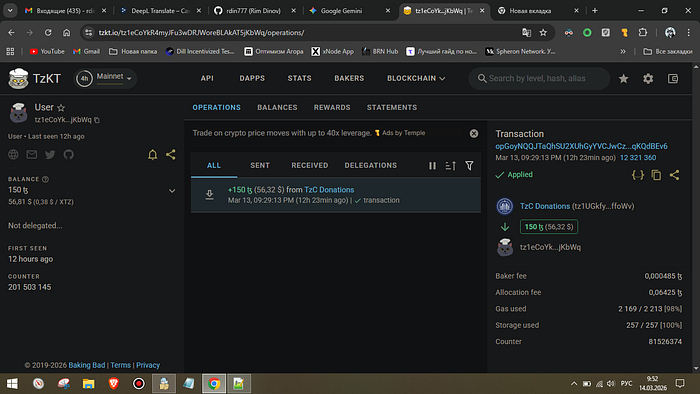
Transparency is a core value of blockchain. The successful implementation of these tasks was acknowledged by the Tez Capital team, and the reward was settled on-chain.
Transaction Details:
Amount: 150 XTZ
Status: Applied / Confirmed
Network: Tezos Mainnet
Conclusion
Securing the decentralized future requires a holistic approach — from the silicon in the server to the logic in the smart contract. I'm excited to continue my research into L1/L2 infrastructure and node resilience. If you are building secure, high-performance blockchain systems, let's connect.
https://github.com/rdin777 https://github.com/rdin777/radxa-zero3-minimal-kernel