
June 4, 2026
AI Experimentation Is Exploding – Now Comes the Hard Part: Turning It Into Value

Abhinay Bhasin
2 min read
Over the past year, enterprises have moved from curiosity to commitment when it comes to AI.
Few examples capture this shift better than a recent disclosure by a large company: the company reportedly exhausted its annual AI coding budget within just a few months, driven by widespread internal adoption of tools like large language model based coding assistants. At the same time, leadership acknowledged something equally important; while productivity gains were visible (around 20 – 25%), the direct link to customer impact or product improvement is still evolving.
This isn't a failure of AI.
It's a sign that we've entered the next, more mature phase of AI adoption.
The Positive Reality: AI Is Working
Let's start with what's going right.
AI is already delivering:
-
Faster development cycles
-
Improved internal productivity
-
Greater experimentation velocity
-
Lower barriers to building and testing ideas
A ~25% productivity gain at scale is not trivial. In most organizations, that level of efficiency would take years of process transformation to achieve.
AI is clearly unlocking capability.
But capability alone is not value.
The Gap: From Productivity to Outcomes
High AI usage ≠ High business impact
This gap exists because:
-
Productivity gains don't automatically translate into better products
-
Increased output doesn't always mean higher quality or relevance
-
Teams often optimize for speed, not outcomes
-
AI costs scale faster than traditional software usage
In other words, organizations are getting better at using AI – but are still learning how to direct it.
The Next Phase: Structured Experimentation
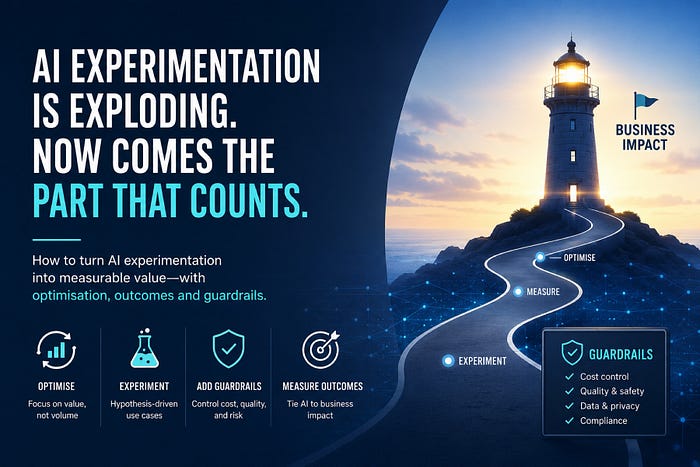
This is where the real opportunity lies.
The companies that win in AI won't slow down experimentation – they'll structure it better.
That means shifting from:
-
Open-ended exploration → Hypothesis-driven experimentation
-
Tool adoption → Use-case prioritization
-
Activity metrics → Outcome metrics
Every AI initiative should start with a clear question:
What business outcome are we trying to improve – and how will we measure it?
Without that, even the most advanced AI stack becomes an expensive sandbox.
Why Guardrails Matter More Than Ever
As experimentation scales, so do risks – especially around cost, quality, and control.
Guardrails are no longer optional. They are foundational.
1. Cost Guardrails
AI consumption (tokens, compute, API calls) can grow exponentially if left unchecked.
Organizations need:
a. Budget caps and usage monitoring
b. Cost-per-use-case tracking
c. ROI visibility at a granular level
2. Performance Guardrails
Not all AI outputs are equal.
Teams must define:
a. Accuracy benchmarks
b. Acceptable error thresholds
c. Continuous evaluation loops
3. Strategic Guardrails
AI should align with business priorities, not distract from them.
This requires:
a. Clear use-case prioritization frameworks
b. Governance on where AI is (and isn't) applied
c. Leadership oversight on high-impact deployments
4. Data & Risk Guardrails
As AI integrates deeper into workflows:
a. Data privacy and compliance become critical
b. Model outputs must be auditable
c. Hallucinations and bias need mitigation strategies
The Real Shift: From Adoption to Discipline
We are moving from the "AI gold rush" phase to the "AI operational excellence" phase.
The key question is no longer:
"How quickly can we adopt AI?"
It is now:
"How effectively can we convert AI into measurable, sustainable value?"
This requires discipline:
-
In where we invest
-
In how we measure success
-
In how we control costs
-
In how we scale what works
The future won't belong to companies that experiment the most.
It will belong to those that experiment intelligently, optimise continuously, and scale responsibly.
Because in the AI era,
value isn't created by usage; it's created by outcomes.