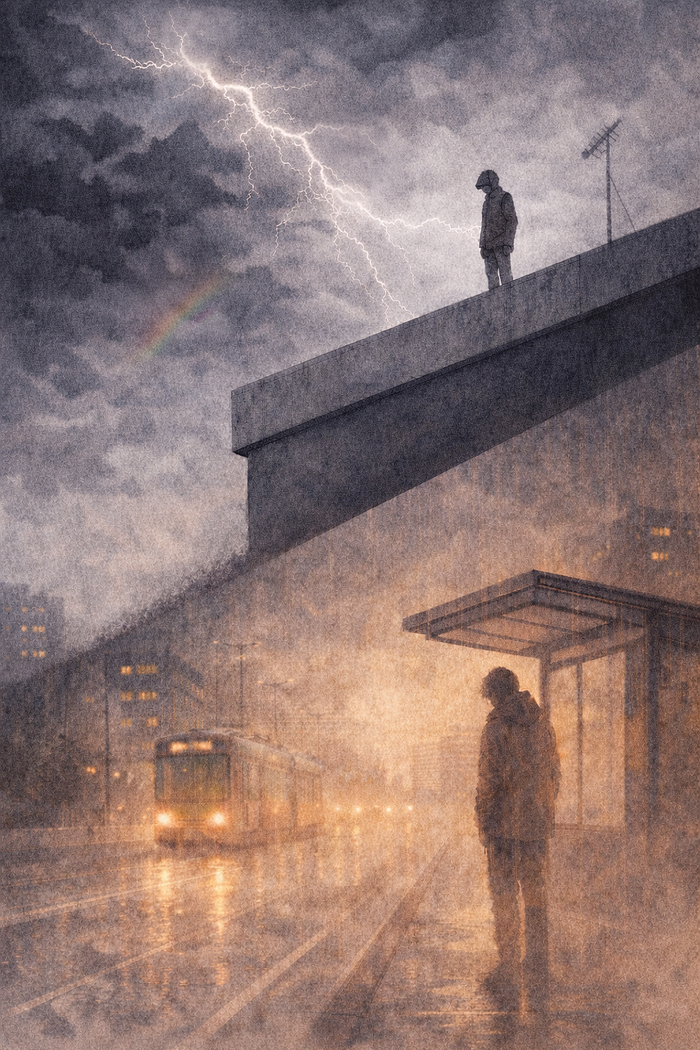

This letter continues a series of personal texts about closeness, fear, and the fragile moments when something real almost becomes possible.
In earlier letters (No. 1 and No. 2) — and in the essay We, Seen Anew – I wrote about recognition: about what it means to see another person and to be seen without disguise.
This text moves deeper into that space. It is about a catastrophe that never became loud.
Nothing "happened" in the usual sense. No betrayal, no scandal, no clear ending.
But something broke anyway – slowly, quietly, between two people who did not yet have a shared language for what was happening to them.
This is a text about how silence can still leave scars.
Best read slowly.
***
There are catastrophes that can be seen and heard. And there are others — vast, like the explosion of a supernova, yet silent. Because there is no medium through which their sound can travel.
You read such a catastrophe only in the eyes. Through pauses. Through inexplicable actions.
**My Catastrophe in Your City**
When I returned to my city in May 2014, I was finishing my studies and working on the side.
We exchanged occasional emails — brief, measured, safe.
And then, in early May 2015, I learned there was a chance to come to your city through an exchange program. Not for study, as before. For an internship. Not for half a year — just one week.
On May 17, 2015, I arrived.
Sometimes memory brings back not events, but sensations – as if the air itself had been different then. Denser. As if it was listening.
Your city had always been like that for me.
When I saw you standing in the doorway of the room, I knew immediately: nothing was over. You entered together with the morning light.
I wasn't afraid. Rather — I recognized something. That state in which pretending becomes impossible.
You were calm, collected, attentive — and that alone unsettled me. I was used to holding onto structure: what we do, where we go, what comes next.
But beside you, structure began to crack. Not because you were breaking it – but because I was forced to feel.
And to feel meant losing control.
When we embraced, I understood it at once. Not as desire. But as a closeness that cannot be rewound.
You looked at me as if you saw not who I wanted to be, but who I actually was. And that was both comforting and unbearable.
That day we went into the mountains again — a May outing, like on the day we first met.
There were people around us, noise, talents, conversations. And all day I kept my distance.
I was "with everyone." Not with you.
Now I understand how many things I did were defenses. I joked. I acted "as usual." I drank more than I should have. I spoke more harshly than I felt.
Not because I wanted to hurt you. But because I didn't know where to put what was rising inside me when I was near you.
You said you wanted to give me something. That we needed to be alone.
At night, we walked beyond the gates of the cottage. The sky felt low, as if it had come closer.
You walked beside me. You didn't demand. You didn't pull. You didn't press.
And that made it even harder.
If you had pressed — I would have resisted. But you were simply there. And everything inside me became too real.
I turned to defiance. That is how I keep myself from collapsing.
If I start speaking normally — I start feeling. And if I start feeling — I lose control.
You opened your backpack. The scarf. Green.
And the way you looked at me – as if you weren't giving me an object, but a part of yourself.
I took it — and felt warmth. Not from the scarf. From the fact that it was you.
You turned on music. And I clung to it like an excuse:
"We're just listening." "We're just friends." "We're just people."
I searched for any way to make what was happening feel "normal."
Then you spoke about the manuscript. About the novel. About writing together. Something inside me faltered.
Because this was no longer a joke. This was already us.
You took out the manuscript in a satin cover — you had sewn it yourself. Blue and pink halves. As if for something alive. For something that was meant to be born.
You said: "your part and mine".
Something shared.
I heard your words about "feminine" and "masculine" thinking. And yes — I agreed. Because you saw me as I felt myself: harder, sharper, more concise.
Yet next to you, I softened. And that frightened me.
I don't know why, but I grabbed the manuscript with both hands and pressed it to myself. As if it mattered more than I wanted to admit.
Then I began to speak harshly. About family. About society. About friends. About how you were going to live.
It wasn't an attack. It was: "stop."
I was trying to stop you in order to stop myself. I wanted to destroy the possibility rising between us.
But it kept rising anyway.
We were already walking back. Standing by the gate.
And then I said what I said. "I don't care if it's a man or a woman." And: "let's do it."
It wasn't calm desire. It was a brake torn loose.
When someone has held themselves in check for too long, at some point they don't choose the form of intimacy. They just try to release the pressure — like heat.
I wanted it to be quick. Rough. Abrupt. So I wouldn't think. So I wouldn't feel. So I could forget.
I pulled you toward the river.
You were sitting. I stood over you. I said, "Come on."
But you lowered your head. Then lifted your eyes and took my hand.
My thumb touched your lips. I wanted it to go further. But you began to kiss my other fingers — gently, as if you were protecting me.
I squeezed your thumb as if holding onto an edge.
And I froze.
Because there were two of me inside.
One wanted: "Yes. Now. Finally." The other was screaming: "After this, you won't survive."
I lay down beside you, baring my stomach, said, "Come on."
And you calmly slid your backpack under my back so I wouldn't lie on the damp ground. You lay beside me and wrapped your arm around me.
And that struck harder than anything.
Because sex I could have blamed on alcohol. On foolishness. On "it just happened."
But scent — that's already love.
That cannot be hidden.
You said: "I'll get even more attached… a sexual thread will appear… and then you'll disappear."
You were right.
I could have jumped even further away — terrified of myself. If I couldn't withstand simple conversation, how could I withstand intimacy?
Now I understand — you did the right thing: you didn't push me away. You preserved my dignity — and your own heart.
Seeing my fever and my panic, you didn't use them. You simply stopped me. Innocently held me.
And in doing so, you saved me.
You chose tenderness and respect. That wasn't a mistake. That was a rare kind of purity.
Firewood. The grill. A hand over the flame
When we returned to the cottage, I needed somewhere to put the energy. I was shaking. So were you.
I escaped into action.
I chopped wood not because I wanted to grill meat. I chopped wood because I needed to become a man. In the blunt, physical sense.
To return to something familiar: I'm doing something — therefore everything is fine.
Sitting by the fire, I stretched my palm over the flame, because I needed pain that was simple.
Physical pain is clear: burn — pull your hand away.
But inside me was another pain. One without instructions. One you cannot recoil from.
You moved my hand away. I resisted.
Because I wanted to punish myself – for the arousal, for the feeling toward you.
And at the same time, I wanted to be stopped.
You stopped me. I remember that.
You weren't just loving me. You were saving me from myself.
We stayed by the fire until morning – arguing, falling silent, watching each other for hours, singing.
The feeling for you kept rising. And I couldn't endure myself within it.
I still couldn't live inside we. I would slip into it — and then immediately jump back out.
By dawn I was completely undone. You saw me switching over and over again — from hatred to tenderness.
You tried to put me to sleep. There was no space. Later, a spot opened up upstairs.
I lay down. And you lay down beside me.
We turned away from each other so we wouldn't invite questions.
It was our small agreement:
we are close, but the world will not see.
Morning came.
It wasn't relief. It wasn't victory. It was a quiet you can breathe.
The night didn't fully leave. It simply stepped back.
Somewhere inside, music was still sounding. Not loudly. Not like a song.
Like residual warmth.
The words we sang during the night no longer tore at us. They simply existed.
"Forgive me, my love" no longer sounded like a plea or guilt, but like a fact.
"You need air" – and so did I.
The light came cautiously – not intruding, but as consent.
I felt the presence of someone third. Like a hand placed over us so nothing would break.
For the first time that night, I felt calm. Not because everything was resolved. But because nothing had been destroyed.
Through sleep, I heard you shooing people away, trying to protect my rest.
And then I understood: you weren't just beside me. You were guarding me.
Morning didn't give answers. It gave a boundary.
A line beyond which catastrophe did not become ruin.
And the music stayed inside – no longer as a scream, but as a memory of the fact that we survived each other.
**Your Catastrophe in My City**
Beginning of July 2015
In my city, it was harder for me than it had been in yours.
Not because it was foreign – but because here, my entire life was laid out.
You entered my city – and with that, entered a structure I had been building for years: studies, work, friends, familiar routes, the normalcy I had hammered myself into.
I felt it immediately: if you came too close, this structure would not hold.
I saw how you looked at me. I saw that you understood everything.
And that made me want not to come closer – but to hide.
Sometimes behind noise. Sometimes behind people. Sometimes behind "ordinary" scenarios.
Not because they were mine. But because they were safe.
Your arrival coincided with the summit – the whole city was tense, stretched like a wire. And also with the sky: Mars and Jupiter drawing near and drifting apart, as if mirroring us.
I don't usually believe in signs. But there were too many to ignore.
You brought the manuscript with you, hoping we would edit it together. And you brought it in the very year my country declared the Year of Literature.
You wanted us to work together.
I read the text and felt: you hadn't brought just a book. You had brought the possibility of us.
You didn't come alone. You brought a translator with you.
Not a linguistic one — a human one. Someone who could say to me what you didn't dare, and tell you what I kept hidden.
But I knew our mutual friend. I knew his love of women, his impulsiveness, his pull toward bodily scripts.
And already on the platform, meeting you, I was playing out a dangerous ending in my head.
I tried to separate your trajectories.
But sometimes catastrophes happen precisely because we try to avoid them.
We met in the evenings. You easily entered conversations with my friends. They were captivated by you.
I was uneasy.
One night we went to the movies. I invited girls – not because I wanted to, but because it seemed "right."
You tensed. I saw it.
And the next day, what happened became your catastrophe.
July 11–12, 2015
I arranged to meet at the mall. Bowling. Late evening.
You arrived – and I saw in your eyes a shiver of anxiety rising inside you.
Later we were in the apartment. Alcohol. Conversations. Games.
Time passed, and the girls didn't leave.
You understood why they were there. You understood the trap.
Two girls. Two guys. And you — the extra one.
You sat, pressing your fingers to your temples. There was panic in your eyes.
And I wanted to stop everything. But I didn't know how.
Our mutual friend was slow-dancing with one of them.
We sat around the table: you, me, and the other girl.
I saw it in your eyes: you already understood what role I was about to play.
The role of "saving the situation."
And I did.
"Let me draw in the hookah smoke," I said, "and pass it to you."
I leaned forward. Our lips came too close.
I blew the smoke into her mouth.
"Now you do it to me."
And then I looked at you.
In your eyes, at that moment, hope exploded – and immediately went out.
Like a supernova. A catastrophe without sound.
You had come with love. With a manuscript. With hope for us.
And instead you found yourself in a scene where a heterosexual script was being performed right in front of you.
It was the public humiliation of your feeling.
I watched you trying to hold yourself together.
And I saw you failing.
You were helpless in that trap.
You couldn't make a scene – you would have lost your dignity.
You couldn't stay silent – you would have died inside.
You couldn't replace me – that wasn't you.
You went upstairs in silence. Lay down on the mattress.
I felt you there. Felt your fear. Your waiting:
any second now, something will start – under our almost intimate, half-whispered voices.
The pain inside you became physical.
Unable to bear it, you came down before dawn.
I was lying on the couch beside the girl – fully dressed, my back turned to hers.
You saw my look. Sad. Empty.
You said you needed a cigarette.
And you left.
When the door closed, something snapped inside me.
I didn't go after you.
Not because I didn't want to. But because I didn't know what I would say if I caught up.
I hoped the city would hold you. My city's name is feminine in my language. You needed maternal ground. I hoped dawn would keep you from falling.
Morning. The balcony
You returned around nine. You were gone for four hours.
Our friend was asleep. The girls were gone.
When you entered, I saw someone who had been executed a few hours earlier.
You were quiet. Collected.
And that was terrifying.
You led me onto the balcony. Sunlight pushed through the clouds.
"It hurts," you said.
I froze.
"You had hopes…" I said.
"It's not about that," you replied. "It just… hurts. Stay with me… please."
Then you said, barely above a whisper: "Please, tell me… that I'll be okay."
I understood: it mattered that I said it.
Not because I knew how. But because it was me.
I said: "You'll be okay. I promise."
And then you cried.
You cried in a way that made me realize: these were not male tears.
Before me was someone who did not fit the role they had been forced into.
I saw you as almost no one ever had – as you felt yourself inside.
Everything in me tightened.
These were not hysterical tears. This was the collapse of hope.
And I understood one thing clearly: you were crying because of me.
From your movements it was obvious you wanted to come closer.
But I extended my hand, building distance between us.
I wanted to hold you. Truly.
But if I did – I wouldn't be able to step away afterward.
So I chose distance.
Not because you were unwanted. But because you were too important.
When you leaned against the windowsill and cried again, I understood:
either I tell the truth now, or I save myself.
I chose myself.
It wasn't victory. It was survival.
I spoke nonsense. About having "already figured myself out." About "saving the situation."
I spoke not because I believed it, but because I couldn't speak otherwise.
Before leaving, I said: "Come here. I'll come tomorrow. I'll walk you off."
I knew I couldn't survive another conversation that day.
Standing at the shoe cabinet, I delayed.
Because if I stepped outside – I would leave the space where you existed.
I had tears. Quiet. Male ones.
The kind you never show.
I had another reason to stand there so long in front of that cabinet.
And I stood there too long. It started to look strange.
I had to turn my head.
And my eyes betrayed me — they glistened.
I left.
Outside the apartment
I felt your gaze from the 11th floor. I held myself together.
You saw my walk. You felt the tension.
It wasn't I won. It was I'm holding on.
Because if I stopped – I would have come back.
And coming back would have meant making a choice I wasn't ready for.
Thunder struck on the way to the stop. Rain began.
I was soaked through.
A raindrop landed in my mouth – it tasted salty.
It felt like I was drenched in your tears.
I got on the tram.
The rain beat against the window as if you were trying to reach me through the glass.
And I understood: nature was on your side.
***
What I understood ten years later
The scene of you crying returned to me many times. But each time — differently than it had been.
Each time, instead of my hand building distance,
I pulled you into me.
Each time, I felt a happiness that never existed in reality.
I understood.
Your tears were not weakness. They were truth.
And they did what no words ever could: they stayed with me.
I didn't leave you without a trace. I left carrying the knowledge that I had been loved.
And that is heavy baggage.
But a precious one.
And if you ask what I understood by thirty-three…
I understood that in those days, you were more honest with me than I was with myself.
And I understood that I was not indifferent to you.
I was simply someone who was terrified of living the truth.
***
Some things couldn't be said here. They found another form in the next letter.
. . .
If you wish to stay, you are welcome.