Engineering Precision in Modern Security Systems (Egypt 2026)
In today's security landscape, CCTV systems are no longer about simply installing cameras across a site. A truly effective surveillance system is the result of careful engineering decisions, where every variable — lens selection, distance, pixel density, and field of view — directly impacts performance.
Across projects in Egypt, many systems still fail at the most critical moment — not because cameras are missing, but because they were not designed to deliver usable detail.
This guide translates real-world engineering practices into a clear and practical methodology for designing CCTV systems that actually work when it matters most.
Understanding Camera Placement: It Starts with the Lens
One of the most common mistakes in CCTV design is assuming that placement is dictated by location.
In reality, the opposite is true.
The lens defines the placement — not the environment.
Each camera lens determines:
- The viewing angle
- The coverage distance
- The level of detail captured
Professional camera datasheets specify optimal mounting height and distance to achieve specific surveillance objectives. Ignoring these parameters leads to a common outcome: the system records footage — but fails to capture meaningful information.
Defining the Surveillance Objective
Before selecting any camera, the first step is defining the required level of detail.
Not all surveillance goals are the same. A parking area does not require the same level of detail as a secured entrance.
There are four primary surveillance levels:
- Overview — Detect presence (people or vehicles)
- General Surveillance — Understand activity and movement
- Recognition — Recognize familiar individuals
- Identification — Clearly identify any person
The difference between a basic installation and a professionally engineered system lies in aligning camera design with the correct objective.
Pixel Density: The Real Measure of Image Quality
Resolution alone does not guarantee clarity.
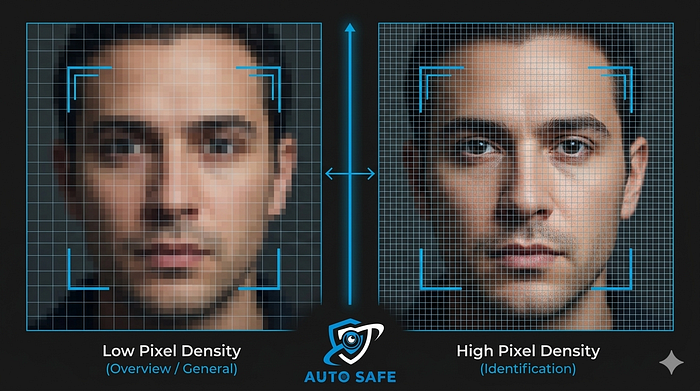
What truly determines whether a camera can identify a face or read a license plate is pixel density — the number of pixels covering a specific target area.
If pixel density is insufficient:
- Faces cannot be identified
- License plates cannot be read
- Critical details are lost
Each surveillance level requires a minimum pixel density threshold. Without meeting it, even high-resolution cameras become ineffective.
This is why a properly positioned 2MP camera can outperform a poorly placed 8MP camera.
Calculating the Correct Camera Distance
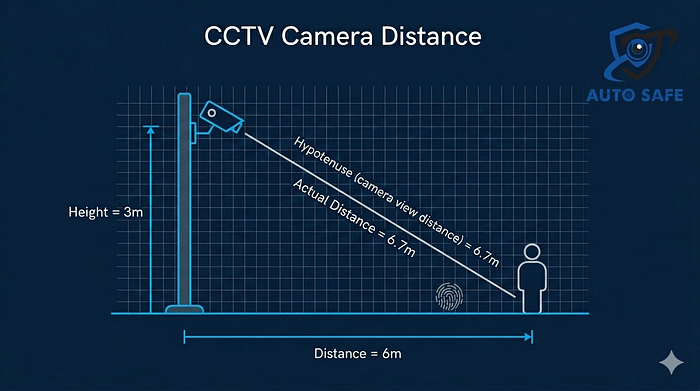
Accurate camera placement depends on understanding the true distance between the camera and the target.
This is not just horizontal distance — it is the diagonal distance that includes mounting height.
For example:
- Camera height: 3 meters
- Horizontal distance: 6 meters
- Actual viewing distance: approximately 6.7 meters
This calculation directly impacts:
- Lens selection
- Field of view
- Pixel density
Even small errors in distance estimation can significantly reduce system effectiveness.
Field of View: Capturing What Actually Matters
A wider field of view is often assumed to be better — but this is rarely the case.
Wide angles introduce unnecessary elements such as:
- Sky
- Empty areas
- Background clutter
This reduces the pixel density on important targets.
An optimized CCTV scene focuses only on relevant areas. In many cases, simply narrowing the viewing angle or adjusting the camera tilt improves clarity without changing the camera itself.
Aspect Ratio and Scene Optimization
Aspect ratio defines how the image is framed and how pixels are distributed.
Different environments require different formats:
- 16:9 — Ideal for wide, open spaces
- 4:3 — Balanced for mixed environments
- 5:4 — Effective for corridors and linear paths
Choosing the correct aspect ratio ensures that pixels are used efficiently, maximizing useful image data instead of wasting it on irrelevant areas.
The Three Factors That Control Image Quality
Beyond positioning and optics, image quality is controlled by three fundamental camera settings:
- Aperture — Controls light entering the lens
- Shutter Speed — Controls motion capture
- ISO — Controls sensor sensitivity
These settings must be carefully balanced.
If misconfigured:
- Motion may appear blurred
- Images may become noisy
- Critical details may be lost
This becomes especially important in low-light environments or high-traffic areas where precision is essential.
Final Insight: CCTV Is Engineering, Not Installation
A successful CCTV system is not defined by:
- The number of cameras
- The resolution of the devices
It is defined by how effectively it achieves its purpose.
A poorly designed high-resolution system will always underperform compared to a properly engineered system built on:
- Correct lens selection
- Accurate positioning
- Adequate pixel density
At its core, CCTV design comes down to one critical question:
What do you need to see — and how clearly do you need to see it?
About Autosafe
At Autosafe, we apply an engineering-driven approach to every project, delivering customized CCTV surveillance solutions across Egypt that are designed around real operational needs — not assumptions.
From initial assessment to system design and deployment, our focus is simple: every camera must deliver meaningful, reliable, and actionable visibility.
You can view the complete CCTV Installatin Guide from this link : https://autosafe-eg.com/blog/the-complete-guide-to-cctv-surveillance-cameras/