
In modern software systems — whether you're downloading an OS image, transferring files over a network, validating APIs, or securing firmware — checksums quietly protect data integrity everywhere.
Yet many developers use them without fully understanding:
- What a checksum actually is
- How it works internally
- What security it provides
- Where it completely fails
This article explains everything — from fundamentals to real-world security implications — so you can confidently use (and explain) checksums like a professional.
1. What Is a Checksum?
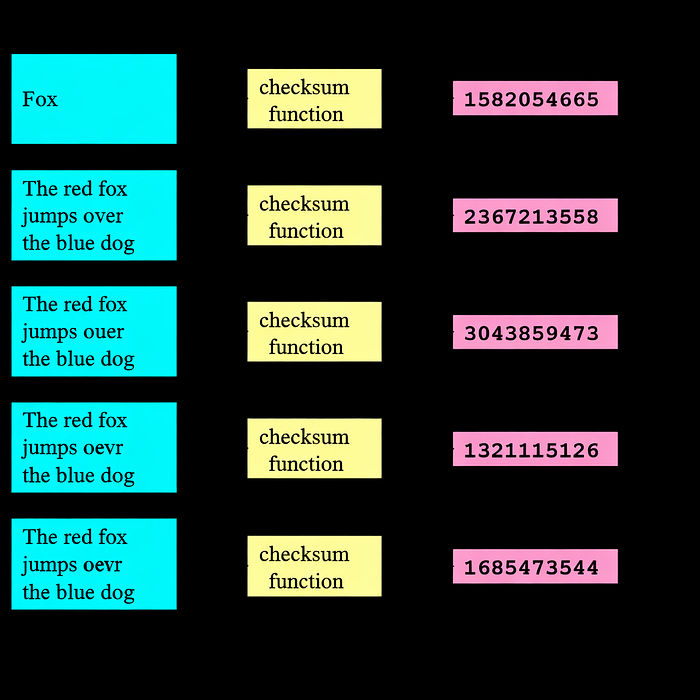
A checksum is a small, fixed-size value calculated from a block of data using a mathematical algorithm. A checksum is a fingerprint of data used to verify integrity, not secrecy.
If the data changes — even by one bit — the checksum value changes.
Real-world analogy
Think of a checksum like:
- A total weight written on a sealed box
- When the box arrives, you re-weigh it
- If the weight differs → something changed
Why Checksums Exist: The Core Problem They Solve
Every time data is created, stored, or transmitted, it is exposed to forces that can quietly change it. Networks are imperfect and can drop or reorder bits during transmission. Storage devices age and develop bad sectors. Memory can flip bits due to hardware faults. Downloads can terminate halfway and still look "complete." Even well-written software can introduce subtle bugs that alter data without warning. On top of all this, malicious actors may deliberately tamper with data to manipulate systems or exploit trust.
The most dangerous aspect of these failures is that they are often silent. The system receives data and assumes it is correct, because nothing obvious appears to be wrong. Without a checksum, there is no reliable way to tell whether the data you are using is the same data that was originally sent or stored.
When silent corruption goes undetected, systems continue operating on invalid data. Configuration files load with altered values, executables run with corrupted instructions, and application logic processes inputs that are no longer trustworthy. Over time, this can lead to unpredictable crashes, subtle security vulnerabilities, incorrect results, and irreversible data loss.
Checksums exist to solve this exact problem. They provide a simple but powerful way to detect change — ensuring that data is not just present, but unchanged. By verifying integrity at every critical step, checksums turn invisible failures into detectable events, allowing systems to stop, reject, or recover before damage spreads.
Scenarios:
What Happens When a User Submits a Form and an Attacker Intercepts the Request?
Imagine a user filling out a simple form on a website. The form might contain fields like a username, an email address, or even something sensitive like an amount to be paid. When the user clicks "Submit," the browser converts everything entered into a structured request — usually an HTTP POST request — and sends it to the server.
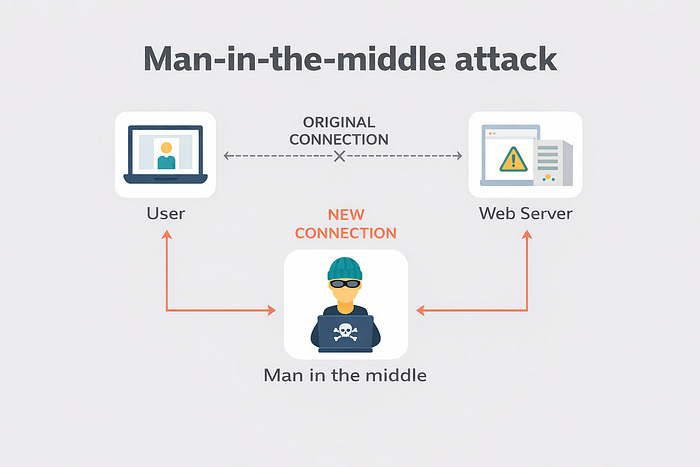
At this moment, the data is nothing more than raw bytes traveling across a network. If the connection is not properly protected, an attacker sitting somewhere between the user and the server — on the same Wi-Fi network, a compromised router, or a malicious proxy — can intercept that request. This is known as a man-in-the-middle scenario.
The attacker can now see something like this:
username=tokishi&role=user&amount=100
Because the request is just data, the attacker can modify it before forwarding it to the server:
username=tokishi&role=admin&amount=10000
From the server's perspective, it simply received a request. Without any integrity protection, the server has no way to know that the request was altered in transit.
This is where checksums and cryptographic verification enter the picture.
Why a Plain Checksum Alone Is Not Enough
Suppose the application adds a simple checksum to the request. Before sending the form, the browser computes a hash of the request body and includes it as part of the request.
The request might now look like this:
username=tokishi&role=user&amount=100 checksum=9a7c…
When the server receives the request, it recalculates the checksum from the received data and compares it to the value sent by the client. If they match, the server concludes that the data arrived intact.
This works perfectly only if the attacker cannot modify both the data and the checksum.
But in this interception scenario, the attacker can change the request body and recompute the checksum. The server recalculates the checksum from the tampered data, sees a match, and accepts the malicious request. The checksum did its job — it verified consistency — but it did not provide security.
This illustrates a crucial principle: integrity without authentication is not security.
How Secure Systems Actually Protect Form Submissions?
The first layer is transport encryption using HTTPS. When HTTPS is used correctly, the request body is encrypted before it ever leaves the browser. An attacker intercepting the traffic sees encrypted bytes, not readable parameters, and cannot modify the contents without breaking the encryption. This alone prevents most interception-based tampering.
However, modern systems do not stop there.
The second layer is cryptographic integrity using a shared secret. Instead of sending a plain checksum, the client generates a message authentication code — typically an HMAC — over the request data using a secret key known only to the client and server.
The browser (or frontend application) computes something like:
signature = HMAC(secret_key, request_body)
That signature is sent along with the request. When the server receives the request, it performs the same computation using its copy of the secret key and the received request body. If the signatures match, the server knows two things at once: the request data has not changed, and it was generated by someone who knows the secret.
An attacker can still intercept the request, but without the secret key, they cannot generate a valid signature after modifying the data. Any change — even a single character — causes the server's computed signature to differ, and the request is rejected.
How the Server Knows What to Compare Against
In this scenario, the server does not compare the request against some stored "original" version. Instead, it compares two independently derived values:
- The signature sent by the client.
- The signature the server computes itself from the received data.
Both values are derived from the same inputs: the request body and a shared secret. If the data changes or the sender is not trusted, the values diverge.
This design eliminates the need for the server to remember every valid request in advance. The server only needs the secret and the algorithm. Everything else is derived on the fly.
Why Hackers Target Weak Form Integrity
When applications rely only on client-side validation, hidden form fields, or plain checksums, attackers thrive. They know that anything visible to the client can be modified. They exploit price manipulation, privilege escalation, and business logic flaws by altering requests that the server blindly trusts.
Strong integrity mechanisms force attackers to move up the attack chain. Instead of modifying requests, they must now steal session keys, break TLS, exploit server-side vulnerabilities, or compromise trusted endpoints. This drastically increases the cost and complexity of the attack.
A Real Man-in-the-Middle Bypass: How Plain Checksums Fail in Practice
To understand where checksums truly fail, let's walk through a real-world scenario that a VAPT tester can reproduce on their own application. This is not hypothetical — it's a pattern seen frequently in custom-built APIs, internal tools, and poorly designed web applications.
Imagine a web application with a payment or profile update form. The frontend developers, attempting to protect request integrity, decide to add a checksum to every form submission. Before sending the request, the browser calculates a hash of the request body and includes it as an additional parameter. On the server side, the application recalculates the checksum and compares it with the one received. If they match, the request is accepted.
At first glance, this looks secure. In reality, it is not.
The Setup (What the Application Is Doing)
The form submission looks something like this when intercepted:
POST /updateProfile username=tokishi&role=user&email=test@mail.com&checksum=9c81f…
The checksum here is simply a hash (for example, SHA-256) of the request body without any secret involved. The server logic is equally simple: recompute the hash from the received parameters and compare it with the provided checksum.
As a VAPT tester, you configure an intercepting proxy (such as Burp Suite or OWASP ZAP) and submit the form normally. The request is intercepted before it reaches the server.
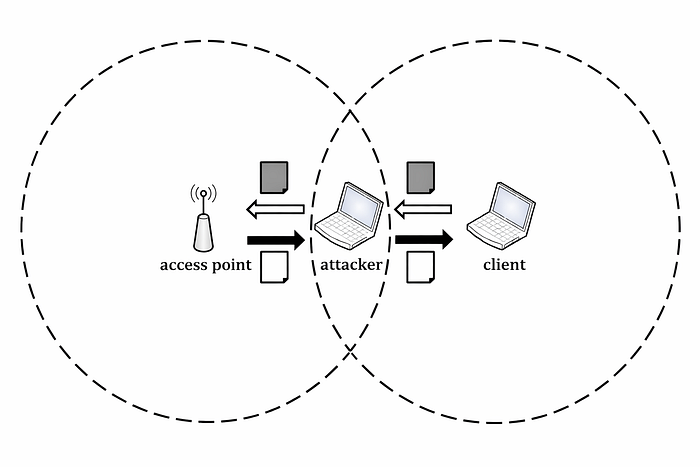
At this point, you modify a sensitive parameter — for example:
role=user → role=admin
Now comes the critical part. Because the checksum is not keyed, you simply recompute it locally using the modified request body. This can be done using any hash utility, scripting language, or even Burp extensions. You replace the old checksum with the newly calculated one and forward the request to the server.
The server recalculates the checksum from the modified request, compares it with the value you supplied, and finds a match. The request is accepted. The role change goes through.
No alerts. No errors. No detection.
This is a complete integrity bypass, and it happens because the checksum verified consistency, not authenticity.
Why This Works (The Core Failure)
The server assumes that if the checksum matches the request data, the request must be legitimate. What it fails to consider is who generated the checksum. Since the attacker controls both the data and the checksum, the comparison becomes meaningless.
This is the defining weakness of plain checksums and unhashed request validation. The math works perfectly. The security model does not.
How to Validate This Vulnerability as a PenTester
A VAPT tester can confidently report this issue if all of the following are true:
- The request contains a checksum or hash generated on the client side
- The checksum does not involve a secret unknown to the client
- Modifying parameters and recomputing the checksum results in successful request processing
- No server-side authorization blocks the modified action
This is typically categorized as Broken Integrity Control or Improper Message Authentication, and often leads directly to privilege escalation, price manipulation, or business logic abuse.
The Correct Fix (What Should Have Been Used)
If the application had used a keyed mechanism — such as an HMAC — or relied solely on HTTPS with strict server-side validation, this attack would fail. With HMAC, the tester could still modify the request, but without the secret key, they would be unable to generate a valid signature. The server's comparison would fail immediately.
A checksum can prove that data is unchanged, but without a secret or identity, it cannot prove that the data is trustworthy — and attackers exploit this gap every day.