June 3, 2026
AI Is Changing Cybersecurity — And the Basics Matter More Than Ever
Over the last few years, most conversations about AI and security have focused on protecting AI systems themselves. Companies are concerned…

Rosh PR
4 min read
Over the last few years, most conversations about AI and security have focused on protecting AI systems themselves. Companies are concerned about employees sharing sensitive information with public AI tools, protecting the data used to train models, securing prompts, and preventing unauthorized access to AI platforms.
Those concerns are real, but they're only part of the story.
The bigger issue is what AI is doing for attackers.
We're entering a new phase of cybersecurity where attackers have access to capabilities that used to be limited to highly skilled researchers and advanced threat groups. AI is making it much easier to launch sophisticated attacks, even without deep technical expertise. At the same time, experienced attackers are using AI to move faster and operate at a scale that wasn't possible before.
In other words, AI hasn't made traditional cybersecurity less important. It's made it even more important.
Organizations that think AI security is only about protecting their own AI applications are missing a much larger piece of the threat landscape.
The Democratization of Cyber Attacks
In the past, pulling off a successful cyberattack usually required a solid amount of technical knowledge. Attackers needed to understand programming, networking, operating systems, vulnerability research, and social engineering.
AI is lowering those barriers.
Today, someone with limited technical skills can use AI to:
- Create convincing phishing campaigns
- Generate malware variants
- Write scripts for reconnaissance and automation
- Research technologies and attack paths
- Analyze publicly available information about a target
- Generate highly personalized social engineering content
The result is pretty straightforward: more people can launch more attacks.
Tasks that once took weeks can now be completed in a matter of hours.
Skilled Attackers Are Becoming More Dangerous
The impact is even bigger for experienced threat actors.
Advanced attackers are using AI to automate repetitive work, analyze huge amounts of data, identify vulnerabilities faster, and build attack strategies more efficiently.
Researchers have already observed malware that uses AI capabilities to change its behavior and improve evasion techniques. AI-assisted malware is still in its early stages, but it offers a glimpse of where things may be headed. (Axios)
As AI models continue to improve, attackers will likely use them more for vulnerability discovery, exploit development, malware creation, and large-scale reconnaissance.
The gap between how quickly attackers can move and how quickly defenders can respond is becoming a growing concern.
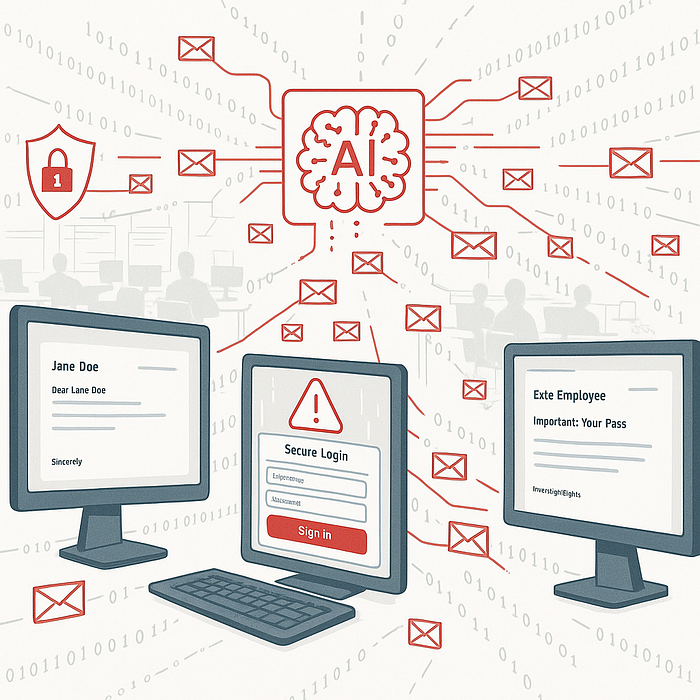
Phishing and Social Engineering Are Entering a New Era
One of the most immediate risks is AI-powered social engineering.
Traditional phishing emails were often easy to spot because of poor grammar, awkward wording, or generic messaging.
AI has removed many of those telltale signs.
Attackers can now generate polished, context-aware messages tailored to specific people, teams, or executives. AI can also create convincing voice clones, deepfake videos, and realistic business communications.
As a result, relying on human judgment alone is becoming less effective as a defense.
Organizations can't depend solely on security awareness training anymore. Strong identity controls, multi-factor authentication, privileged access management, and zero-trust architectures are becoming even more critical.
AI Is Accelerating Vulnerability Discovery
One of the more concerning developments is AI's growing ability to identify software vulnerabilities.
Several AI companies are developing cybersecurity-focused models that can identify software weaknesses at remarkable speed. Access to some of these advanced models is currently being limited to trusted cybersecurity partners, not only to reduce the risk of misuse but also to help security vendors strengthen their products, identify and remediate vulnerabilities more quickly, and build defenses against future AI-assisted attacks. By using these models proactively, defenders can better understand how attackers may leverage similar capabilities and improve their resilience before those threats become widespread. (The Times of India)
That should be a wake-up call for organizations.
If defenders can use AI to find vulnerabilities faster, attackers will eventually have access to similar capabilities.
Companies should assume that exposed vulnerabilities will be discovered much more quickly than they were in the past.
Patch management, vulnerability scanning, secure software development, and infrastructure hardening can't be treated as afterthoughts anymore.
Traditional Security Is Still the Foundation
Despite all the buzz around AI, most successful breaches still come down to familiar issues:
- Unpatched systems
- Weak passwords
- Misconfigured cloud environments
- Excessive permissions
- Poor network segmentation
- Stolen credentials
- Inadequate monitoring
- Delayed incident response
AI doesn't eliminate these problems.
It just makes them easier to exploit.
Organizations often ask what their AI security strategy should look like. In many cases, the answer starts with getting the fundamentals right.
Another important consideration is staying informed about how AI is already being used in real-world attacks. Recent reporting has highlighted the growing use of AI-generated phishing campaigns, deepfake-enabled fraud, and automated reconnaissance techniques by cybercriminals. For example:
- Reuters: AI-powered deepfake scams are increasingly targeting businesses and financial institutions — https://www.reuters.com/world/ai-deepfake-fraud-threat-grows/
- BBC News: Criminals are using AI voice cloning technology to impersonate executives and family members in fraud schemes — https://www.bbc.com/news/technology
- The Record: Researchers continue to track AI-assisted phishing and malware campaigns targeting organizations worldwide — https://therecord.media/
Security Prevention and Defense
Organizations can reduce risk through zero-trust architectures, multi-factor authentication, continuous monitoring, vulnerability management, and employee awareness programs.
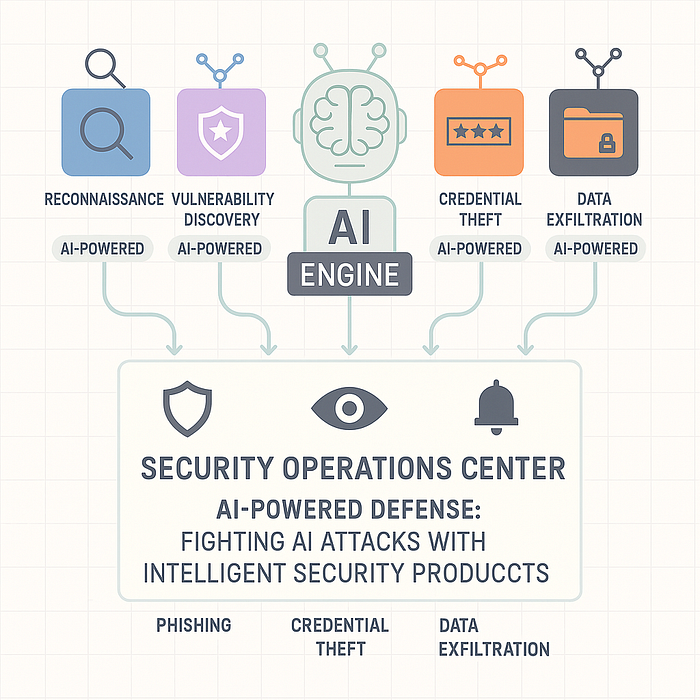
If an organization struggles with patch management, identity governance, endpoint protection, logging, or network security, simply adding AI-powered tools won't magically solve those problems. In today's threat landscape, nothing should be automatically trusted. Attackers still rely on ransomware, phishing, credential theft, lateral movement, malware, command-and-control communications, and data exfiltration opportunities created by weak security practices. AI can help detect threats faster, but it can't make up for gaps in a zero-trust strategy or poor operational discipline.
Strong fundamentals are still the first line of defense.
The Industry Is Already Responding
The cybersecurity industry clearly understands how significant this shift is.
Major security vendors and AI companies are working together more closely to build AI-driven security capabilities. Partnerships involving cybersecurity firms and AI providers such as OpenAI and Anthropic are focused on improving threat detection, vulnerability identification, and automated security operations.
This reflects a simple reality: AI will be used by both attackers and defenders.
The organizations that come out ahead will be the ones that use AI to strengthen their defenses while continuing to invest in strong security fundamentals.
Final Thoughts
AI isn't creating an entirely new cybersecurity problem. It's speeding up an existing one.
Attackers now have tools that help them move faster, scale their efforts, and operate more effectively. Less-skilled attackers can launch campaigns that once required significant expertise, while advanced threat actors can become even more capable.
That makes cybersecurity more important than ever.
The future of security isn't about choosing between traditional security and AI security.
It's about combining the two.
Organizations need to keep investing in proven security fundamentals while also adopting AI-powered defensive capabilities. Those that fail to strengthen their security posture today may find themselves dealing with a new generation of AI-assisted attacks tomorrow.