Most hunters scroll past cache-related behavior, thinking:
"This is CDN stuff… not my problem."
"That assumption has paid attackers thousands of dollars."
This post dives into Web Cache Deception — a vulnerability that doesn't exploit your code, but how your application is interpreted by caching layers.
And when it hits, it leaks authenticated user data to the public.

🧠 What Is Web Cache Deception (In Plain English)
Web Cache Deception happens when:
-> A user is logged in
-> They request a dynamic, authenticated page
-> The request looks like a static file
-> A cache (CDN / reverse proxy) stores it
-> Anyone can later access that cached response without authentication
The application thinks:
"User is authenticated → serve private data"
The cache thinks:
"This is a static file → store and reuse"
That mismatch is the bug.
🎯 Why This Bug Is Dangerous (And Pays Well)
This bug often leads to:
-> Profile data leakage
-> Email addresses, phone numbers
-> Account settings
-> API responses
-> Sometimes tokens or internal IDs
And the scariest part?
👉 No victim interaction needed after caching. 👉 One request can expose thousands of users.
That's why this is often rated P1.
📹 Real Exploitation Flow (PoC Mindset)
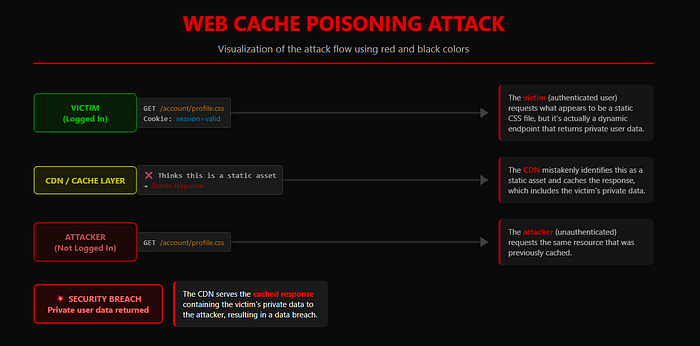
No brute force. No XSS. No IDOR.
"Just misinterpreted intent."
🧪 How to Find Web Cache Deception (Step-by-Step)
Step 1: Identify Authenticated Endpoints
Login and list pages like:
/account/profile/settings/dashboard/api/user/me
If it returns user-specific data, it's a candidate.
Step 2: Append Fake Static Extensions
Try appending extensions that CDNs love to cache:
.css
.js
.jpg
.png
.svg
.ico
.json
Examples:
/account/profile.css
/settings.js
/api/user.json
/dashboard.png
⚠️ Important: Do this while logged in, with cookies intact.
Step 3: Check Cache Headers
Look for headers like:
X-Cache: HIT
X-Cache-Status: HIT
CF-Cache-Status: HIT
Age: 120
If you see HIT, the response is cached.
Step 4: Test Without Authentication
Now:
-> Open incognito
-> Or use curl without cookies
-> Request the same URL
curl https://target.com/account/profile.cssIf you still get user data → 💥 vulnerability confirmed.
🧰 Tools You'll Actually Use
🔧 Primary Tools
-> Burp Suite
-> Repeater (manual testing)
-> Proxy (header inspection)
-> curl
-> Browser Incognito Mode
No fancy automation needed.
🧪 Real Payloads That Work
Save these — they work surprisingly often:
/profile.css
/account/settings.jpg
/dashboard.js
/api/me.json
/user/info.png
💡 Tip:
.cssand.jpghave the highest success rate.
🚩 Advanced Detection Tricks (Pro Level)
1️⃣ Cache Bypass Comparison
Request twice:
/profile
/profile.css
If behavior changes → investigate deeper.
2️⃣ User-to-User Leakage Test
-> Login as User A
-> Cache the page
-> Login as User B
-> Access cached URL
If User B sees User A data → critical impact.
3️⃣ Time-Based Cache Check
Look at:
Age: 300That means the data has been cached for 5 minutes already.
🧨 Chaining This Bug (How It Becomes P1)
Web Cache Deception becomes lethal when combined with:
-> IDOR → leak arbitrary users
-> API endpoints → structured JSON leaks
-> Profile images / documents
-> OAuth user info endpoints
This is how:
"Low complexity bug" → High business impact
📝 How to Report This (Report-Ready Language)
Title
Web Cache Deception Allows Public Access to Authenticated User Data
Impact
An unauthenticated attacker can retrieve sensitive user-specific information by accessing a cached version of an authenticated endpoint. This may lead to large-scale exposure of user data without any interaction from the victim.
Why This Matters
-> Affects all users behind CDN
-> Breaks authentication guarantees
-> Violates privacy expectations
🧠 Why Most Hunters Miss This Bug
Because:
-> It's not in OWASP Top 10
-> Scanners don't flag it
-> It doesn't "look like a bug"
-> It requires understanding how systems interact
But companies care deeply about it.
🚀 What You Should Do After Reading This
Next time you:
-> See a CDN
-> See authenticated pages
-> See unusual caching headers
👉 Don't ignore it. 👉 Test it.
This one bug alone has earned researchers consistent P1s.
🐾 Coming Next in This Series
In the next post, I'll break down:
👉 OAuth Misbinding — the bug that silently logs victims into attacker accounts 👉 With real flows, payloads, and PoC logic
☕Support the Work (If This Helped You)
If this write-up helped you understand Web Cache Deception better — or saved you hours of trial and error — you can support my work here:
👉 Buy Me a Coffee: Abhijeet Kumawat❤️
Your support helps me keep publishing deep, practical bug bounty content with real attack flows, payloads, and reporting insights — not surface-level theory.
_ No pressure. Just appreciation❤️