

Introduction
Imagine you store your personal data on a cloud platform
The security measures are taken care of , yet data integrity and confidentiality isn't guaranteed.
The Government of India introduced Digital Personal Data Protection Act, 2023 in order to secure users' personal data and address the growing risks of personal information.
This article explores the key aspects of the law, including its principles, individual rights, and the responsibilities organizations must follow to remain compliant.
What is the Digital Personal Data Protection Act, 2023?
The Digital Personal Data Protection (DPDP) Act, 2023 regulates how personal data is collected, processed, and stored in the digital realm.
This law grants individual rights for users to protect their data
Any organization storing digital personal data offline or online and later digitized is applicable to this law Additionally, organizations are required to process personal data only for lawful purposes.
Data Lifecycle under DPDP Act
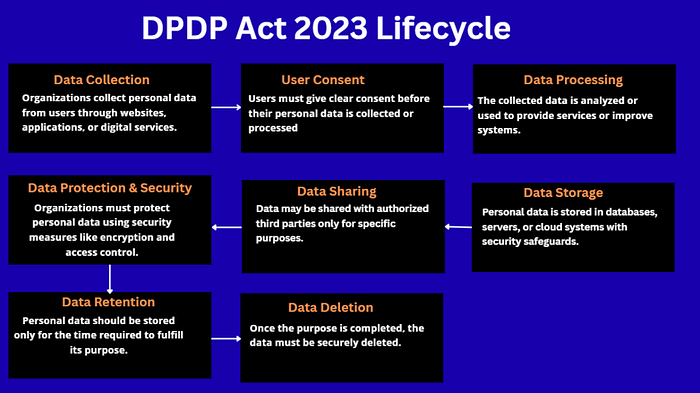
This diagram represents the data flow in DPDP Act, 2023.
Key roles of DPDP Act, 2023
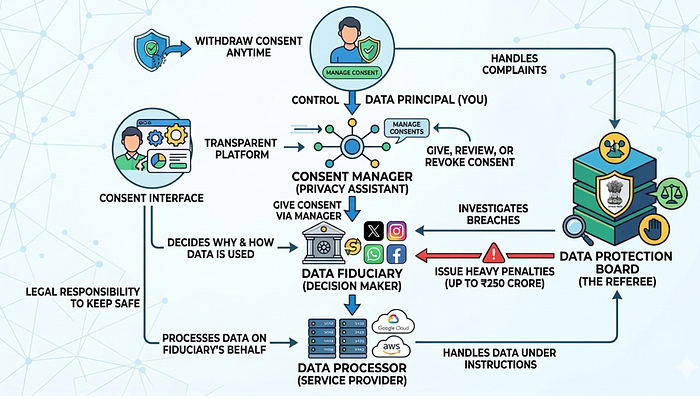
The key roles of DPDP Act,2023 According to MeitY
· The Data Principal (That's You!)
Data Principal is the individual whose personal data is being collected and processed You can manage this data and even withdraw your consent at any point of time.
· The Consent Manager (Your Privacy Assistant)
Consent Manager is a digital agent that acts on your behalf. They provide a single, transparent platform where you can easily give, review, or revoke your consent across multiple services.
· The Data Fiduciary (The Decision Maker)
The Data Fiduciary is the company or person (like a bank or social media site) that decides why and how your data is used. They carry the legal responsibility to keep your information safe and follow the law.
· The Data Processor (The Service Provider) A Data Processor is an entity that handles data strictly on behalf of the Data Fiduciary. For example, a Cloud Service Provider (like AWS or Google Cloud) processes your data under the Fiduciary's instructions but doesn't decide what happens to it.
· The Data Protection Board (The Referee) The Data Protection Board is the government's enforcement arm. They are the ones who investigate breaches, handles your complaints , and issue heavy penalties up to ₹250 crore to organizations that fail to protect your privacy.
Key Principles of DPDP Act 2023
According to MeitY, these are the key principles
1. Lawful and Transparent Processing
Data must be processed in a fair, transparent and lawful manner. Individuals should understand how their information is being used.
2. Purpose Limitation
Personal data must be collected only for specific and legitimate purposes.
3. Data Minimization
Minimal amount of data should be collected necessary to fulfil a specific purpose.
4. Data Accuracy
Entities processing data must ensure that personal information is accurate, complete, and updated when necessary.
5. Storage Limitation
Personal data should not be stored indefinitely. It must be deleted once the purpose for which it was collected is fulfilled.
6. Security Safeguards
Organizations must implement reasonable security measures to prevent unauthorized access, data breaches, or misuse.
7. Accountability
The organization responsible for processing personal data must ensure compliance and remain accountable for data protection practices.
Rights of Individuals (Data Principals)
The DPDP Act provides several rights to individuals to ensure they maintain control over their personal data given in the document of MeitY
1 Right to Access Information
Individuals have the right to request information regarding how their personal data is being processed and shared with other entities.
2 Right to Correction and Erasure
Data principals can request correction of inaccurate data or deletion of personal data that is no longer required
3 Right to Withdraw Consent
Individuals have the right to withdraw consent previously given for the processing of their personal data.
4 Right to Grievance Redressal
Users can file complaints against organizations if they believe their personal data is being misused.
5 Right to Nominate
Individuals can nominate another person to exercise their data rights in case of death or incapacity.
These rights provide transparency and control over personal information.
Responsibilities of Organizations (Data Fiduciaries)
Organizations that process personal data have several responsibilities under the DPDP Act provided by MeitY
1 Obtain Valid Consent
Organizations must obtain free, informed, and explicit consent from individuals before collecting or processing their personal data.
2 Ensure Data Security
Companies must implement security safeguards such as encryption, access control, and monitoring systems to protect personal data.
3 Notify Data Breaches
If a data breach occurs, organizations must inform the Data Protection Board of India and affected individuals.
4 Data Deletion
Organizations must delete personal data once it is no longer required for its intended purpose.
5 Compliance for Children's Data
Special protection measures are required for processing children's personal data, including parental consent and restrictions on targeted advertising.
Conclusion
The DPDP Act 2023 marks a significant shift in India's digital landscape, moving from a "wild west" of data usage to a framework built on consent and accountability. For individuals, it offers newfound control over their digital footprint. For businesses, it's a call to overhaul data practices and prioritize privacy by design. While the transition may be challenging, the end goal is clear: a safer, more transparent digital India where trust is the cornerstone of every transaction.